



Chung Dong-young urges restart of four-party talks for Northeast Asia peace
Jun 05, 2026, 09:38 am


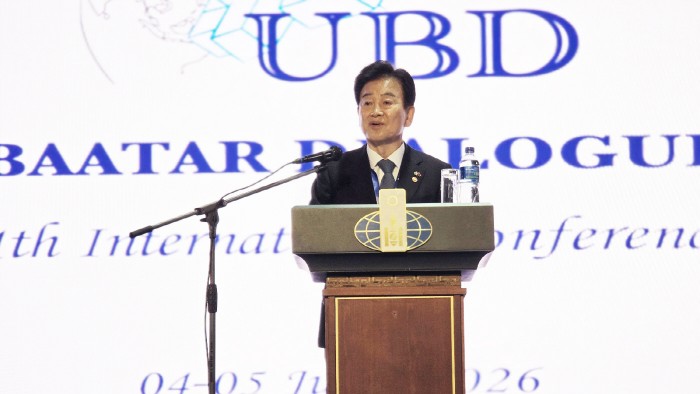 |
| Unification Minister Chung Dong-young delivers a special speech in English at the ‘Ulaanbaatar Dialogue’ held in Mongolia on June 4. / Provided by Ministry of Unification |
Minister of Unification, Chung Dong-young, visiting Mongolia, proposed on June 4 that South Korea, North Korea, the United States, and China resume four-party talks to establish peace in Northeast Asia, and further expand them into multilateral dialogue including Mongolia, Japan, and Russia. He also urged North Korea to rejoin the Greater Tumen Initiative (GTI) and presented a vision for logistics cooperation linking regional rail networks with Arctic shipping routes.
Delivering a special address at the 11th “Ulaanbaatar Dialogue” in Mongolia’s capital, Chung emphasized the need to build a new “peace identity” in Northeast Asia. He stressed that restoring trust between the two Koreas and reviving peace on the Korean Peninsula are essential. This marks the first time a South Korean unification minister has visited Mongolia, at the invitation of the Mongolian government.
The Ulaanbaatar Dialogue is a regular international conference addressing Northeast Asian security issues. It began in 2014 as a civilian academic forum and was upgraded in 2017 to a semi-official 1.5-track dialogue. North Korea has not attended since 2019.
On peace-building for the Korean Peninsula, Chung said, “The Republic of Korea, the Democratic People’s Republic of Korea, the United States, and China can hold four-party talks. This framework should be expanded to include Mongolia, Japan, Russia, and other Northeast Asian countries.”
He added, “In the September 19 Joint Statement of the Six-Party Talks, the six parties agreed to promote lasting peace and security in Northeast Asia. It is time to apply that experience to today’s reality and rekindle the flame of dialogue.”
As a driver of joint growth in Northeast Asia, Chung proposed strengthening cooperation within the GTI framework. He envisioned connecting regional rail networks—including the Trans-Siberian Railway, the China Transcontinental Railway, the Mongolia Transcontinental Railway, and the Seoul–Beijing high-speed rail—with the Arctic shipping route.
“By linking transportation networks with regional markets and trade flows, we can build an innovative logistics network across Eurasia,” Chung said. “To make these visions a reality, I urge the Democratic People’s Republic of Korea to rejoin the GTI as a full member. They would be the greatest beneficiary of this initiative.”
The GTI is a multilateral consultative body launched to promote development and economic cooperation in Northeast Asia. North Korea was an original member but withdrew in 2009.
Chung concluded, “If the three pillars—restoring inter-Korean trust, institutionalizing a peace regime on the Korean Peninsula, and advancing multilateral dialogue in Northeast Asia—move forward together, we can establish a new peace order across the region.”
After his special address, Chung met with Mongolian Foreign Minister Battsetseg Batmunkh and President Ukhnaagiin Khürelsükh. He departed for Mongolia on June 3 to attend the Ulaanbaatar Dialogue and will return to Korea on June 6.
Mok Yong-jae
Most Read
-
1
Trump demands rates fall below 1% as Fed hikes for..

-
2
Celltrion seeks rheumatoid arthritis indication ex..

-
3
Chinese e-commerce giants AliExpress, Temu and She..

-
4
Trump warns countries not helping U.S. must pay re..

-
5
Turkish Airlines named main club partner of Liverp..

-
6
China expels No. 2 military official Zhang Youxia..

-
7
Houthi rebels release video claiming downing of Sa..

PEOPLE






-
Address : In-Young Bldg., 34, Uisadang-daero 1-gil, Yeongdeungpo-gu, Seoul
Copyright by ASIATODAY CO., LTD. All rights resereved