



WSJ raises 3 questions that will determine the fate of US economy
Jun 01, 2026, 02:20 pm


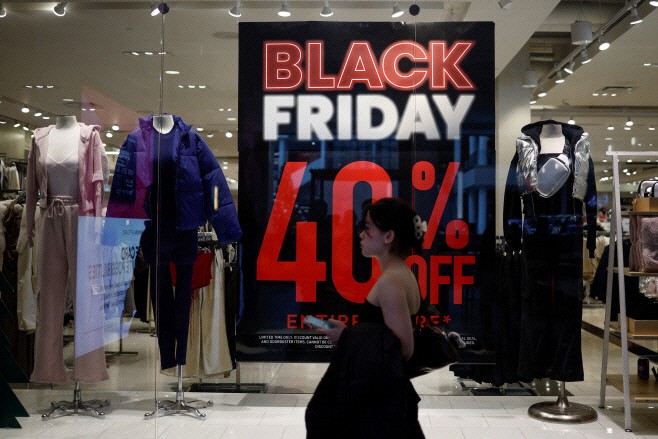 |
| A shop in Arlington, Virginia, announces its Black Friday discount event on November 27, 2025 (local time). / Photo via Reuters, Yonhap News |
The American model of capitalism stands before three existential questions—specifically, the distribution of economic opportunity, its engagement with the global economy, and the optimal equilibrium between state intervention and market forces—the Wall Street Journal (WSJ) analyzed on May 31 (local time).
The share of total wealth held by the top 1 percent of households surged to 30.8 percent as of 2024, up from 22.8 percent in 1989, while the average effective tariff rate on imports stands at approximately 12 percent, a staggering sevenfold increase over the past decade. The WSJ diagnosed that the choice between two diverging paths—leveraging artificial intelligence (AI) and clean tech to boost productivity and forge a path of shared prosperity, versus deepening the rift between economic winners and losers while erecting barriers that block the flow of the global economy—will decisively shape the lives of future generations.
U.S. median household income stagnates below 1% growth: wealth share of top 1% leaps from 22.8% to 30.8% as inequality deepens
The overall economic pie in the United States has expanded at a sluggish pace over the past half-century, widening the opportunity gap, the WSJ evaluated. On an inflation-adjusted basis, the median weekly earnings for full-time male wage and salary workers stood at $1,325 in 2025, virtually unchanged from 1979 levels. The real annual income of a typical American household grew at an average rate of less than 1 percent per year over the last 50 years.
The wage premium of college graduates over high school graduates widened from 30 percent to 55 percent over the same period, which the WSJ analyzed as a consequence of a sharp increase in economic rewards skewed toward talent.
The share of total wealth held by the top 1 percent of households jumped from 22.8 percent in 1989 to 30.8 percent in 2024. According to Opportunity Insights, a research institute based at Harvard University, roughly 90 percent of children born in 1945 went on to earn more than their parents by age 30; however, for those born in 1985, this metric was slashed in half to approximately 50 percent.
Last year, 78 percent of Americans disagreed with the premise that "the lives of our children's generation will be better than ours." Amid mounting anxieties that AI will displace jobs in the future labor market, Sam Altman, CEO of OpenAI, stated that he is "fairly confident that at some point in the future, as technology continues to replace traditional jobs and vast amounts of new wealth are generated, a state-level universal basic income (UBI) will emerge," the WSJ reported.
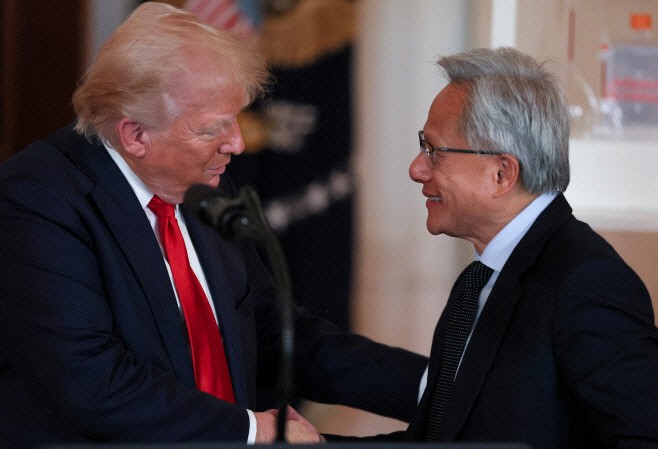 |
U.S. President Donald Trump (left) shakes hands with Nvidia CEO Jensen Huang during the Investing in America event held at the White House in Washington, D.C., on April 30 (local time). / Photo via Reuters, Yonhap News |
Redistribution through wealth taxes and basic income vs Growth through expanded federal R&D investment
The WSJ pointed out that two contrasting paths for resolving inequality are currently in opposition. On the redistribution front, a ballot initiative emerged in California proposing a one-time 5 percent levy on residents with a net worth of $1 billion or more. Meanwhile, Democratic Senator Elizabeth Warren of Massachusetts proposed legislation that would impose an annual 2 percent tax on households with a net worth over $50 million, and a 6 percent annual tax on those exceeding $1 billion.
Conversely, the growth-oriented approach highlights specific mechanisms such as expanding federal research and development (R&D) investments alongside lifelong human capital investments, including early childhood education. Providing high-quality early education programs worth $4,000 for each of the approximately 25 million children under the age of five in the United States would require $100 billion annually; however, research by Nobel laureate James Heckman, director of the Center for the Economics of Human Development at the University of Chicago, demonstrates that the societal benefits of early educational interventions outweigh the costs sevenfold.
Nevertheless, federal R&D expenditures have plummeted from 2.8 percent of GDP in 1963 to a mere 0.6 percent in 2023. Furthermore, federal spending on individuals aged 65 and older tracks at six times the amount allocated to those under 26, revealing a structural regression in intergenerational investment, the WSJ analyzed.
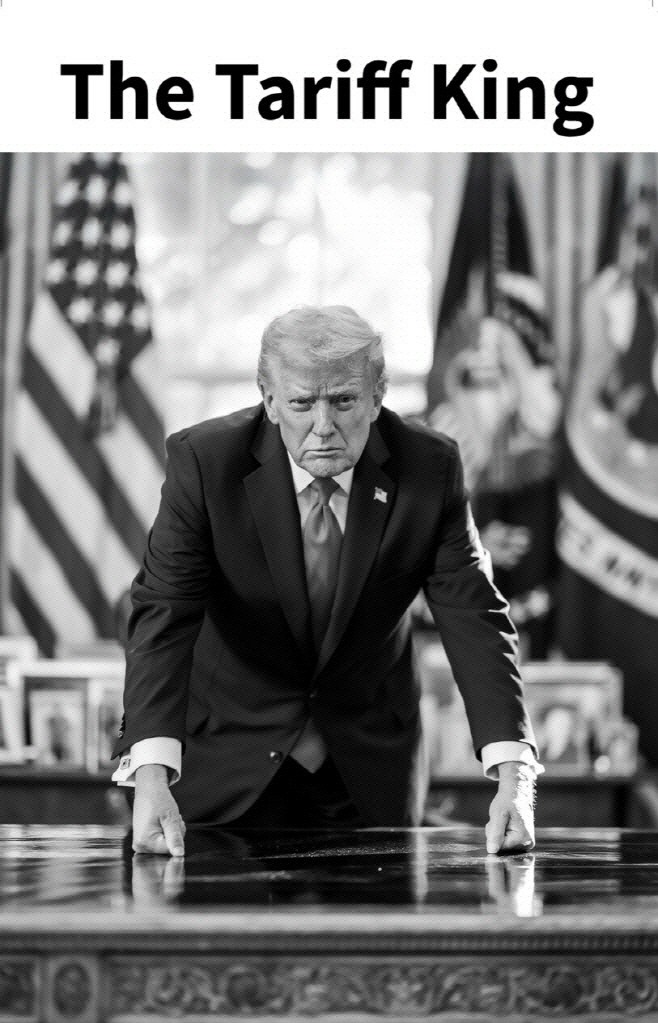 |
| A photo of the Oval Office, uploaded to Truth Social by U.S. President Donald Trump on January 16 (local time), features the phrase 'King of Tariffs.' / Photo via President Trump's Truth Social |
Average effective tariff rate jumps sevenfold: Trump administration pivots sharply to erecting walls and targeting net-zero immigration
The United States has shifted gears dramatically under President Donald Trump, dismantling the open global economic order it spent 80 years building, the WSJ diagnosed.
President Trump, who won both his initial and subsequent elections by tapping into the ambivalent sentiment Americans hold toward trade and globalization, has imposed high tariffs on imports regardless of whether they originate from allies or adversaries. As a result, the average effective tariff rate in the U.S. has climbed to approximately 12 percent—a nearly sevenfold surge compared to a decade ago and a level rarely witnessed since the era of the notorious Smoot-Hawley Tariff Act, the WSJ analyzed.
Net immigration has dropped to nearly zero for the first time in decades. Furthermore, the administration is weighing a plan to impose a $100,000 fee on individuals obtaining new H-1B specialty occupation visas, a move that appears to be restricting even the influx of highly skilled global talent.
Citing research findings, the WSJ explained that what the American public desires is neither unconditional globalization nor the endless expansion of economic walls, but rather a strategic combination of global economic engagement and meaningful investment in domestic labor market capabilities.
The WSJ pointed out that two-thirds of global venture capital continues to flow toward American enterprises. Moreover, the average total compensation for the 29.9 million workers employed by U.S.-based multinational corporations reached $97,078 in 2023, tracking roughly 20 percent higher than the average for the rest of the private sector—evidence demonstrating that global enterprises tend to generate the high-quality jobs that Americans crave.
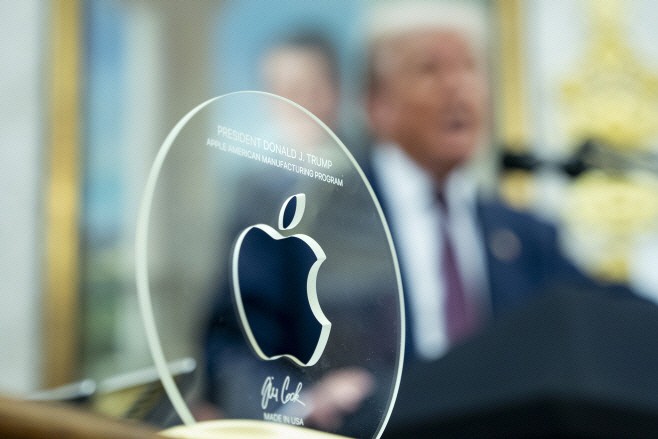 |
| An Apple glass plate set on a 24-karat gold base, presented as a gift to U.S. President Donald Trump by Apple CEO Tim Cook, rests on a table as they announce Apple's $600 billion investment plan in the United States over the next four years at the White House on August 6, 2025 (local time). / Photo via UPI, Yonhap News |
WSJ outlines principles for government: correcting market failures, promoting competition, and cutting off crony capitalism
Regarding the balance between the state and the market, the WSJ highlighted the global financial crisis of 2007–2009 as a prime example of failure in market oversight. In October 2008, then-Federal Reserve Chairman Alan Greenspan admitted during a congressional hearing that he made a mistake in presuming that the self-interest of organizations, specifically banks and others, was best capable of protecting their own shareholders and equity.
Pinpointing such instances of market failure, the WSJ outlined four core principles to achieve a balanced role for government.
First, government must correct market failures. This involves expanding state investment in areas with high public returns—such as basic R&D, government statistics, and public health—while imposing regulations and taxes on activities that generate external costs, such as carbon emissions.
Second, government should promote competition. While curbing market concentration is necessary, the WSJ noted that policymakers must distinguish whether an enterprise expanded through superior competitiveness or built an unfair monopoly.
Third, regulatory frameworks must separate safety protections from outdated red tape that stymies economic growth. The report cited growth-stifling examples such as zoning regulations that trigger housing shortages, protracted permitting processes for power transmission lines, and federal subsidies that encourage hyper-customization of public transit buses, thereby undermining economies of scale.
Fourth, government must cut off crony capitalism. The WSJ stressed that allocating government subsidies, contracts, and tariff exemptions based on political connections squanders taxpayer resources and erodes public trust in government institutions.
"Whether the United States can chart a path toward greater prosperity is not merely a question of policy design," analyzed Matthew Slaughter, dean of the Tuck School of Business at Dartmouth, and David Wessel, a senior fellow at the Brookings Institution's Hutchins Center on Fiscal and Monetary Policy, who co-authored the WSJ series. "It hinges on the emergence of leaders capable of articulating an inspiring, rational, and unifying vision."
Ha Man-ju
Most Read
-
1
Trump shares map on social media labeling Strait o..

-
2
Kia Sportage outperforms Mazda CX-5 in German auto..

-
3
Houthis launch successive attacks on Saudi airport..

-
4
U.S. deploys carrier, 10,000 more troops to Middle..

-
5
Trump rejects Iran's offer to open Strait of Hormu..

-
6
N. Korea conducts first swarm attack drill with dr..

-
7
U.S.-China summit falls short on substance as Trum..

PEOPLE






HEADLINE NEWS
- Seoul dismisses Ukraine's claim of 'S. Korean support for Russia' as "inaccurate and inappropriate"
- S. Korea, Japan race to develop nuclear-powered submarines
- Henri Kagan, Kenso Soai win Nobel Prize in Chemistry for uncovering how mol..
- Vance says Alaska LNG cooperation will move forward with Seoul's current or..

-
Address : In-Young Bldg., 34, Uisadang-daero 1-gil, Yeongdeungpo-gu, Seoul
Copyright by ASIATODAY CO., LTD. All rights resereved