



Kim Jong-un accompanies his daughter to inspect local farming complex
Jun 01, 2026, 11:08 am


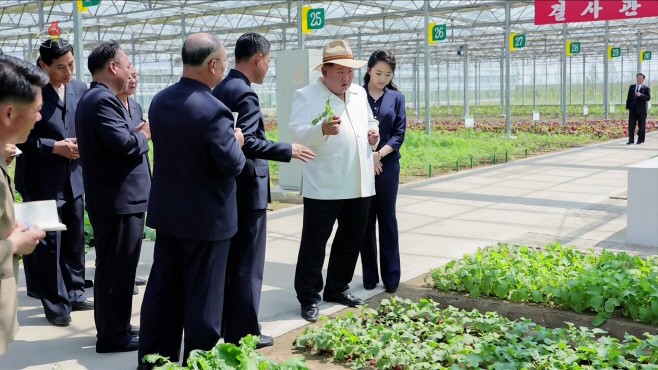 |
| North Korean Leader Kim Jong Un conducted field guidance at the Sinuiju Greenhouse Farm, newly developed in the Wihwado district along the banks of the Yalu River on May 31, Korean Central Television reported on June 1. Sporting a straw hat, Kim is pictured touring the interior of the greenhouse alongside his daughter Ju Ae. / Photo via Yonhap News |
North Korean Leader Kim Jong Un has conducted field guidance at a massive domestic greenhouse farming complex alongside his daughter, Kim Ju Ae, marking his first public economic visit in over two months.
According to the Korean Central News Agency (KCNA) on June 1, Kim inspected the Sinuiju Greenhouse Farm on May 31, accompanied by Ju Ae and key cadres from the ruling party and government. The Sinuiju Greenhouse Farm is a site of immense personal interest for Kim, who visited it five times last year alone, including for its groundbreaking ceremony. He also selected the farm for his first public itinerary of the new year and subsequently attended its completion ceremony this past February.
During the visit, Kim emphasized, "We must not lean solely toward productivity; instead, we must diversify crop varieties, apply scientific and technological principles to fertilizer and cultivation management, and ensure the supply of highly nutritious and flavorful vegetables for the people." He further stressed, "The mission entrusted to the Sinuiju Vegetable Science Research Center is exceptionally vital in realizing the systematization and scientific advancement of greenhouse vegetable production."
Kim also noted, "We should look into organizational countermeasures regarding the Sinuiju Vegetable Science Research Base so that accomplished research breakthroughs can be swiftly implemented across greenhouse farms nationwide." He added that the Sinuiju facility must serve as a gold standard to ensure the balanced development of newly constructed greenhouse farms throughout the country.
Upon receiving briefings that hundreds of tons of dozens of varieties of vegetables harvested daily from the roughly 1,150 greenhouse structures at the complex are being supplied to child care and educational facilities, Kim expressed deep satisfaction.
Furthermore, Kim toured the construction sites of healthcare infrastructure, a comprehensive welfare service center, and a integrated vegetable processing plant within the Sinuiju Greenhouse Farm district. The KCNA reported that construction on these respective facilities has progressed by approximately 50 percent. Kim highly lauded the Wihwado district—which now houses the farm, medical centers, the processing factory, and research institutions—characterizing it as a "prime example of local transformation in the new era."
Following the severe, large-scale flooding that devastated the Sinuiju Wihwado district in the summer of 2024, North Korea has been constructing this mammoth greenhouse farm—spanning an area 1.5 times the size of Seoul's Yeouido district (2.9 square kilometers)—propagandizing it as a hallmark initiative of its "people-first" philosophy and regional development policies. Analysts suggest that by designating the Sinuiju Vegetable Science Research Center in the Wihwado district as an academic, scientific research, and dissemination base, Pyongyang aims to position it as the central R&D hub driving the advancement of greenhouse farming nationwide.
Having heavily focused his public itineraries on military affairs in recent months, Kim's tour of the Sinuiju Greenhouse Farm marks his first return to livelihood-and-economy-focused activities since his inspection of service facilities in the fourth-stage zone of the Hwaseong district this past April. This move is widely interpreted as a calculated effort to project the image of a leader practicing benevolent politics, demonstrating that he remains deeply attentive to public welfare alongside the reinforcement of national defense capabilities.
Mok Yong-jae
Most Read
-
1
Trump demands rates fall below 1% as Fed hikes for..

-
2
Celltrion seeks rheumatoid arthritis indication ex..

-
3
Chinese e-commerce giants AliExpress, Temu and She..

-
4
Trump warns countries not helping U.S. must pay re..

-
5
Turkish Airlines named main club partner of Liverp..

-
6
China expels No. 2 military official Zhang Youxia..

-
7
Houthi rebels release video claiming downing of Sa..

PEOPLE





-
Address : In-Young Bldg., 34, Uisadang-daero 1-gil, Yeongdeungpo-gu, Seoul
Copyright by ASIATODAY CO., LTD. All rights resereved