



[2026 Environment Forum] Climate Policy Bureau Chief: "AI era competitiveness hinges on electricity, must end fossil fuel reliance"
May 29, 2026, 10:22 am


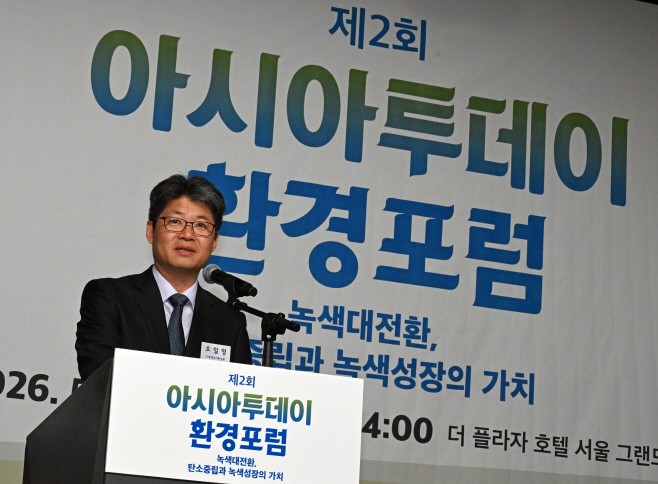 |
| Oh Il-young, head of the Climate and Energy Policy Bureau at the Ministry of Climate, Energy and Environment, delivers a presentation titled "Great Energy Transition Centered on Renewable Energy" at the 2nd Asia Today Environment Forum held at The Plaza Hotel in Jung-gu, Seoul, on May 29. / Photo by Reporter Song Ui-ju |
South Korea must break away from its heavy reliance on fossil fuel imports and transition into a self-reliant "Electro-State," powering its industry, transport, and building sectors with domestic renewable energy and nuclear power to counter Middle East energy shocks and the AI-driven surge in power demand, experts urged.
Oh Il-young, director general of the Climate and Energy Policy Bureau at the Ministry of Climate, Energy and Environment, emphasized during the 2nd Asia Today Environment Forum on May 29 that energy security is no longer just about stockpiling oil or diversifying import channels. Instead, it requires establishing a domestic structural framework where homegrown electricity fuels the entire national industry and economy.
The ministry’s tactical pivot comes in response to South Korea’s staggering vulnerability to global energy markets, as the country currently imports 93% of its energy resources. This foreign energy dependency racks up an annual import bill of approximately 240 trillion won, swallowing up nearly one-third of the total national budget. Compounded by volatile geopolitical conditions in the Middle East and global supply chain disruptions, a fundamental redesign of national energy security has become an urgent imperative.
The government views the explosive proliferation of AI as a major catalyst rewriting the rules of energy policy. As data centers and semiconductor manufacturing facilities experience exponential growth, securing a stable and massive supply of electricity has emerged as the linchpin of macro-level national competitiveness. "In the United States, we are already seeing tech firms freeze data center construction simply because local grids cannot provide enough electricity," Oh noted. "Whether it is AI or any other advanced manufacturing sector, long-term economic growth is fundamentally impossible without solving the power supply bottleneck."
To mitigate these risks, the ministry proposed systemic electrification across the economy. Currently, the domestic industrial, building, and transportation sectors remain highly dependent on fossil fuels like coal and liquefied natural gas (LNG). Critically, thermal energy accounts for roughly 60% of South Korea's final energy consumption, and the vast majority of this heat is generated via fossil fuels. Oh explained that transitioning these thermal processes to electricity will allow the country to simultaneously achieve energy security, net-zero carbon goals, and industrial competitiveness.
In the industrial sector, the clean transformation of the steel industry serves as a primary example. Modern steel production relies on coal not only as a heat source but also as a raw material in blast furnaces, releasing massive greenhouse gas emissions. Oh highlighted the need to migrate toward hydrogen-reduction steelmaking—replacing coal with clean hydrogen—while aggressively driving electrification across the petrochemical and manufacturing industries.
Alongside the expansion of renewable energy infrastructure, optimizing the national grid architecture was identified as a critical priority. "Our legacy grid relies on a highly centralized model that funnels electricity generated in rural provinces up to the Seoul metropolitan area," Oh observed. "Moving forward, we must reinforce a decentralized power grid where electricity is consumed within the specific regions where it is harvested."
The bureau chief added that resetting the energy baseline toward renewables is a vital step for future growth. "The energy transition is not merely about swapping out power plant technologies; it is a profound overhaul that reshapes our entire industry, regional economies, and national competitiveness," Oh remarked. "The ministry will steer this transition to simultaneously hit our benchmarks for energy security, carbon neutrality, industrial expansion, and balanced regional development."
Lee Sae-mi
Most Read
-
1
Celltrion’s Omlyclo gains ground in major European..

-
2
Trump demands rates fall below 1% as Fed hikes for..

-
3
Trump makes $1 trillion bet ahead of midterm elect..

-
4
Iran resumes ballistic missile production, assembl..

-
5
Samsung Electronics, Mistral AI to jointly develop..

-
6
Trump warns countries not helping U.S. must pay re..

-
7
Apple launches first foldable, 1 million won prici..

PEOPLE






HEADLINE NEWS
- Trump to roll out ‘unprecedented welcome’ for Xi with B-2 bombers, F-22 fighters
- S. Korea, U.S., and Japan form united front on Taiwan and economic coercion..
- Trump administration moves to impose sweeping sanctions on International Cr..
- Xi to make state visit to U.S. Sept. 23-25, dispelling rumors over his heal..

-
Address : In-Young Bldg., 34, Uisadang-daero 1-gil, Yeongdeungpo-gu, Seoul
Copyright by ASIATODAY CO., LTD. All rights resereved