



The Philippines to adopt Korea’s advanced police system
May 29, 2026, 10:16 am


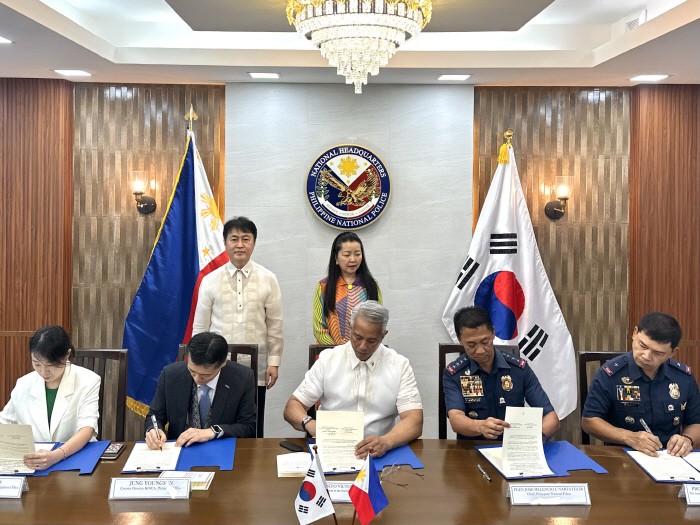 |
| The Korea International Cooperation Agency (KOICA) announced on May 29 that it has signed a Record of Discussions (RoD) with the Philippine National Police (PNP) to execute a project aimed at establishing an integrated crime investigation and intelligence management system for the Southeast Asian nation. / Photo courtesy of KOICA |
South Korea’s pioneering integrated crime investigation and intelligence management system will be transplanted to the Philippine government. The strategic initiative to reinforce local investigative capabilities is expected to substantially upgrade the safety nets protecting both Philippine citizens and South Korean expatriates and tourists traveling within the country.
The Korea International Cooperation Agency (KOICA) announced on May 29 that it signed a Record of Discussions (RoD) with the Philippine National Police (PNP) on May 28 (local time) to execute a bilateral project establishing the integrated criminal investigation platform.
The initiative functions as a subsequent phase of the "Project for Enhancing the Criminal Investigation Capability of the Philippine National Police," which was successfully implemented between 2016 and 2022. The new operational roadmap will run through 2028.
While the previous phase focused primarily on deploying hard infrastructure—such as patrol cars, police motorcycles, and forensic investigation kits—alongside foundational capacity-building exercises, the current phase shifts focus toward high-level digital transformation. KOICA will consolidate four fragmented criminal justice databases currently operating independently in the Philippines—covering criminal case reporting/analysis, investigation intelligence management, electronic warrants, and suspect profile tracking—into a singular, unified platform to foster a highly efficient and systematic criminal justice process.
In South Korea, law enforcement and judicial authorities seamlessly execute operations and pool intelligence through standardized, interconnected data platforms. In contrast, the Philippines has faced significant operational bottlenecks due to isolated systems, which frequently forced personnel to repeatedly enter identical case profiles or caused data discrepancies stemming from unstandardized metrics.
The digital integration is anticipated to eliminate redundant, repetitive administrative tasks, centralize case histories, and facilitate swift, high-accuracy investigations by mapping the entire life cycle of criminal proceedings within a unified framework.
Amid a rising global surge in sophisticated, transnational crimes—such as narcotics trafficking and online scams—reducing cases involving South Korean casualties in the Philippines and enhancing international joint operations are viewed as tangible milestones for this police-centric Official Development Assistance (ODA) program. The tactical objectives mapped out for the project’s conclusion include a 10% reduction in average case processing times and achieving 100% case traceability.
"This project carries profound significance as it reflects the South Korean government’s unwavering commitment to simultaneously protecting the safety of both Philippine citizens and our overseas Korean community by establishing a transparent, reliable, and integrated investigative infrastructure," remarked Ju Jeong-seon, director of the KOICA Philippines office.
Major General Jose Melencio Nartatez Jr., director of the Philippine National Police, expressed deep gratitude, stating, "Through this milestone project designed to upgrade our investigative and administrative architecture, we look forward to a sustained partnership between South Korea and the Philippines toward engineering a safer society and elevating public service standards."
Bilateral cooperation to bolster the Philippines' public safety infrastructure has been steadily recognized for its efficacy by Manila since 2018, reinforcing mutual commitments for long-term partnership. Notably, in March of this year, during President Lee Jae-myung’s state visit to the Philippines, the police chiefs of both nations signed a comprehensive Memorandum of Understanding (MOU) on bilateral police cooperation in the presence of both heads of state.
Lee Han-sol
Most Read
-
1
Trump demands rates fall below 1% as Fed hikes for..

-
2
Celltrion seeks rheumatoid arthritis indication ex..

-
3
Chinese e-commerce giants AliExpress, Temu and She..

-
4
Trump warns countries not helping U.S. must pay re..

-
5
Turkish Airlines named main club partner of Liverp..

-
6
China expels No. 2 military official Zhang Youxia..

-
7
Houthi rebels release video claiming downing of Sa..

PEOPLE







-
Address : In-Young Bldg., 34, Uisadang-daero 1-gil, Yeongdeungpo-gu, Seoul
Copyright by ASIATODAY CO., LTD. All rights resereved