



Bank NPL ratio hits 5-year high in March amid SME, SOHO distress
May 29, 2026, 10:10 am


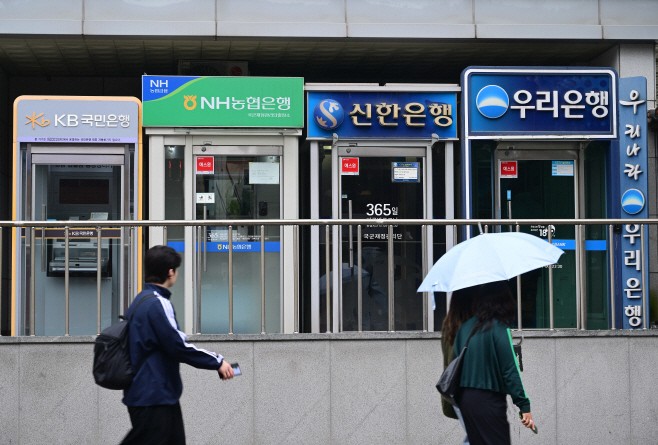 |
| Total estimated losses at South Korea’s four major financial institutions—KB, Shinhan, Hana, and Woori Financial Groups—reached a historic high of 2.9963 trillion won at the end of the first quarter of this year, according to financial sector sources on May 3. This metric tracks loan bonds deemed virtually unrecoverable by lenders. Photo shows bank automated teller machines (ATMs) installed in central Seoul on the same day. / Photo by Reporter Lee Byung-hwa |
The non-performing loan (NPL) ratio at South Korean commercial banks hit a five-year quarterly high at the end of the first quarter of this year. While the volume of newly generated bad debt contracted slightly, the total balance of bad loans expanded as banks sharply scaled back their write-offs and sales of distressed assets.
According to preliminary data titled "Status of Non-Performing Loans at Domestic Banks as of Late March 2026" released by the Financial Supervisory Service (FSS) on May 29, the average NPL ratio stood at 0.60% in the first quarter. This represents a 0.03 percentage point increase from the end of last year (0.57%) and marks the highest level recorded since March 2021 (0.62%).
The aggregate balance of NPLs climbed to 17.7 trillion won, up 1.1 trillion won from the prior quarter. By sector, corporate loans accounted for the lion's share at 14.2 trillion won, followed by household loans at 3.3 trillion won and credit card debt at 300 billion won.
Loan loss provisions held steady from the previous quarter at 26.7 trillion won. However, the surge in bad debt dragged the loan loss coverage ratio down to 150.4%, shedding 9.9 percentage points from the previous quarter (160.3%) and plunging 20.1 percentage points compared to the same period last year (170.5%).
Newly occurring bad debt in the first quarter came in at 5.5 trillion won, down 400 billion won from the preceding quarter. New corporate defaults dropped by 300 billion won to 4.1 trillion won, while new household defaults slid by 100 billion won to 1.3 trillion won. Conversely, the volume of cleared NPLs dropped even more sharply, logging 4.4 trillion won for the quarter—a 1.3 trillion won decrease from the prior three-month period.
Broken down by segment, the corporate NPL ratio edged up 0.04 percentage points from the end of last quarter to 0.74%. The bad debt ratio for large conglomerates ticked up 0.01 percentage points to 0.50%, while the ratio for small and medium-sized enterprises (SMEs) rose 0.05 percentage points to 0.88%. Notably, the self-employed entrepreneur (SOHO) segment saw the steepest increase, with its NPL ratio jumping 0.09 percentage points to 0.66%, its highest mark in a decade since March 2015 (0.71%).
The household NPL ratio crept up 0.01 percentage points from the previous quarter to 0.32%. Mortgage NPLs rose to 0.22% and other unsecured credit loans hit 0.66%, climbing 0.01 and 0.02 percentage points respectively. Meanwhile, the credit card NPL ratio dropped 0.02 percentage points to 1.82%, a 0.19 percentage point decrease year-on-year.
By banking sector, regional lenders exhibited disproportionately higher financial strain. The NPL ratio for regional banks rose 0.11 percentage points from the previous quarter to 1.13%. In contrast, nationwide commercial banks saw a mild 0.02 percentage point increase to 0.36%, while internet-only banks held flat at 0.60%. Special-purpose fiscal institutions rose 0.02 percentage points to 0.88%.
The FSS stated that it will closely monitor the banking sector's asset quality as macroeconomic uncertainties persist. "We intend to track soundness indicators across the industry, including trends in NPL ratios and delinquency rates, while rigorously auditing the adequacy of loan loss reserves," an FSS official remarked. "We will steer financial institutions to reinforce their asset management via aggressive NPL write-offs and debt sales."
Han Sang-wook
Most Read
-
1
Celltrion’s Omlyclo gains ground in major European..

-
2
Trump demands rates fall below 1% as Fed hikes for..

-
3
Trump makes $1 trillion bet ahead of midterm elect..

-
4
Iran resumes ballistic missile production, assembl..

-
5
Samsung Electronics, Mistral AI to jointly develop..

-
6
Trump warns countries not helping U.S. must pay re..

-
7
Apple launches first foldable, 1 million won prici..

PEOPLE






HEADLINE NEWS
- Trump to roll out ‘unprecedented welcome’ for Xi with B-2 bombers, F-22 fighters
- S. Korea, U.S., and Japan form united front on Taiwan and economic coercion..
- Trump administration moves to impose sweeping sanctions on International Cr..
- Xi to make state visit to U.S. Sept. 23-25, dispelling rumors over his heal..

-
Address : In-Young Bldg., 34, Uisadang-daero 1-gil, Yeongdeungpo-gu, Seoul
Copyright by ASIATODAY CO., LTD. All rights resereved