



Safety, housing take center stage in heated election debate
May 29, 2026, 09:33 am


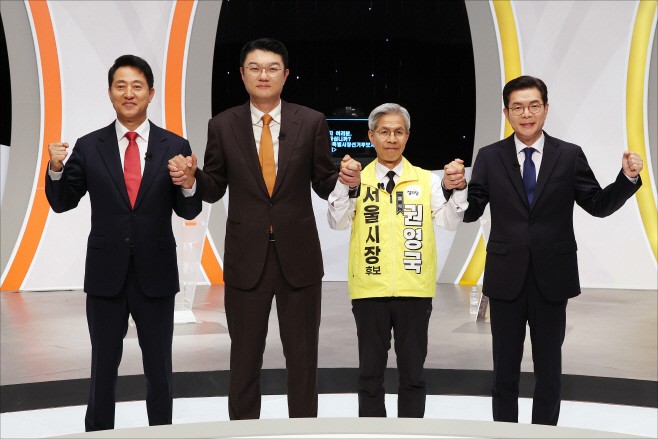 |
| Candidates for the 2026 Seoul mayoral election pose for a commemorative photo prior to a debate held at the SBS Prism Tower in Mapo-gu, Seoul, on May 28. From left: Oh Se-hoon of the People Power Party, Kim Jung-cheol of the New Reform Party, Kwon Young-guk of the Justice Party, and Jeong Won-oh of the Democratic Party of Korea. / Joint Press Pool |
The Seoul mayoral candidate TV debate, broadcast live for 120 minutes on the night of May 28—just a day ahead of early voting for the June 3 local elections—was a continuous series of heated clashes centering on citizen safety and housing stability.
The flashpoint of the night's debate was the recent Seosomun Overpass collapse coupled with the emerging scandal surrounding missing rebar at the GTX-A Samseong Station construction site. Controversy flared over the revelation that while the Ministry of Land, Infrastructure and Transport and the construction management firm were aware of the omissions and reported them directly to the minister, the head of Seoul’s responsible department judged that the issues could be resolved through internal remediation and failed to brief Mayor Oh Se-hoon for five months.
Candidate Jeong Won-oh defined the core undercurrent of these consecutive incidents as a fundamental insensitivity to safety. "Candidate Oh has still not even visited the Samseong Station site," Jeong pointed out. "Because the mayor treats safety so lightly, his department chief similarly dismissed the gravity of the situation, resulting in a six-month lapse in reporting."
Oh countered the accusation sharply. "Experts evaluated that the structural integrity could be supplemented through remediation, a conclusion that the Ministry of Land infrastructure and Transport also acknowledged, and more than 90 test runs have already been completed," Oh responded. "What exactly would be accomplished by my physical presence at the site? Candidate Jeong is simply exploiting this issue for electoral leverage."
Jeong, however, cautioned against dismissing the matter as mere political theater. "Much like Heinrich’s Law, which dictates that major accidents are invariably preceded by numerous minor warning signs, preemptive inspections are vital when it comes to safety," Jeong stressed. "The lives and safety of our citizens must never become a casualty of electoral political disputes. I will establish a Life and Safety Committee reporting directly to the mayor to audit the safety protocols of every single construction site in the city from square one."
High-stakes clash over housing: Jeong asks "Where are the 360,000 units?" vs. Oh blames Park Won-soon, states "389 sites being restored"
The two candidates locked horns with equal intensity over housing supply, an issue tied directly to real estate prices. Jeong launched an offensive by invoking Oh’s campaign promises from the previous election. "During the 2021 election, Candidate Oh pledged to supply 360,000 housing units within five years, yet according to data from the Ministry of Land, Infrastructure and Transport, housing starts from 2022 through 2024 amounted to a mere 39,000 units," Jeong argued. "Having failed to deliver even half of your promised volume, why do you continue to deflect blame onto the former mayor and the central government? I will swiftly alleviate the housing shortage through our 'Chak-Chak Development' initiative, which includes over 100,000 units of public rental and newborn-family housing."
Forced onto the defensive, Oh pointed back at the previous city administration. "During the term of the former mayor (Park Won-soon), 389 redevelopment zones were unilaterally canceled—essentially leaving the city's housing landscape scorched—and we are currently in the middle of restoring those exact areas," Oh countered. "The 360,000-unit target was explicitly based on designated development zones, and Candidate Jeong is distorting that context."
Oh probes "Haengdang Zone 7" as Jeong retaliates with "Banfo Deck Park"
The debate also devolved into a localized dogfight over administrative procedures in specific districts. Oh zeroed in on Haengdang Zone 7 in Seongdong-gu, where Jeong previously served as district mayor. "There was severe disruption after an guidance was issued to accept the Agissi-dang (a shamanic shrine) valued at 20 billion won as a public contribution," Oh charged. "Doesn't this suggest potential collusion with either the cooperative head or the shrine itself?"
Jeong flatly dismissed the allegation. "That specific determination was finalized back in 2008 during the tenure of a Hanuri Party (predecessor to the People Power Party) district mayor," Jeong clarified. "After taking office, I actually corrected the issue by clearly explaining that a public contribution could not be executed. This accusation is a blatant falsehood."
Furthermore, when Oh attempted to link the financial losses stemming from delays in constructing a daycare center in Haengdang Zone 7 (amounting to 70 million won in interest) to the disciplinary targeting of public officials, Jeong fired back. "The delay was heavily driven by the city itself, as Seoul's aggressive insistence on placing a senior day-care facility on the contributed site stalled negotiations with the cooperative," Jeong argued. "Moreover, regarding the Banpo Jugong Apartment Unit 1 deck park project, construction cannot even begin due to a lack of federal approval, yet the city claims ownership transfer is feasible. Why apply a double standard to identical administrative issues?"
Following the conclusion of the 120-minute debate, the four candidates made their closing appeals for voter support. "Elevating Seoul into one of the top three global cities demands proven experience," Oh stated, rallying his base. "Please protect Seoul, which stands as the critical baseline to check the arrogance and unilateral dominance of the Lee Jae-myung administration." Candidate Jeong focused on his executive record, pledging, "Based on my hands-on experience resolving resident grievances and implementing local policies as district mayor, I will reliably support the daily lives of our citizens. I will also integrate the strong policies of other candidates to alleviate public inconvenience, and I urge voters to demonstrate through the ballot box that the citizens are the true owners of Seoul."
Third-party candidates directed their efforts toward criticizing both major political establishments. New Reform Party candidate Kim Jung-cheol referenced the Seosomun Overpass accident, vowing to "put an end to the cowardly politics of the two major parties that relegate public safety to the back burner," while Justice Party candidate Kwon Young-guk concluded the debate by urging voters to "support a progressive party that continuously stands on the side of ordinary citizens, workers, and tenants."
Shim Jun-bo
Most Read
-
1
Trump demands rates fall below 1% as Fed hikes for..

-
2
Celltrion seeks rheumatoid arthritis indication ex..

-
3
Chinese e-commerce giants AliExpress, Temu and She..

-
4
Trump warns countries not helping U.S. must pay re..

-
5
Turkish Airlines named main club partner of Liverp..

-
6
China expels No. 2 military official Zhang Youxia..

-
7
Houthi rebels release video claiming downing of Sa..

PEOPLE






-
Address : In-Young Bldg., 34, Uisadang-daero 1-gil, Yeongdeungpo-gu, Seoul
Copyright by ASIATODAY CO., LTD. All rights resereved