



Household income rises for 11th quarter but gap widens
May 28, 2026, 04:56 pm


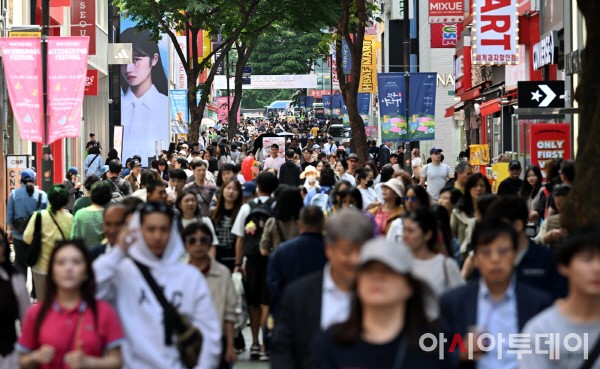 |
| Myeongdong Street / Photo by Reporter Song Ui-joo |
The nation’s household income extended its upward trajectory for the 11th consecutive quarter in the first quarter of this year. Powered by this income growth, consumer spending also logged its sharpest increase in three years. Concurrently, however, the income gap across economic strata widened to its worst level in six years, driven by a pronounced surge in earnings among high-income households—many employed by large corporations—fueled by performance bonuses and related incentives.
According to the "First Quarter 2026 Household Income and Expenditure Survey" released by the National Data Agency on May 28, the average monthly income per household stood at 5.48 million won in the first quarter, marking a 2.4% increase compared to the same period last year. This marks the 11th straight quarter of expansion since the second quarter of 2023, when income contracted by 0.8%. Real income, which adjusts for inflation, edged up by 0.4% over the same period.
Average monthly consumer spending per household hit 3.11 million won, climbing 5.3%. This represents the highest growth rate in three years since the first quarter of 2023, when spending surged by 11.5%. Consequently, the growth rate of consumer spending outpaced income growth for the first time in seven quarters. Real consumer spending, adjusted for inflation, also recorded a 3.1% expansion.
Analysts point out that appreciation in asset values, including equities, buoyed consumer confidence and spending capacity. An official from the Data Agency remarked, "Given that consumer spending rose predominantly around durable goods such as automobiles and furniture, asset appreciation appears to have exerted some degree of influence." In practice, expenditures on automobile purchases jumped by 29.6% in the first quarter, while spending on furniture and lighting spiked by 36.6%.
In contrast, income distribution metrics took a turn for the worse. The average monthly income for bottom-tier households in the lowest 20th percentile (the first quintile) reached 1.17 million won, up 2.7% year-on-year. However, the average monthly income for top-tier households in the highest 20th percentile (the fifth quintile) swelled by 4.2% to 12.38 million won, significantly outpacing the gains of the lowest income bracket. As a result, the quintile share ratio for equalized disposable income hit 6.59, climbing 1.0 percentage point from the previous quarter’s 5.59. This marks the highest ratio recorded in six years since the first quarter of 2020, when it stood at 6.89. A higher ratio typically signifies a deterioration in income distribution.
A government official explained, "The fifth quintile ratio worsened under the influence of rising wages at enterprises with 300 or more employees, including special bonuses for regular workers." The official nonetheless cautioned, "Because quarterly household income is susceptible to seasonality and volatility, a degree of prudence is warranted when analyzing broader income distribution solely through the household survey’s quintile ratio." The official added, "We will accelerate efforts to address structural issues such as polarization. To safeguard the livelihoods of vulnerable groups, we plan to swiftly execute a supplementary budget to provide high-oil-price relief funds and expand emergency welfare livelihood support."
Lee Ji-hoon
Most Read
-
1
Celltrion’s Omlyclo gains ground in major European..

-
2
Trump demands rates fall below 1% as Fed hikes for..

-
3
Trump makes $1 trillion bet ahead of midterm elect..

-
4
Iran resumes ballistic missile production, assembl..

-
5
Samsung Electronics, Mistral AI to jointly develop..

-
6
Trump warns countries not helping U.S. must pay re..

-
7
Apple launches first foldable, 1 million won prici..

PEOPLE





HEADLINE NEWS
- Trump to roll out ‘unprecedented welcome’ for Xi with B-2 bombers, F-22 fighters
- S. Korea, U.S., and Japan form united front on Taiwan and economic coercion..
- Trump administration moves to impose sweeping sanctions on International Cr..
- Xi to make state visit to U.S. Sept. 23-25, dispelling rumors over his heal..

-
Address : In-Young Bldg., 34, Uisadang-daero 1-gil, Yeongdeungpo-gu, Seoul
Copyright by ASIATODAY CO., LTD. All rights resereved