



Korean auto industry vows to remain vigilant to stay competitive
May 28, 2026, 03:48 pm


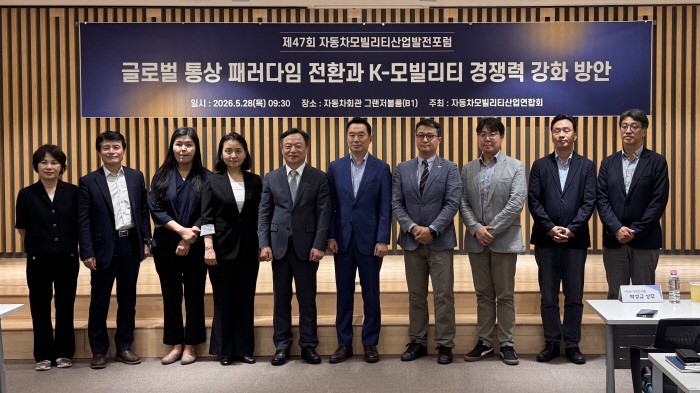 |
| Domestic automotive industry officials pose for a commemorative photograph at the 47th Automotive and Mobility Industry Development Forum held at the Automobile Hall in Seocho-gu, Seoul, on the morning of May 28. / Photo by Reporter Kim So-young |
Amid the intensifying protectionist stance adopted by major economies worldwide, voices are growing within the domestic automotive sector emphasizing the urgent need to preserve the nation's manufacturing base and bolster support for the future mobility industry. Industry insiders and experts underscored that reinforcing domestic manufacturing competitiveness and overhauling institutional frameworks are of paramount importance to navigate shifting trade dynamics, including tariffs, subsidies, and investment regulations.
The Korea Automobile and Mobility Association (KAIA) hosted the 47th Automotive and Mobility Industry Development Forum at the Automobile Hall in Seocho-gu, Seoul, on May 28, focusing on the theme of "The Global Trade Paradigm Shift and Strategies to Sharpen K-Mobility Competitiveness."
KAIA Chairman Dae-jin Jung diagnosed the situation, stating, "Primary export destinations, such as the United States and the European Union (EU), are moving to shield their domestic industries through tariffs, import-export controls, and industrial subsidy policies. While South Korea has also stepped up efforts to expand investments in future vehicles and improve institutional systems, these measures fall short of matching the sheer velocity of shifts in the global trade environment."
Sung-kyu Park, Senior Vice President at the Hyundai Motor Group Economic Research Institute, observed, "The high-tariff barriers and import restrictions imposed by the United States stem from a calculation that the existing free trade order no longer serves its national interests. We have entered an era where economic security is synonymous with national security." He further explained, "Ultimately, our most critical weapon is manufacturing competitiveness, and our flagship industries, including automotive, must merge with artificial intelligence (AI) to elevate their edge."
Experts also raised the necessity of designing targeted policies to sustain the domestic manufacturing footprint. Su-jung Cho, a professor at the Korea University School of Law, suggested, "With China's electric vehicle (EV) production surpassing 70% of the global total, anxieties over its market encroachment are mounting. It is time to actively consider trade remedies, strengthened foreign investment security screenings, and the introduction of tax incentives to promote domestic EV manufacturing."
Ji-hyun Jung, a research fellow at the Korea Institute for International Economic Policy (KIEP), added, "China's strategy concerning overseas manufacturing hubs has evolved beyond simple geographical diversification into constructing comprehensive supply chain networks. To buffer against the risk that expanding overseas localized production could lead to a contraction of domestic manufacturing, we must simultaneously reinforce our domestic EV and future vehicle manufacturing base alongside the battery and component ecosystem."
Kim So-young
Most Read
-
1
Kia Sportage outperforms Mazda CX-5 in German auto..

-
2
Houthis launch successive attacks on Saudi airport..

-
3
Saudi Arabia, Iran hold first diplomatic talks to..

-
4
U.S. deploys carrier, 10,000 more troops to Middle..

-
5
Saudi airport in Riyadh struck again, leaving at l..

-
6
Putin's ally visits China on the 8th ahead of APEC..

-
7
Chinese military support and training center opens..

PEOPLE






HEADLINE NEWS

-
Address : In-Young Bldg., 34, Uisadang-daero 1-gil, Yeongdeungpo-gu, Seoul
Copyright by ASIATODAY CO., LTD. All rights resereved