



Indian films undergo revisions to refrain from criticizing China
May 28, 2026, 01:46 pm


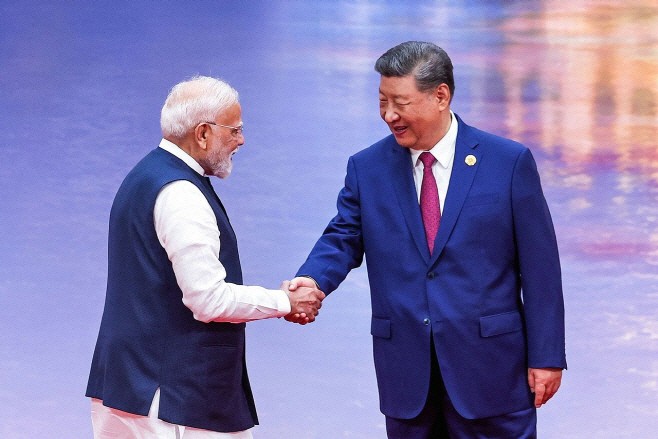 |
| Indian Prime Minister Narendra Modi shakes hands with Chinese President Xi Jinping during the Shanghai Cooperation Organisation (SCO) summit held in Tianjin, China, in August last year. / Photo via AFP-Yonhap News |
As India and China move to smooth over the lingering animosity from their border disputes, Indian films centering on the 2020 Galwan Valley clash are undergoing consecutive title changes and extensive reshoots. Some projects have been shuttered entirely.
According to a report by the South China Morning Post (SCMP) on May 28 (local time), the Indian government recently issued a directive to domestic film production companies advising them to "refrain from bashing China." Against the backdrop of thawing diplomatic ties between the two Asian giants, cinematic works centered on the 2020 Galwan Valley skirmish have fallen directly within the blast radius of this policy shift.
A prominent casualty is an upcoming war film starring Bollywood megastar Salman Khan. Originally titled "The Battle of Galwan," the film has been rebranded as "Matribhoomi: May War Rest in Peace." Reports indicate that roughly 40% of the entire movie has been reshot, and dialogues directly naming China have been swapped for more ambiguous terminology. Although initially slated for release on April 17, its premiere has been postponed indefinitely due to prolonged rating reviews by the Central Board of Film Certification (CBFC). Due to the sheer geopolitical sensitivity of the subject matter, production houses must secure prior clearance from the Indian Army and the Ministry of Defence before submitting their work to the CBFC.
Meanwhile, another project titled "The Lion of Galwan" has ground to a complete halt. The film was conceived to chronicle the life of Sepoy Gurtej Singh, a soldier posthumously awarded India's wartime gallantry medal, the Vir Chakra, after losing his life in the Galwan clash. "We received a clear directive from the Ministry of Defence stating that 'China-bashing is a no-go,'" producer Himalay Dasani stated in an interview with the Indian daily Mid-Day. "If you strip away why the clash erupted and how the troops fought, there is simply no justification for making this movie anymore."
The freeze follows a June 2020 military standoff between Indian and Chinese troops in the Galwan Valley of the Ladakh region in Kashmir. The clash claimed the lives of 20 Indian soldiers and four Chinese troops, sending bilateral relations into a deep freeze. However, the two nations reached a breakthrough agreement on border disengagement and patrolling in October 2024, which serves as a springboard to rapidly expand cooperation across trade, security, and multilateral diplomacy. This rapid diplomatic rapprochement has effectively slammed the brakes on the film industry.
As this expanding bilateral cooperation narrows the scope of artistic expression in cinema, public criticism is mounting that government directives are applying freedom of speech selectively. "How does it make sense that criticizing China is forbidden, yet bashing Pakistan is perfectly acceptable?" questioned Indian filmmaker Onir. "It was China that actively backed Pakistan during last year's India-Pakistan military confrontation, Operation Shindoor."
Ira Bhaskar, a former professor of cinema studies at Jawaharlal Nehru University, echoed these concerns. "Targeting Pakistan remains easy, but China is a completely different story," Bhaskar noted. "In India, freedom of expression is perpetually tethered to caveats concerning neighborhood relations and sovereignty issues. The government wants only its own narrative captured on celluloid, turning freedom of speech into a mere illusion."
Documentary filmmaker Aditi Sharma pointed to "Dhurandhar," a recently released action film centered on Indian intelligence operations, as a case in point. "There were no title changes, no reshoots, and no defense ministry directives for that project," Sharma lamented. "The industry is permitted to wield cinema like a blunt instrument against Pakistan, but China remains completely untouchable. This isn't about principle; it's the proxy enforcement of foreign policy through film."
Conversely, some voices defend the government's stance. "With Beijing signaling a desire for a diplomatic thaw, New Delhi has no reason to pick a fight unnecessarily," said Major General (Retd.) G.D. Bakshi of the Indian Army. "Given that relations with the United States have also grown fraught following the Trump administration's tariff measures, it is entirely rational to dial back nationalist narratives in cinema for the time being." He added, "The wars against China in 1962 and 1967 were eventually adapted into movies when the timing was right. The valor displayed by our troops in Galwan will also find its way to the silver screen when the moment is ripe."
Jeong Ri-na
Most Read
-
1
U.S. Treasury Secretary Bessent publicly warns ove..

-
2
Celltrion’s Omlyclo gains ground in major European..

-
3
Hyundai Motor Group breaks ground on integrated st..

-
4
Russia faces warning signs over prolonged war econ..

-
5
U.S. strikes 3 Iranian oil tankers, Iran vows reta..

-
6
S. Korea seeks redemption from World Cup setback w..

-
7
Trump makes $1 trillion bet ahead of midterm elect..

PEOPLE







-
Address : In-Young Bldg., 34, Uisadang-daero 1-gil, Yeongdeungpo-gu, Seoul
Copyright by ASIATODAY CO., LTD. All rights resereved