



Will 'shy conservatives' tip the scales out of anxiety over a DPK sweep?
May 28, 2026, 10:38 am


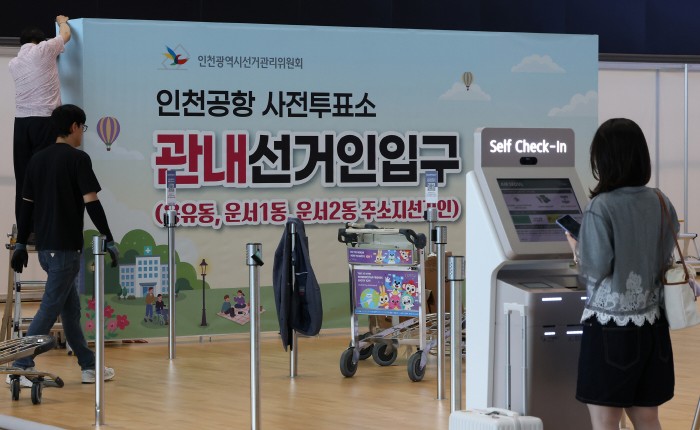 |
| Workers set up an early voting station for the 9th nationwide simultaneous local elections at Incheon International Airport Terminal 2 on May 27. Early voting for the upcoming local elections allows eligible voters to cast their ballots at any designated station nationwide, regardless of their registered residential address, and will run for two days from May 29 to 30, between 6 a.m. and 6 p.m. daily. / Photo via Yonhap News |
"I dislike the People Power Party, but I am anxious about a Democratic Party monopoly."
This single sentence penetrates the psyche of voters in the final stretch of the June 3 local elections. While the approval ratings for the People Power Party (PPP) show little sign of rebounding, a paradoxical trend is emerging as the number of neck-and-neck battlegrounds continues to expand. Whether the so-called "hidden conservatives"—whose preferences are not clearly captured in public opinion polls—will actually show up at the polling booths has emerged as the ultimate variable in the eleventh hour.
According to political circles on May 27, the Democratic Party of Korea (DPK) was widely expected to dominate the early stages of this local election, capitalized on a conservative landscape that had collapsed post-impeachment. In various opinion polls, the DPK maintained its lead across the Seoul metropolitan area and the Chungcheong region. Coupled with the PPP's internal friction over candidate nominations, some corners of the political arena even whispered about a landslide victory that could eclipse the results of the 2018 local elections.
However, the political undercurrent shifted as the official campaign commenced. Once the PPP’s internal strife was largely resolved and the final matchups were locked in, the conservative base began to consolidate gradually, widening the scope of highly contested races in key regions such as Seoul, Daegu, Busan, and Ulsan. Even within the DPK, warnings are mounting that optimism is dangerous.
What stands out is that this trend is not translating into an uptick in the PPP's official party approval ratings. In a survey conducted by Gallup Korea from May 19 to 21 among 1,002 eligible voters aged 18 and older nationwide, the DPK recorded 45% support, while the PPP stood at 22%. The DPK's rating remained unchanged from the previous poll, whereas the PPP actually dipped by 1 percentage point.
Consequently, analysts suggest that a growing number of voters are decoupling their assessment of the political parties from the individual candidates. Above all, while the public's unfavorable perception of the PPP remains stagnant, a counterbalancing desire to check the DPK against an excessive consolidation of power is operating simultaneously.
This analysis is further supported by the unusually high percentage of undecided or independent voters maintained late into the race. Typically, floating voters shrink in the final stages of a campaign, dragging the proportion of independent voters down to the low 10% range. Yet, this election is witnessing an unprecedented trend where independent voters hover around 20% even at the finish line.
Strategists are paying close attention to the probability that a substantial portion of these independent voters are not die-hard PPP loyalists, but rather moderate or latent conservatives driven by a desire to keep the DPK in check. This explains why both rival camps are hyper-focused on the sentiment of independent voters in these final hours; the choice made by moderate conservatives—who distance themselves from hardline right-wing politics—is pinned as the pivotal variable that will dictate the entire election outcome.
Commenting on this dynamic, Park Chang-hwan, a special professor at Jangan University, noted, "Local elections are traditionally highly susceptible to sweeping party waves, and while the DPK's momentum was dominant early on, a desire for checks and balances has reared its head over time." He added, "However, the reason the PPP's party approval rating is failing to rise is that internal party rifts and emotional fractures within the conservative camp have yet to be fully mended."
Professor Park projected, "The sentiment of 'I do not support the party, but we must check the DPK' is the primary catalyst driving candidate approval ratings higher than their respective party support. The voter turnout and the ultimate election results will hinge on how many of these independent voters actually show up at the ballot box."
Shin Yul, a professor of political science and international relations at Myongji University, offered a parallel analysis: "A significant number of these battlegrounds are areas where candidates are running like independent lone wolves. This implies that moderate, rational conservatives harbor a strong aversion to the PPP’s hardline leadership." Professor Shin concluded, "There is a non-trivial segment of voters who identify as conservative but dislike hardline right-wing politics, yet are equally reluctant to vote for the DPK. The fact that tight battlegrounds are multiplying indicates an increasing probability that these passive conservative voters are shifting into motion toward the polling stations."
Kim Chae-yeon
Most Read
-
1
Trump demands rates fall below 1% as Fed hikes for..

-
2
Celltrion seeks rheumatoid arthritis indication ex..

-
3
Chinese e-commerce giants AliExpress, Temu and She..

-
4
Trump warns countries not helping U.S. must pay re..

-
5
Turkish Airlines named main club partner of Liverp..

-
6
China expels No. 2 military official Zhang Youxia..

-
7
Houthi rebels release video claiming downing of Sa..

PEOPLE






-
Address : In-Young Bldg., 34, Uisadang-daero 1-gil, Yeongdeungpo-gu, Seoul
Copyright by ASIATODAY CO., LTD. All rights resereved