



China's NIIP overtakes Japan's, plunging Tokyo to 3rd
May 26, 2026, 03:28 pm


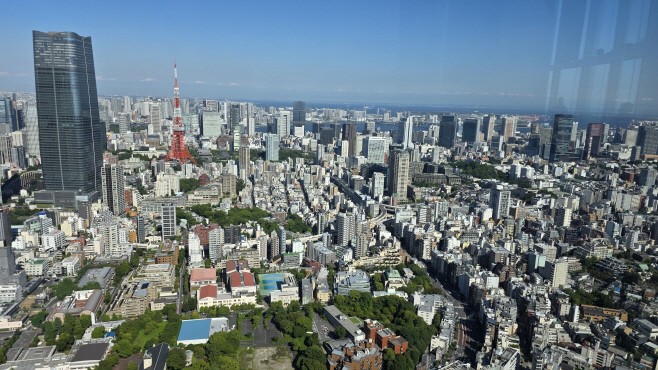 |
| Downtown Tokyo. Japan's net international investment position (NIIP) reached a record high, yet the country was overtaken by China, dropping to third place globally. / Photo by Tokyo Correspondent Choi Young-jae |
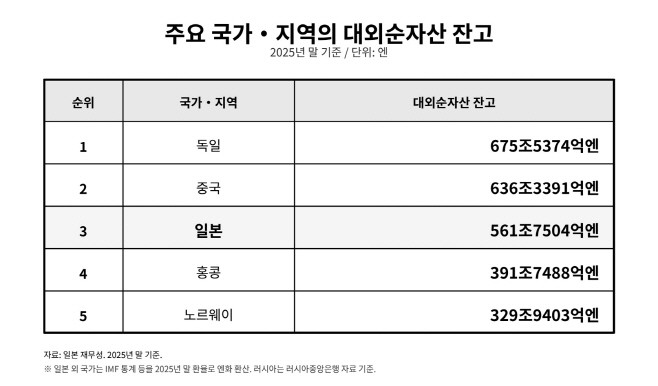
Japan's net international investment position (NIIP)—the net foreign assets held by its government, corporations, and individuals—has dropped to third place globally after being overtaken by China, despite expanding to a record high. The Japanese Ministry of Finance announced on May 26 that Japan's NIIP stood at 561.7504 trillion yen as of the end of 2025, up 4.4% from the previous year. While the figure itself marked a record high for the seventh consecutive year, Japan fell behind Germany and China in the global rankings.
Japan was once the definitive symbol of the world's largest creditor nation. It held the top spot globally for 36 consecutive years starting in 1991, but conceded the number-one position to Germany at the end of 2024. At the end of 2025, it slipped further to third place after being bypassed by China. Germany's NIIP was logged at 675.5374 trillion yen, while China's reached 636.3391 trillion yen. Driven by an expanding trade surplus, China saw its net foreign assets surge by more than 100 trillion yen in a single year.
Japan's descent in the rankings does not stem from a contraction in overseas assets. On the contrary, Japan's gross foreign assets grew 8.5% from the prior year to 1,805.6342 trillion yen, marking the 17th consecutive year of growth. This expansion was powered by Japanese corporations' direct investments in the US and Europe, cross-border mergers and acquisitions, and valuation gains on foreign securities holdings.
 |
Japanese firms profit abroad, but domestic growth remains weak
The core issue lies in the fact that liabilities—assets held by foreign investors within Japan—grew at an even faster clip. Gross foreign liabilities jumped 10.5% to 1,243.8838 trillion yen. Notably, the rally in the Japanese stock market drove up the valuation of domestic equities held by overseas investors, compressing the net growth of Japan's asset position. Reuters reported that the value of Japanese securities held by non-residents surged by 62.2 trillion yen, fueled by the appreciation of Japanese stock values.
While a country's net international investment position serves as a primary barometer of its net wealth held abroad, these latest metrics expose a glaring dichotomy within the Japanese economy. Japan remains a wealthy creditor nation with vast overseas holdings, yet its pace of accumulation lags behind Germany and China, both of which are rapidly building up net assets on the back of widening trade surpluses and manufacturing competitiveness. Inside Japan, a weakening yen, expanding outbound investment, and domestic industrial hollowing out have converged, prompting critics to point out that Japanese corporations are making money abroad while domestic growth potential continues to wither.
The implications for South Korea are profound. Japan's descent in the rankings is not merely a shift in economic standings, but a reflection of a structural realignment in East Asian capital flows. China is rapidly expanding its net foreign assets through robust exports and current account surpluses, whereas Japan is becoming increasingly dependent on returns from overseas investments. South Korea faces remarkably similar structural pressures, including a rapidly aging population, slowing growth, and the offshoring of its manufacturing base. This serves as a stark warning that simply increasing foreign assets is insufficient; maintaining a vibrant domestic industrial base and domestic investment attractiveness is equally paramount.
Choi Young-jae
Most Read
-
1
Celltrion nears additional contract with major U.S..

-
2
Putin proposes trilateral U.S.-China-Russia summit..

-
3
U.S. weighs dropping MOAB, world's most powerful n..

-
4
"Aren't those foreigners on welfare?": M..

-
5
Attention centers on APEC for possible Trump-Xi-Pu..

-
6
Saudi Arabia, Iran hold first diplomatic talks to..

-
7
U.S., Israel plan to resume strikes on Iran after..

PEOPLE







-
Address : In-Young Bldg., 34, Uisadang-daero 1-gil, Yeongdeungpo-gu, Seoul
Copyright by ASIATODAY CO., LTD. All rights resereved