



Hyundai Rotem wins state contract for physical AI unmanned robots
May 26, 2026, 10:28 am


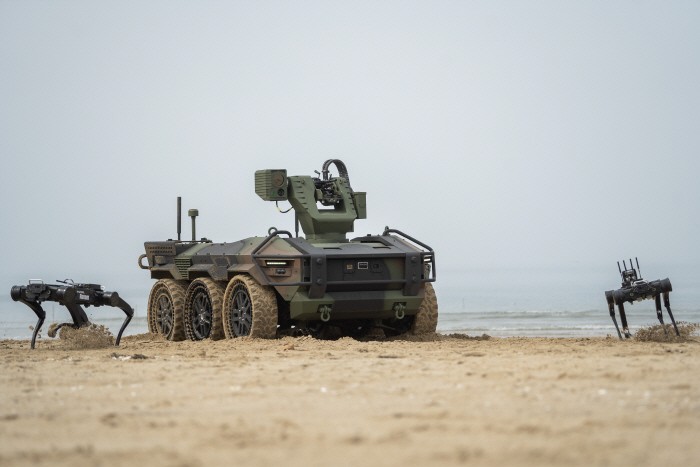 |
| The HR-Sherpa multipurpose unmanned ground vehicle (UGV) and a quadrupedal walking robot. / Photo courtesy of Hyundai Rotem |
Hyundai Rotem announced on May 26 that it has been selected as the final contractor for two major state-backed research and development (R&D) projects: the "Natural Language Command-Based Heterogeneous Multi-Robot Integrated Control System" commissioned by the Ministry of Trade, Industry and Energy, and the "Physical AI-Based Integrated Simulator and Modular Robot System" ordered by the Agency for Defense Development (ADD).
The core objective of the Ministry of Trade, Industry and Energy project is to develop control software that enables the integrated command of various types of unmanned robots using human natural language and text commands. Previously, operators had to input standardized, manual commands using specific remote control units to operate a single unmanned robot.
Moving forward, Hyundai Rotem plans to internalize and apply this integrated control technology to its flagship unmanned platforms, including the HR-Sherpa multipurpose unmanned ground vehicle (UGV) and quadrupedal walking robots. The company aims to establish and continuously upgrade an integrated command and control architecture capable of simultaneously deploying multiple HR-Sherpa vehicles and quadrupedal robots at a swarm level.
The ADD project focuses on developing a digital twin simulator to validate the performance of unmanned robots within realistic virtual environments, alongside a modular unmanned robot platform. Once developed, the simulator is expected to boost development efficiency and operational safety by allowing repeated verification under diverse environments and mission conditions prior to physical deployment, free from spatial and temporal constraints.
The modular unmanned robot platform will feature four legs equipped with detachable wheels, capable of mounting various mission equipment such as robotic arms or explosive ordnance disposal devices. The system will also integrate Edge AI technology, enabling the platform to make autonomous on-site decisions based on localized data, even when disconnected from a central server.
"In line with Hyundai Motor Group's overarching vision to lead global physical AI technology, we plan to concentrate our corporate-wide capabilities on driving innovation for physical AI within the defense sector," Hyundai Rotem stated. "Alongside securing these state contracts, we are actively setting the standard for intelligent future battlefields through multi-faceted public-private technical collaborations, including our memorandum of understanding with the American defense tech firm Anduril."
Kang Tae-yun
Most Read
-
1
Kia Sportage outperforms Mazda CX-5 in German auto..

-
2
Houthis launch successive attacks on Saudi airport..

-
3
Saudi Arabia, Iran hold first diplomatic talks to..

-
4
U.S. deploys carrier, 10,000 more troops to Middle..

-
5
Saudi airport in Riyadh struck again, leaving at l..

-
6
Putin's ally visits China on the 8th ahead of APEC..

-
7
Chinese military support and training center opens..

PEOPLE






HEADLINE NEWS

-
Address : In-Young Bldg., 34, Uisadang-daero 1-gil, Yeongdeungpo-gu, Seoul
Copyright by ASIATODAY CO., LTD. All rights resereved