



ROK Marine's new attack chopper clears weapons tests, set for 2027 production
May 26, 2026, 10:16 am


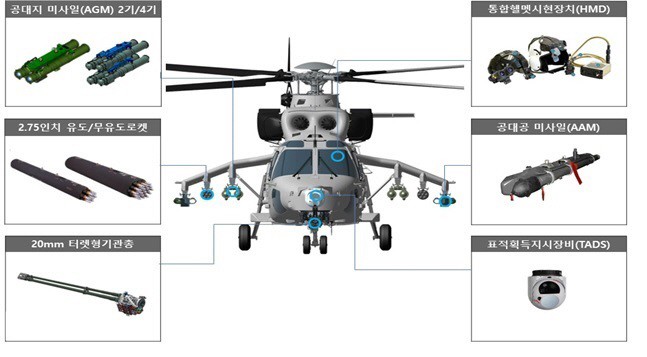 |
| An infographic detailing the integrated weapons and avionic systems of the South Korean Marine Attack Helicopter (MAH). / Diagram courtesy of the Defense Acquisition Program Administration (DAPA) |
The domestically developed Marine Attack Helicopter (MAH) for the Republic of Korea Marine Corps has successfully cleared all weapons integration tests, including live-fire trials of air-to-air guided missiles. The Defense Acquisition Program Administration (DAPA) announced on May 26 that the platform has officially entered the final stages of system development, with plans to complete the development phase this August and launch mass production starting in 2027.
Following successful test-firings of its automatic cannon, guided and unguided rockets, and air-to-ground missiles last year, the MAH recently completed its weapons capability profile by successfully executing a live-fire trial of an air-to-air guided missile. DAPA underscored that the helicopter is now fully capable of operating four core weapon systems required for modern warfare: a turreted automatic cannon, Cheongeom air-to-ground guided missiles, 70mm guided and unguided rockets, and air-to-air guided missiles.
The successful live-fire testing of the air-to-air guided missile carries significant strategic weight, as it equips the aircraft with aerial combat capabilities to defend itself against adversarial attack helicopters and drones while providing escort screening for marine utility helicopters. This achievement marks the first time a domestically developed military helicopter operated by the South Korean Armed Forces has demonstrated the capability to mount and launch air-to-air missiles, fueling high expectations for enhanced multidimensional amphibious operational capabilities for the Marine Corps.
The primary mission of the MAH is to escort marine utility helicopters to guarantee the survivability of Marine Corps air assault units. To execute these missions, the aircraft is outfitted with cutting-edge avionic suites, including a Target Acquisition and Designation Sight (TADS) for day and night target tracking, a Helmet Mounted Display (HMD), maritime-optimized avionics, and an Automatic Flight Control System (AFCS).
The platform is slated to serve as a cornerstone asset for three-dimensional amphibious maneuvers, expanding the Marine Corps’ operational theater from the ground into the air domain while maximizing the mobility of landing forces.
System development for the MAH originally commenced in October 2022. Following its successful maiden test flight in December 2024, the aircraft underwent rigorous test and evaluation programs, including weapons live-fire trials, shipboard compatibility tests, and environmental qualification testing. DAPA plans to wrap up system development by August and enter mass production in 2027. To meet this timeline, DAPA is coordinating closely with the Joint Chiefs of Staff and other relevant oversight agencies to finalize the official test and evaluation verdicts scheduled for early July.
"By successfully integrating air-to-air missiles alongside our automatic cannon, rockets, and air-to-ground missiles, we have fully secured the operational capabilities of the MAH's core weapon systems," said Kim Kyung-heo, head of the Helicopter Program Department at DAPA. "We will do our utmost to keep the remaining development milestones on track to ensure timely deployment for active service."
Lee Han-sol
Most Read
-
1
Trump demands rates fall below 1% as Fed hikes for..

-
2
Celltrion seeks rheumatoid arthritis indication ex..

-
3
Chinese e-commerce giants AliExpress, Temu and She..

-
4
Trump warns countries not helping U.S. must pay re..

-
5
Turkish Airlines named main club partner of Liverp..

-
6
China expels No. 2 military official Zhang Youxia..

-
7
Houthi rebels release video claiming downing of Sa..

PEOPLE







-
Address : In-Young Bldg., 34, Uisadang-daero 1-gil, Yeongdeungpo-gu, Seoul
Copyright by ASIATODAY CO., LTD. All rights resereved