



High school credit system enter year 2; rural schools left behind in course selection
May 22, 2026, 01:39 pm


 |
| Photo courtesy of the National Assembly Research Service |
In year two of the nationwide rollout of the high school credit system, students at small rural high schools face severe structural disadvantages in course selection and teacher recruitment, threatening to widen the country's educational opportunity gap.
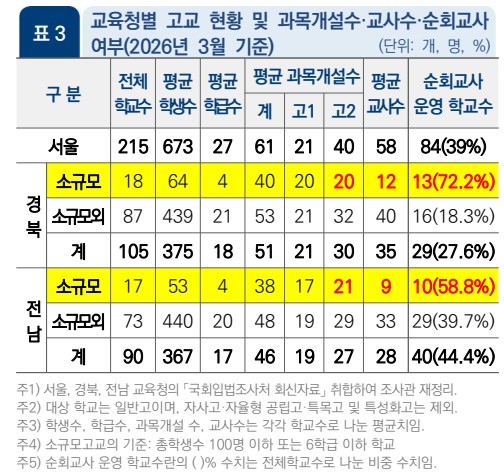
According to a report titled "Is the High School Credit System Ensuring Educational Opportunities for Small Schools? A Case Study of High Schools in Gyeongbuk and Jeonnam," published by the National Assembly Research Service (NARS) on May 22, the average number of courses offered for second-year high school students—the cohort that begins taking elective subjects—stood at just 30 in Gyeongbuk and 27 in Jeonnam, compared to 40 in Seoul.
Significant disparities were also observed within the same provinces. In Gyeongbuk, small high schools offered an average of 20 courses for second-year students, compared to 32 at larger institutions. In Jeonnam, small schools offered 21 courses, while larger ones provided 29.
The staffing gap was even more pronounced. The average number of teachers at small high schools in Gyeongbuk was 12, less than one-third of the 40 teachers averaged at larger schools. In Jeonnam, small high schools averaged nine teachers, falling far short of the 33 tracked at larger institutions. The report warned that this deficit frequently forces a single educator to cover multiple subjects or teaches courses outside their primary academic major.
Consequently, rural institutions depend heavily on traveling teachers who divide their hours among multiple schools. The proportion of institutions utilizing traveling educators reached 72.2% among small high schools in Gyeongbuk and 58.8% in Jeonnam. These figures significantly outpaced the 39% average across all high schools in Seoul, as well as the averages of larger schools in Gyeongbuk and Jeonnam. Analysts noted that drawing heavily on traveling staff reduces the number of full-time, resident teachers, leading to structural gaps in student counseling, discipline, and routine school administration.
The report also raised concerns regarding university admissions disadvantages under the current school-grade evaluation system. In a relative-evaluation grading structure, smaller school sizes mean that elective courses are frequently splintered into small-enrollment classes of fewer than nine students. Under these conditions, the mathematical pool required to secure top grades can vanish entirely, severely harming students' cumulative grade point averages and driving them to select subjects based on strategic grading advantages rather than personal aptitude.
While small schools have attempted to circumvent limited course offerings via cooperative regional curricula and online schooling platforms, these measures present clear operational limits. The share of off-campus cooperative courses stood at 44.4% for small schools in Gyeongbuk and 41.2% in Jeonnam, outstripping larger institutions in the same regions. This data reflects a heavy systemic dependence on external programs due to an inability to open courses internally.
However, the rural geography itself imposes logistical burdens on students due to long travel distances and poor public transit options. Furthermore, while grades for cooperative curricula and online schools are calculated using absolute evaluation metrics, larger schools can easily open localized elective courses evaluated on relative scales. This structural divergence puts rural students at a competitive disadvantage in university admissions.
"Due to disparities in course offerings and grading methodologies, students at small high schools are highly likely to find themselves at a disadvantage in the competitive college admissions market," said Cho Jong-oh, a legislative research officer at NARS. "To successfully anchor the high school credit system, the state must establish firm legal foundations to support small-scale schools, and local education offices must transition to a system where they directly recruit and supply qualified instructors to these vulnerable institutions."
Kim Nam-hyeong
Most Read
-
1
Celltrion’s Omlyclo gains ground in major European..

-
2
Trump demands rates fall below 1% as Fed hikes for..

-
3
Hyundai Motor Group breaks ground on integrated st..

-
4
U.S. strikes 3 Iranian oil tankers, Iran vows reta..

-
5
Trump makes $1 trillion bet ahead of midterm elect..

-
6
Iran resumes ballistic missile production, assembl..

-
7
Samsung Electronics, Mistral AI to jointly develop..

PEOPLE







-
Address : In-Young Bldg., 34, Uisadang-daero 1-gil, Yeongdeungpo-gu, Seoul
Copyright by ASIATODAY CO., LTD. All rights resereved