



K-water expands global role in solving water crises
May 22, 2026, 08:22 am


 |
K-water, the state-run agency credited as a key driver behind South Korea’s rapid industrial development along the Han River, is stepping up efforts to tackle global water challenges using advanced climate technologies and artificial intelligence.
As climate change intensifies floods and droughts worldwide, K-water is leveraging its 60 years of water management expertise to expand overseas projects, including digital twin-based disaster management systems and the world’s first AI-powered water treatment plants. The agency is also positioning itself as a gateway for Korean companies seeking entry into global water infrastructure markets.
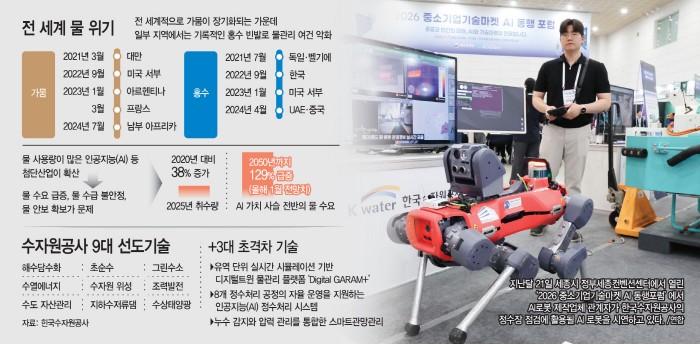
According to Global Water Intelligence (GWI) on May 21, global water withdrawals increased 38% last year compared with 2020 levels, while water demand across the AI value chain is projected to surge 129% by 2050. Rising industrial demand for water, combined with delayed infrastructure construction and prolonged droughts caused by climate change, has heightened concerns over global water security. In some regions, record-breaking floods are also becoming more frequent, further worsening water management conditions.
To address these challenges, climate technologies capable of replacing aging infrastructure are emerging as critical solutions.
One of K-water’s flagship overseas projects is the construction of an urban flood digital twin platform in Jeddah, Saudi Arabia’s second-largest city. The area has experienced frequent flash floods and faces increasing demand for improved sewage and drainage infrastructure. Based on the project’s performance, K-water plans to expand the platform to other Saudi cities.
In Japan, the city of Nagai — which suffered severe flooding during record rainfall in 2022 — has also partnered with K-water to introduce advanced digital twin technology amid concerns over weakening regional disaster response capacity caused by population decline and aging demographics. Following the successful completion of a disaster response showcase project, K-water secured Japanese government funding this year to move forward with a full-scale initiative, with potential expansion into other regions under consideration.
K-water’s AI water treatment plant technology is also gaining international recognition and moving toward global standardization. Using big data and artificial intelligence, the system autonomously operates water production and supply processes while optimizing energy management and predictive maintenance. The technology was previously selected as a “Global Lighthouse” project by the World Economic Forum.
The agency is currently applying the AI water treatment technology to a newly built water treatment facility in Nusantara, Indonesia’s future capital city, and plans to expand related business opportunities through further project development and technology proposals.
Alongside its overseas expansion, K-water is also working to strengthen South Korea’s domestic water industry ecosystem. The corporation has established a 525.4 billion won venture fund for water-related industries and supports technology development through integrated management of testing infrastructure as the nation’s lead test-bed operator.
At the “2026 SME Technology Market AI Partnership Forum” held in Sejong last month, an AI robotics company demonstrated inspection robots designed for use at K-water treatment facilities.
Speaking during the “47th International Environmental Industry & Green Energy Expo (ENVEX 2026),” Yoon Seok-dae said, “We will continue supporting technologically competitive small and medium-sized enterprises by connecting innovative water management technologies with industry demand, while strengthening the competitiveness of the water industry ecosystem and expanding growth opportunities for SMEs.”
#K-water #Korea Water Resources Corporation #water security #AI water treatment plant #digital twin
Copyright by Asiatoday
Most Read
-
1
Kia Sportage outperforms Mazda CX-5 in German auto..

-
2
Houthis launch successive attacks on Saudi airport..

-
3
Saudi Arabia, Iran hold first diplomatic talks to..

-
4
U.S. deploys carrier, 10,000 more troops to Middle..

-
5
Saudi airport in Riyadh struck again, leaving at l..

-
6
Putin's ally visits China on the 8th ahead of APEC..

-
7
Chinese military support and training center opens..

PEOPLE





HEADLINE NEWS

-
Address : In-Young Bldg., 34, Uisadang-daero 1-gil, Yeongdeungpo-gu, Seoul
Copyright by ASIATODAY CO., LTD. All rights resereved