



Driven out by Southeast Asian 'Crime Den' crackdown, fraud rings move to Sri Lanka
May 18, 2026, 04:27 pm


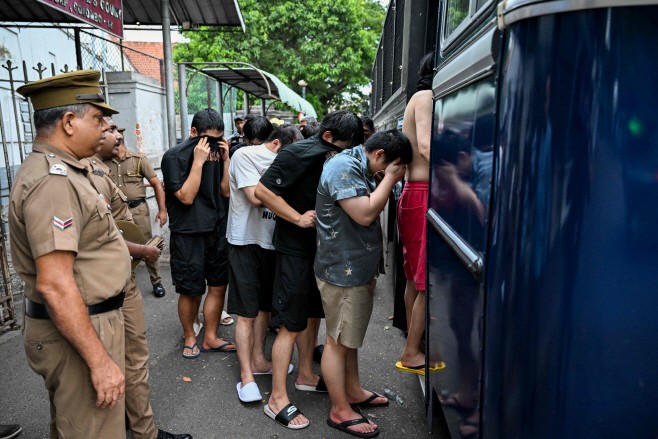 |
| Chinese suspects arrested on charges of operating a cyber scam base are escorted by prison guards to a detention center in Colombo, Sri Lanka, on May 9, local time. As massive crackdowns continue in Cambodia and Myanmar, scam networks are relocating their bases to Sri Lanka, leading to a sharp surge in arrests. /AFP via Yonhap News |
As crackdowns on scam syndicates intensify across Southeast Asia, online fraud networks that previously used Cambodia and Myanmar as their bases are relocating their operations to Sri Lanka, AFP reported on May 18, local time. Concerns are growing that Sri Lanka is emerging as a new scam hub, with the number of foreign scam suspects arrested in the first five months of this year alone more than doubling the figure for the entirety of last year.
Sri Lanka Police recently arrested over 1,000 foreigners since the beginning of this year on charges of involvement in cybercrime. Police spokesperson Fredrick Utler stated that the majority of those detained hold Chinese, Vietnamese, and Indian nationalities. This marks a sharp surge compared to 2024 when 430 people were arrested, and last year when the number was even lower.
What alarms authorities is not just the sheer scale of the arrests, but the shifting locus of the scam networks. Following massive crackdowns and forced deportations in Cambodia and Myanmar, evidence suggests that some syndicates are relocating their entire operations to Sri Lanka. Sri Lankan authorities point to the country's 30-day visa-free entry for more than 40 nations and stable, high-speed internet as major drawcards for these criminal rings. Indian and Chinese nationals are covered under the visa exemption scheme, while other nationalities can easily secure entry permits online.
The criminal enterprises relocating to Sri Lanka are setting up bases by renting everything from luxury villas to office complexes. Spokesperson Utler noted that during five joint raids conducted overnight last week in the southern coastal areas of Galle and Matara, 192 Indians and 29 Nepalese were detained. Just last week, 280 foreigners were apprehended near the capital, Colombo, and in March, 135 Chinese nationals were swept up at a single scam base. Police have recently begun warning property owners that they could face charges for aiding and abetting a crime if they rent villas or apartments to tenants suspected of running scam operations.
Last month, Sri Lankan customs intercepted nine Chinese nationals attempting to smuggle in hundreds of used mobile phones and laptops. Authorities are investigating under the suspicion that this equipment was destined for large-scale scam dens. Investigators are also looking into whether foreign fraud syndicates were involved in a recent cyberattack targeting the Sri Lankan Ministry of Finance, which resulted in the siphoning off of approximately $2.5 million.
The migration of these scam operations is a trend officially recognized by the Chinese government as well. The Chinese Embassy in Colombo said in a recent statement that illicit activities have been on the rise in Sri Lanka following tightened enforcement in Cambodia, Myanmar, and the United Arab Emirates (UAE). "The Chinese government attaches great importance to this trend," the embassy stated, adding that it would strengthen cooperation with Sri Lankan law enforcement.
Scam compounds across Southeast Asia have typically operated by luring internet users into romance scams, cryptocurrency investment frauds, and illegal gambling sites. While they initially targeted Chinese speakers, their focus has since expanded to other language groups. Some participants are voluntary accomplices, but others are foreign nationals trafficked and forced into labor. Sri Lankan authorities believe the bases within their borders are currently targeting victims across Asia, including India, Vietnam, and the Philippines, and express concern that their own citizens could soon become targets.
As the number of arrests skyrockets, immigration authorities have joined the front lines of the investigation. "With the number of cases handled by the police rising, our agents are being deployed directly," an immigration official told AFP. A United Nations report published this year estimated that at least 300,000 people have been trafficked into Southeast Asian scam centers. Sri Lankan authorities stated that no foreign nationals trafficked into Sri Lanka have been identified yet, though dozens of Sri Lankans who were rescued from overseas scam dens have returned home over the past year.
Most Read
-
1
Celltrion’s Omlyclo gains ground in major European..

-
2
Trump demands rates fall below 1% as Fed hikes for..

-
3
Trump makes $1 trillion bet ahead of midterm elect..

-
4
Iran resumes ballistic missile production, assembl..

-
5
Samsung Electronics, Mistral AI to jointly develop..

-
6
Trump warns countries not helping U.S. must pay re..

-
7
Apple launches first foldable, 1 million won prici..

PEOPLE






HEADLINE NEWS
- Trump to roll out ‘unprecedented welcome’ for Xi with B-2 bombers, F-22 fighters
- S. Korea, U.S., and Japan form united front on Taiwan and economic coercion..
- Trump administration moves to impose sweeping sanctions on International Cr..
- Xi to make state visit to U.S. Sept. 23-25, dispelling rumors over his heal..

-
Address : In-Young Bldg., 34, Uisadang-daero 1-gil, Yeongdeungpo-gu, Seoul
Copyright by ASIATODAY CO., LTD. All rights resereved