



Key variables emerge one month before local elections
May 04, 2026, 09:00 am


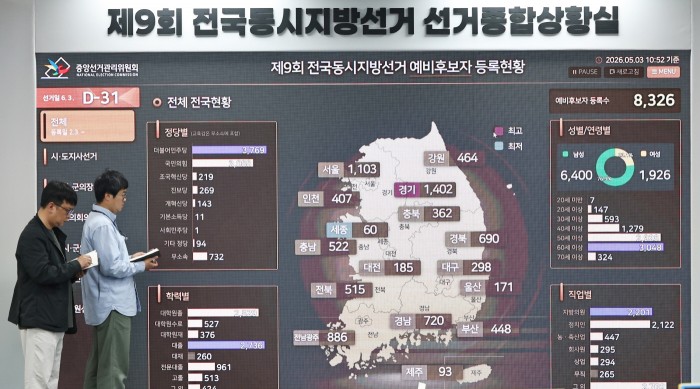 |
| Officials at the National Election Commission prepare for the upcoming local elections as key political variables emerge one month ahead of voting./ Yonhap |
With just one month remaining before South Korea’s local elections, political attention is increasingly focused on last-minute variables that could determine the fate of both the ruling and opposition parties.
Issues such as public sentiment on real estate, a controversial special prosecutor bill, conservative voter consolidation, and overall turnout are emerging as decisive factors that could reshape the electoral landscape.
In Seoul—widely seen as the most competitive battleground—real estate policy is expected to play a pivotal role.
Candidates from the Democratic Party of Korea and the People Power Party are intensifying policy competition to win over voters sensitive to housing issues.
Jung Won-oh has emphasized shortening redevelopment timelines, while Oh Se-hoon is focusing on expanding housing supply through deregulation.
Tax policy is also a potential swing factor. Debates over abolishing long-term holding tax deductions and the expiration of capital gains tax relief for multi-homeowners could significantly influence voter sentiment.
A bill proposed by the Democratic Party on April 30—aimed at enabling the cancellation of prosecutions through a special prosecutor—has quickly become a central campaign issue.
The Democratic Party argues that a special investigation is necessary following alleged prosecutorial misconduct under the current administration. It aims to pass the bill within May.
In contrast, the People Power Party has strongly opposed the proposal, warning that it could lead to the dismissal of cases involving President Lee Jae-myung. Party leaders have framed the issue as a matter of rule of law, intensifying political confrontation.
Another key variable is whether conservative voters will consolidate, particularly in traditional strongholds such as Busan, Ulsan, South Gyeongsang (Buul-Gyeong), and Daegu–North Gyeongsang (TK).
Recent polls suggest a potential narrowing of support gaps in some regions, raising the possibility of a “shy conservative” effect that could alter expectations of a landslide victory for the Democratic Party.
Voter turnout will also be critical. The 2022 local elections recorded a turnout of 50.9%, significantly lower than the 67% in the 2024 general election and 79.4% in the 21st presidential election.
While lower turnout is often seen as favorable to conservative parties and higher turnout to progressive ones, analysts say the decisive factor will be each party’s ability to mobilize its base.
Political analyst Park Sang-byung noted that the race could shift significantly in the final month, adding that in closely contested regions where margins are within five percentage points, outcomes could easily be reversed.
#South Korea election #local elections #Democratic Party #People Power Party
Copyright by Asiatoday
Most Read
-
1
Trump shares map on social media labeling Strait o..

-
2
Kia Sportage outperforms Mazda CX-5 in German auto..

-
3
Houthis launch successive attacks on Saudi airport..

-
4
U.S. deploys carrier, 10,000 more troops to Middle..

-
5
Trump rejects Iran's offer to open Strait of Hormu..

-
6
N. Korea conducts first swarm attack drill with dr..

-
7
U.S.-China summit falls short on substance as Trum..

PEOPLE





HEADLINE NEWS
- Seoul dismisses Ukraine's claim of 'S. Korean support for Russia' as "inaccurate and inappropriate"
- S. Korea, Japan race to develop nuclear-powered submarines
- Henri Kagan, Kenso Soai win Nobel Prize in Chemistry for uncovering how mol..
- Vance says Alaska LNG cooperation will move forward with Seoul's current or..

-
Address : In-Young Bldg., 34, Uisadang-daero 1-gil, Yeongdeungpo-gu, Seoul
Copyright by ASIATODAY CO., LTD. All rights resereved