



Kia bets big on EVs, robotics and future mobility
Apr 10, 2026, 09:19 am


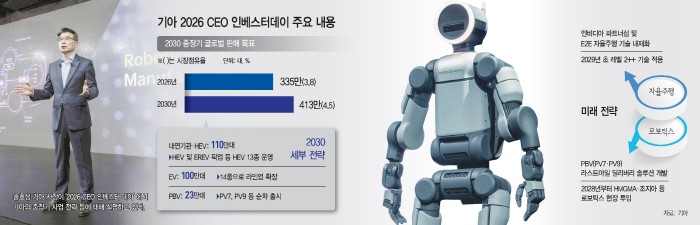 |
| Boston Dynamics’ humanoid robot Atlas appears on stage at Kia’s 2026 CEO Investor Day event. / Courtesy of Kia |
Kia Corporation is accelerating its transformation from a traditional automaker into a technology-driven mobility company, unveiling a 49 trillion won ($36 billion) investment plan to expand into future mobility sectors including electric vehicles, autonomous driving and robotics.
At its 2026 CEO Investor Day held in Seoul, Kia presented its mid- to long-term business strategy and financial roadmap, setting a target of selling 4.13 million vehicles globally by 2030 and achieving a 4.5% market share.
The company plans to maintain a dual-track strategy by expanding both electric vehicles (EVs) and hybrid electric vehicles (HEVs). HEV sales are expected to rise from 690,000 units in 2026 to 1.1 million units in 2030, with additional production capacity of 400,000 units. EV sales are targeted to reach 1 million units by 2030, with the lineup expanding from 11 models in 2026 to 14 models.
Beyond sales targets, Kia emphasized technological advancement. The company plans to introduce next-generation EV platforms to improve battery capacity, motor performance and energy density, while integrating autonomous driving and software capabilities.
Kia aims to complete development of its first software-defined vehicle (SDV) by the end of 2027. By early 2029, it plans to deploy “Level 2++” autonomous driving technology capable of operating on highways and in urban environments.
The first SDV will feature Kia’s proprietary architecture “CODA,” next-generation infotainment platform “Pleos Connect,” and in-vehicle agentic AI system “Gleo AI.”
To strengthen its autonomous driving capabilities, Kia will build a data alliance with Nvidia, leveraging real-world driving data collected from mass-produced vehicles to create a virtuous cycle of learning, performance improvement and product application.
Kia is also expanding its purpose-built vehicle (PBV) business, planning to launch the PV7 in 2027 and PV9 in 2029, with a target of selling 232,000 units by 2030. The company will operate its Hwaseong EVO plant as a dedicated PBV facility and establish a flexible production system through conversion centers and global partnerships.
In robotics, Kia is collaborating with Boston Dynamics to drive innovation in manufacturing and logistics. The humanoid robot Atlas is set to be deployed at Hyundai Motor Group’s Metaplant America in 2028, with expansion to Kia’s Georgia plant planned for the second half of 2029.
The company also aims to integrate PBVs with robotics for last-mile delivery solutions. For example, logistics robots such as Stretch could handle inventory and unloading tasks, while Spot robots may be used for doorstep deliveries.
Regionally, Kia outlined differentiated growth strategies. In the United States, it targets sales of 1.02 million units and a 6.2% market share by 2030, expanding its HEV lineup and entering the pickup truck segment. In Europe, Kia aims to sell 746,000 units with EVs accounting for 66% of sales. In emerging markets, particularly India, it plans to boost eco-friendly vehicle offerings and dealer networks to reach 1.48 million units in sales.
Of the total 49 trillion won investment planned between 2026 and 2030, 21 trillion won will be allocated to future businesses such as electrification, autonomous driving and robotics.
Kia CEO Song Ho-sung said, “Building on the innovations achieved over the past five years, we will grow at the fastest pace with EVs, HEVs, autonomous driving and robotics,” adding that the company will proactively respond to market changes despite growing global uncertainties.
#Kia #electric vehicles #SDV #autonomous driving #robotics
Copyright by Asiatoday
Most Read
-
1
Kia Sportage outperforms Mazda CX-5 in German auto..

-
2
Houthis launch successive attacks on Saudi airport..

-
3
Saudi Arabia, Iran hold first diplomatic talks to..

-
4
U.S. deploys carrier, 10,000 more troops to Middle..

-
5
Saudi airport in Riyadh struck again, leaving at l..

-
6
Putin's ally visits China on the 8th ahead of APEC..

-
7
Chinese military support and training center opens..

PEOPLE






HEADLINE NEWS

-
Address : In-Young Bldg., 34, Uisadang-daero 1-gil, Yeongdeungpo-gu, Seoul
Copyright by ASIATODAY CO., LTD. All rights resereved