



US investment bill seen as tariff turning point
Feb 05, 2026, 08:18 am


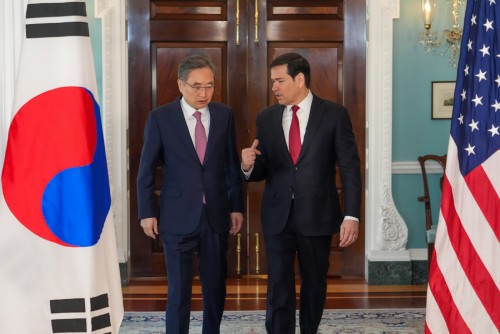 |
| South Korean Foreign Minister Cho Hyun (left) meets with U.S. Secretary of State Marco Rubio in Washington on Monday. / Ministry of Foreign Affairs |
South Korea’s efforts to defuse Washington’s renewed pressure to raise tariffs have yet to yield visible results, as discussions during a high-level diplomatic meeting failed to produce concrete progress.
Cho Hyun met with Marco Rubio in Washington on Monday in an attempt to ease U.S. demands for a tariff increase. According to the Foreign Ministry, Cho explained Seoul’s implementation of bilateral tariff agreements and its commitment to U.S.-bound investment, calling for continued communication and coordination between the two governments’ trade and diplomatic channels.
However, the U.S. State Department’s official readout of the meeting made no mention of tariffs. Instead, it said the two sides discussed ways to advance the alliance through forward-looking agendas, agreeing to closely cooperate on expanding South Korean investment in key U.S. industries such as civilian nuclear energy, nuclear-powered submarines and shipbuilding.
The lack of progress comes despite a full-scale diplomatic push by Seoul. After U.S. President Donald Trump issued a warning last month on social media about a possible tariff hike, South Korea dispatched its industry minister to Washington, followed by Cho’s visit as part of a broader effort to head off higher duties.
Cho is expected to continue lobbying U.S. officials during the remainder of his visit, including meetings with lawmakers on Capitol Hill to explain the legislative process surrounding South Korea’s special bill on U.S.-bound investment, which Seoul views as key to persuading Washington to reconsider the tariff move.
Some analysts believe the tariff pressure is aimed at accelerating passage of the investment bill, allowing U.S. authorities greater leverage in steering Korean capital toward preferred domestic projects. Others see the move as a signal not only to Seoul but also to Japan and the European Union.
There is also cautious optimism that the current standoff could ease if South Korea demonstrates tangible progress on the investment legislation. Observers note that Trump’s ultimate objective may be to showcase swift investment inflows rather than to dismantle existing tariff arrangements with Seoul.
Min Jung-hoon, a professor at the Korea National Diplomatic Academy, said raising tariffs to 25 percent would only increase uncertainty for Korean companies considering U.S. investment — an outcome Washington does not desire. “If Korea’s sincerity is conveyed, the process could be halted quickly at the president’s direction,” he said.
Meanwhile, the Democratic Party and the People Power Party agreed on Tuesday to form a special parliamentary committee to review the U.S. investment bill. The bill is scheduled to be taken up at a plenary session on Feb. 12.
The committee will consist of 16 members — eight from the Democratic Party, seven from the People Power Party and one from a minor party — with the chair to be held by a People Power Party lawmaker. The panel is set to be formally approved on Feb. 9 and will operate for one month to finalize the legislation.
#tariff pressure #US investment bill #Cho Hyun #Marco Rubio #US-Korea relations
Copyright by Asiatoday
Most Read
-
1
Trump shares map on social media labeling Strait o..

-
2
Kia Sportage outperforms Mazda CX-5 in German auto..

-
3
Houthis launch successive attacks on Saudi airport..

-
4
U.S. deploys carrier, 10,000 more troops to Middle..

-
5
Trump rejects Iran's offer to open Strait of Hormu..

-
6
N. Korea conducts first swarm attack drill with dr..

-
7
U.S.-China summit falls short on substance as Trum..

PEOPLE





HEADLINE NEWS
- Seoul dismisses Ukraine's claim of 'S. Korean support for Russia' as "inaccurate and inappropriate"
- S. Korea, Japan race to develop nuclear-powered submarines
- Henri Kagan, Kenso Soai win Nobel Prize in Chemistry for uncovering how mol..
- Vance says Alaska LNG cooperation will move forward with Seoul's current or..

-
Address : In-Young Bldg., 34, Uisadang-daero 1-gil, Yeongdeungpo-gu, Seoul
Copyright by ASIATODAY CO., LTD. All rights resereved