



PPP struggles as elections near
Feb 05, 2026, 08:18 am


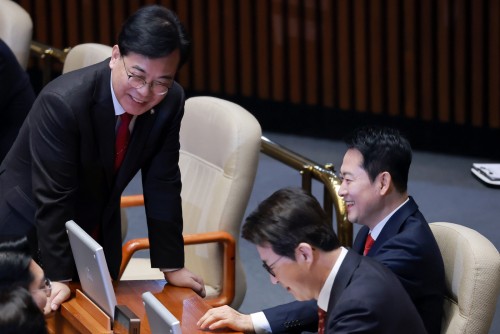 |
| Jang Dong-hyuk, leader of the People Power Party, talks with floor leader Song Eon-seok during a plenary session at the National Assembly on Tuesday. / Yonhap |
With local elections just four months away, South Korea’s main opposition People Power Party is facing mounting criticism for failing to regain political momentum or present a clear exit strategy.
Political observers say the party has struggled to maintain initiative in its confrontation with the ruling camp, leading to a visible erosion of its presence as the largest opposition force. According to political sources on Tuesday, the party has made little progress in pushing for the appointment of so-called “dual special prosecutors” to probe allegations involving the Democratic Party, including controversies linked to the Unification Church and alleged election nomination donations.
The People Power Party has also attempted to counter the ruling party’s judicial reform bills through filibusters, but analysts say such tactics have proven insufficient to block legislation in plenary sessions. With the Democratic Party holding a parliamentary majority and controlling key standing committees, including the Legislation and Judiciary Committee, the opposition has been left with limited tools to effectively check the government’s agenda.
Efforts to forge broader conservative alliances have likewise stalled. Lee Jun-seok, leader of the Reform Party, and Jang Dong-hyuk of the People Power Party had pledged cooperation centered on the dual special prosecutor issue, but tangible results have yet to materialize. Appearing on an MBC radio program Tuesday, Lee questioned the value of an electoral alliance, saying his party had little to gain from cooperating in elections and had no interest in such arrangements.
Internal divisions are further weighing on the party. Prolonged infighting over the proposed expulsion of former leader Han Dong-hoon has significantly weakened party cohesion. A recent lawmakers’ meeting convened to discuss the issue reportedly devolved into open confrontation, with poor attendance highlighting the party’s fractured state. Floor leader Song Eon-seok even remarked wryly that there were “no colleagues left to shake hands with,” underscoring the grim internal mood.
The timing of the turmoil has heightened concern, as it comes just months before the June 3 local elections. Instead of rallying as a unified bloc to prepare for the vote and challenge the ruling party, critics warn that internal discord and a loss of momentum are deepening.
Calls for a strategic shift within the leadership are growing louder. Veteran lawmaker Cho Kyung-tae, a six-term member of the National Assembly, said on a CBS radio program that the party stands at a crossroads between rebuilding itself or facing a difficult path in the upcoming elections. “The golden time is from February to early March,” he said, warning that without a decisive change in direction from the leadership, local election candidates could mount strong resistance and backlash.
As the electoral clock ticks down, the People Power Party faces increasing pressure to resolve its internal rifts and articulate a clearer strategy if it hopes to regain relevance ahead of the polls.
#People Power Party #local elections #special prosecutors #opposition alliance #party infighting
Copyright by Asiatoday
Most Read
-
1
Trump shares map on social media labeling Strait o..

-
2
Kia Sportage outperforms Mazda CX-5 in German auto..

-
3
Houthis launch successive attacks on Saudi airport..

-
4
U.S. deploys carrier, 10,000 more troops to Middle..

-
5
Trump rejects Iran's offer to open Strait of Hormu..

-
6
N. Korea conducts first swarm attack drill with dr..

-
7
U.S.-China summit falls short on substance as Trum..

PEOPLE





HEADLINE NEWS
- Seoul dismisses Ukraine's claim of 'S. Korean support for Russia' as "inaccurate and inappropriate"
- S. Korea, Japan race to develop nuclear-powered submarines
- Henri Kagan, Kenso Soai win Nobel Prize in Chemistry for uncovering how mol..
- Vance says Alaska LNG cooperation will move forward with Seoul's current or..

-
Address : In-Young Bldg., 34, Uisadang-daero 1-gil, Yeongdeungpo-gu, Seoul
Copyright by ASIATODAY CO., LTD. All rights resereved