



Jeong’s leadership tested despite vote reform
Feb 05, 2026, 08:18 am


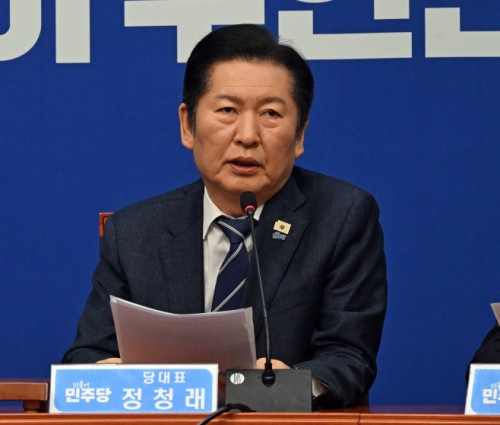 |
| Jeong Cheong-rae, leader of the Democratic Party, speaks at a Supreme Council meeting at the National Assembly on Tuesday. / Song Eui-joo |
Despite the passage of the “one member, one vote” system, the leadership of Jeong Cheong-rae, head of the Democratic Party, remains on shaky ground.
Although the party’s central committee approved the reform, analysts point to a sharp drop in the approval rate as a warning sign for Jeong’s leadership. Support for the measure stood at 60.6 percent, down more than 12 percentage points from late last year, prompting interpretations that party officials were signaling resistance to what they see as Jeong’s increasingly unilateral style.
According to political sources on Tuesday, the central committee passed the proposal to introduce the one-member, one-vote system the previous day, roughly two months after an earlier attempt failed due to insufficient quorum. Following the vote, Jeong said the decision marked “a full stop” to calls for a party where “members are the true owners.”
The reform has long been controversial within the party, with critics arguing it serves Jeong’s personal political ambitions. Having been elected party leader on the back of strong support from rank-and-file members, Jeong is widely seen as benefiting from the system should he seek another term.
Skepticism over his leadership has intensified because of the declining approval rate. While the revised party rules passed with 60.6 percent in favor and 39.4 percent against, the margin narrowed significantly from the December vote, when support stood at 72.7 percent.
Party leaders had attempted to address concerns raised after the earlier rejection by offering additional discussions and compensatory measures for strategic regions such as Yeongnam. However, those efforts failed to reverse sentiment among central committee members. Responding to the criticism, Jeong downplayed the significance of the numbers, saying, “Whether you win a soccer match 1–0 or 3–0, a win is still a win,” adding that he was not deeply troubled by the approval rate.
Political observers attribute the weakening support in part to Jeong’s handling of a proposed merger with the Innovation Party. Critics argue that Jeong pushed the idea without sufficient internal consultation, fueling accusations of unilateral decision-making. Discontent over the merger proposal has since surfaced across the party.
A first-term Democratic Party lawmaker said many within the party question the timing of the merger initiative. “People keep asking, ‘Why now?’ It leads to suspicion that the party leader is pursuing his own political agenda,” the lawmaker said. “The lower approval rate for the one-member, one-vote system appears to reflect pushback or a form of restraint by central committee members.”
While the reform clears a procedural hurdle for Jeong’s future leadership ambitions, the vote has underscored persistent internal resistance that could complicate his ability to steer the party through upcoming challenges.
#Jeong Cheong-rae #Democratic Party #one member one vote #party leadership #internal dissent
Copyright by Asiatoday
Most Read
-
1
Trump shares map on social media labeling Strait o..

-
2
Kia Sportage outperforms Mazda CX-5 in German auto..

-
3
Houthis launch successive attacks on Saudi airport..

-
4
U.S. deploys carrier, 10,000 more troops to Middle..

-
5
Trump rejects Iran's offer to open Strait of Hormu..

-
6
N. Korea conducts first swarm attack drill with dr..

-
7
U.S.-China summit falls short on substance as Trum..

PEOPLE






HEADLINE NEWS
- Seoul dismisses Ukraine's claim of 'S. Korean support for Russia' as "inaccurate and inappropriate"
- S. Korea, Japan race to develop nuclear-powered submarines
- Henri Kagan, Kenso Soai win Nobel Prize in Chemistry for uncovering how mol..
- Vance says Alaska LNG cooperation will move forward with Seoul's current or..

-
Address : In-Young Bldg., 34, Uisadang-daero 1-gil, Yeongdeungpo-gu, Seoul
Copyright by ASIATODAY CO., LTD. All rights resereved