



Samsung redraws supply map under Lee
Feb 05, 2026, 08:18 am


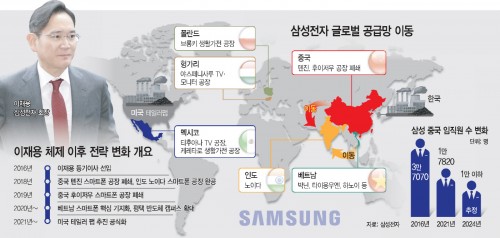 |
The year 2016, when Lee Jae-yong stepped fully into management as a registered director of Samsung Electronics, marked a turning point in the company’s manufacturing history. Over the past decade, Samsung has moved away from the expansion-driven strategy of the late Lee Kun-hee era toward a sweeping overhaul of its global supply chain, guided by pragmatism and a focus on securing future technologies.
At the core of this shift was a bold reduction of China’s role as Samsung’s manufacturing base. Once heavily reliant on what was known as the “world’s factory,” the company reorganized its production belt around Vietnam and India, while positioning the United States and South Korea as hubs for advanced manufacturing and core technologies. Analysts describe the move as a strategic redeployment that reflects both geopolitical risks and changes in cost structures, rather than a simple factory relocation.
According to Samsung’s sustainability reports, the number of employees in China fell from 37,070 in 2016 to fewer than 10,000 by the end of 2024, down sharply from nearly 60,000 in 2013. As Samsung’s smartphone market share in China plunged to near zero and labor costs surged, the company opted to withdraw rather than absorb continued losses, closing its Tianjin plant in 2018 and its Huizhou factory in 2019.
Experts see the decision as a preemptive response to shifting conditions. “More than a decade ago, there were signs that Chinese authorities and companies were pushing foreign firms out while internalizing assets and technology,” said Hwang Yong-sik, a professor of business administration at Sejong University. “Samsung quickly read the deteriorating business environment and moved its manufacturing axis to Southeast Asia, where efficiency was higher.”
Vietnam and India have since filled the gap. Samsung now produces more than half of its Galaxy smartphones at its Bac Ninh and Thai Nguyen complexes in Vietnam, while its Noida plant in India serves both domestic demand and exports. Although Samsung’s total workforce across Asia, including China, fell by more than 40% from 170,000 in 2016 to 95,501 in 2024, production capacity has been maintained or expanded. The company replaced labor-intensive processes with smart factories and automation, boosting productivity per worker and reinforcing profitability.
While consumer electronics manufacturing shifted to Southeast Asia and India, Samsung’s semiconductor footprint expanded in the United States in line with Washington’s reshoring push. The Taylor, Texas foundry, approved for investment in 2021 and scheduled to begin operations within the year, reflects U.S. efforts to classify semiconductors as a national security industry and reduce reliance on overseas supply chains.
Pressure to restructure supply chains intensified under the first Trump administration through high tariffs on Chinese products and continued under subsequent administrations via semiconductor subsidies and incentives for local production. “U.S. reshoring policies were signaled as early as Trump’s first term,” Hwang said. “Samsung accurately read the geopolitical landscape and tariff pressures, and made proactive decisions.”
The Taylor facility is also seen as a strategic investment to meet growing U.S. demand for advanced chips. Built around cutting-edge logic processes, the plant is expected to serve North American customers as demand surges for AI accelerators and autonomous driving semiconductors. With companies such as Nvidia, AMD, and Tesla seeking to diversify supply chains, industry watchers say Samsung aims to strengthen its competitiveness in next-generation chip orders by narrowing physical distance to customers.
Meanwhile, South Korea’s role as Samsung’s “mother factory” has grown stronger. Domestic employment rose from about 93,000 in 2016 to a record 125,297 in 2024, reflecting a structural shift from labor-intensive finished products toward technology-intensive semiconductors and research and development.
“Samsung has always moved with future industrial change in mind,” Hwang said. “Its current competitiveness is the result of proactive judgment and decisive action.”
#Lee Jae-yong #Samsung Electronics #global supply chain #Vietnam manufacturing #India manufacturing
Copyright by Asiatoday
Most Read
-
1
Kia Sportage outperforms Mazda CX-5 in German auto..

-
2
Houthis launch successive attacks on Saudi airport..

-
3
Saudi Arabia, Iran hold first diplomatic talks to..

-
4
U.S. deploys carrier, 10,000 more troops to Middle..

-
5
Saudi airport in Riyadh struck again, leaving at l..

-
6
Putin's ally visits China on the 8th ahead of APEC..

-
7
Chinese military support and training center opens..

PEOPLE






HEADLINE NEWS

-
Address : In-Young Bldg., 34, Uisadang-daero 1-gil, Yeongdeungpo-gu, Seoul
Copyright by ASIATODAY CO., LTD. All rights resereved