



Property tax hike returns, even single-home owners targeted
Feb 05, 2026, 08:18 am


 |
As the Lee Jae-myung administration makes its intention to “normalize” the real estate market increasingly clear, the housing market in Seoul and the wider metropolitan area has entered a state of heightened tension. With the president himself repeatedly warning of the dangers of what he calls “real estate-driven national decline,” market participants are closely watching for sweeping policy shifts across the tax system. Homeowners, meanwhile, are reassessing their strategies in anticipation of potential changes.
Historically, South Korea has seen sharp swings in housing taxation whenever power shifts from conservative to progressive governments. With recent signs of renewed price instability in Seoul, concerns are growing that another round of high-intensity tax reforms may be imminent. Although the government has unveiled supply-oriented measures such as the “Jan. 29 package,” critics argue that the lack of a concrete execution roadmap undermines confidence in their effectiveness. Without credible follow-through, analysts warn, the market could face prolonged stagnation rather than stabilization.
According to government and industry sources on Tuesday, attention is now focused on the next policy move as the temporary suspension of higher capital gains taxes for multi-home owners is set to expire in May. President Lee has made it clear that an extension is off the table, stating on social media that the expiration “is already decided” and warning that expectations of further legal revisions are misplaced. At a Cabinet meeting on Monday, he went further, describing real estate problems as a “cancer that obstructs social development” and calling the moment a “last chance” for reform.
As pressure on multi-home owners intensifies, market unease is growing that the familiar cycle of regulatory tightening could repeat itself. In past transitions to progressive administrations, aggressive tax overhauls have consistently followed, fueling both hopes for price stability and fears of excessive regulation.
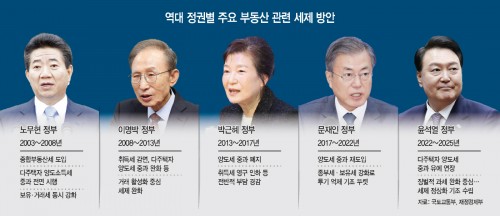
Previous governments offer a clear contrast. The Roh Moo-hyun administration introduced the comprehensive real estate holding tax in 2005 and fully implemented heavier capital gains taxes on multiple homeowners in 2007. After the global financial crisis, the Lee Myung-bak government shifted toward stimulating transactions through tax cuts, a stance largely maintained under the Park Geun-hye administration. The Moon Jae-in government reversed course in 2017, reinstating stricter capital gains taxes through its “Aug. 2 measures,” while the Yoon Suk Yeol administration later eased what it called “punitive taxation” by extending tax relief for multiple homeowners.
Despite President Lee’s campaign pledge not to rely on taxes to curb housing prices, persistent market volatility appears to be nudging policy back toward demand suppression. Prime Minister Kim Min-seok recently noted that while the government prefers not to rely on taxation, it would not rule out fiscal or financial tools to address “excessive and unreasonable demand.”
Against this backdrop, market observers expect a so-called “package deal” approach: easing transaction taxes while strengthening and differentiating holding taxes. This could mean maintaining or refining capital gains taxes for multiple homeowners while partially lowering acquisition or transaction burdens. At the same time, holding taxes could be tightened through more finely segmented assessed value brackets, heavier progressive rates on high-priced homes, and differentiated treatment based on actual occupancy. Such measures would likely bring even high-value single-home owners — often described as pursuing a “one-home strategy” — into the policy spotlight.
Experts caution, however, that abrupt tax changes could backfire. With lingering doubts over the feasibility of the government’s supply measures, tightening demand without firm assurances on housing supply could further freeze listings and suppress transactions, deepening market rigidity rather than resolving it.
#real estate #property tax #holding tax #capital gains tax #multiple homeowners
Copyright by Asiatoday
Most Read
-
1
Celltrion’s Omlyclo gains ground in major European..

-
2
Trump demands rates fall below 1% as Fed hikes for..

-
3
Trump makes $1 trillion bet ahead of midterm elect..

-
4
Iran resumes ballistic missile production, assembl..

-
5
Trump warns countries not helping U.S. must pay re..

-
6
Apple launches first foldable, 1 million won prici..

-
7
Turkish Airlines named main club partner of Liverp..

PEOPLE







-
Address : In-Young Bldg., 34, Uisadang-daero 1-gil, Yeongdeungpo-gu, Seoul
Copyright by ASIATODAY CO., LTD. All rights resereved