



Eco-friendly vehicles push auto exports to record high
Jan 16, 2026, 07:53 am


 |
South Korea’s automobile exports hit a new all-time high last year, powered by strong growth in eco-friendly vehicles, even as U.S. tariffs reshaped global trade flows.
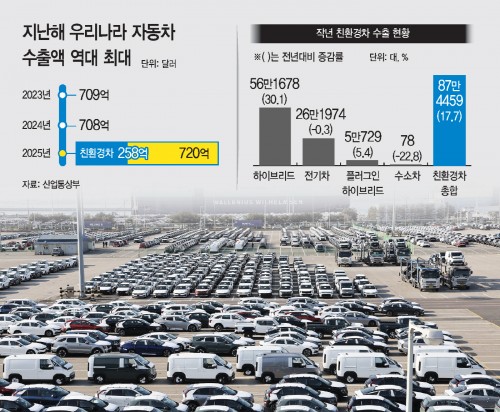
According to the 2025 automotive industry outlook released Thursday by the Ministry of Trade Industry and Energy, total vehicle exports reached $72 billion in 2025, up 1.9% from a year earlier. The figure marks a fresh record and the third consecutive year that exports have exceeded $70 billion.
Eco-friendly vehicles led the surge. Exports of environmentally friendly cars totaled $25.8 billion, an 11% increase year on year. Despite a slowdown in global electric vehicle demand, often described as a market “chasm,” hybrid vehicle exports jumped 30% to a record $14.8 billion. Analysts say hybrids have emerged as a practical alternative during the transition to full electrification.
By volume, exports of eco-friendly vehicles rose 17.7% to 874,459 units. Hybrids accounted for the largest share at 561,678 units, followed by electric vehicles at 261,974 units.
Used-car exports also emerged as a new growth engine. Overseas shipments of used vehicles soared 75.1% from the previous year to a record $8.87 billion, driven by rising confidence in Korean vehicle quality, a weaker won, and rerouted demand following the Russia–Ukraine war.
Domestic vehicle production slipped 0.6% to 4.1 million units, but remained above 4 million for a third straight year. About 67% of production, or 2.74 million vehicles, was exported. The most-exported models included the Chevrolet Trax, Hyundai Kona, and Hyundai Avante.
Exports remained resilient despite pressure from U.S. tariffs. Since April last year, the United States has imposed a 25% tariff on Korean automobiles, weighing on shipments. In response, automakers diversified export destinations toward Europe, Asia, and Latin America.
As a result, exports to the U.S. fell 13.2% to $30.15 billion. In contrast, exports to Asia surged 31.9% to $7.75 billion, shipments to the European Union climbed 20.1% to $9.68 billion, and exports to other European markets rose 30.5% to $6.2 billion.
Industry officials say the shift marks a turning point away from heavy reliance on the U.S. market, strengthening long-term competitiveness amid growing global trade uncertainty.
The government plans to sustain export momentum this year through expanded tariff-response measures and market diversification. Support will focus on North America-facing exporters, while trade vouchers, insurance discounts for parts suppliers, and expanded logistics hubs are expected to help buffer tariff impacts.
A ministry official said that while challenges such as protectionism and intensifying global competition remain, the government will continue implementing its K-mobility strategy to bolster future competitiveness and export growth.
#South Korea #auto exports #eco-friendly vehicles #hybrid cars #electric vehicles
Copyright by Asiatoday
Most Read
-
1
Kia Sportage outperforms Mazda CX-5 in German auto..

-
2
Houthis launch successive attacks on Saudi airport..

-
3
Saudi Arabia, Iran hold first diplomatic talks to..

-
4
U.S. deploys carrier, 10,000 more troops to Middle..

-
5
Saudi airport in Riyadh struck again, leaving at l..

-
6
Putin's ally visits China on the 8th ahead of APEC..

-
7
Chinese military support and training center opens..

PEOPLE






HEADLINE NEWS

-
Address : In-Young Bldg., 34, Uisadang-daero 1-gil, Yeongdeungpo-gu, Seoul
Copyright by ASIATODAY CO., LTD. All rights resereved