



Medical school expansion to feed regional doctor program
Jan 14, 2026, 08:06 am


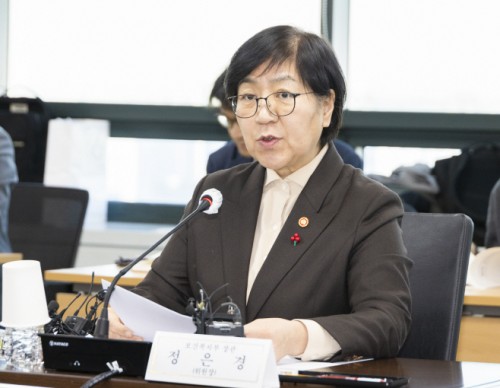 |
| Health and Welfare Minister Jeong Eun-kyeong speaks at the third meeting of the Health and Medical Policy Deliberation Committee in Seocho District, Seoul, on Jan. 13. / Ministry of Health and Welfare |
South Korea’s Ministry of Health and Welfare on Jan. 13 discussed a plan to apply all future increases in medical school enrollment, starting in 2027, to the regional doctor program, underscoring its goal of strengthening regional, essential, and public healthcare.
At a meeting of the Health and Medical Policy Deliberation Committee held in Seocho District, Seoul, the ministry reviewed how to apply workforce expansion after 2027 by respecting projections from the physician workforce supply-and-demand estimation committee. The discussion focused on allocating the entire post-2027 increase to regional doctor quotas.
The move is intended to operationalize the committee’s first evaluation criterion discussed at its initial meeting—addressing regional healthcare disparities and shortages in essential and public medical services.
Participants also agreed to factor in the scale and timing of workforce training tied to the proposed establishment of a public medical academy and the creation of medical schools in regions without one. In addition, the committee decided to incorporate future changes in the medical environment and healthcare policy by considering all combinations of the three demand models and two supply models adopted by the estimation committee.
Regarding educational quality—the fourth evaluation criterion—the committee discussed keeping year-on-year changes in 2027 admissions below a certain threshold compared with the 2026 intake of 3,058 students, while ensuring small medical schools can secure adequate class sizes. Officials also said they would consider the current situation in which students admitted in 2024 and 2025 are attending classes together.
On predictability and stability, the committee reviewed a plan to apply quotas derived from the 2025 workforce estimates for five years, from the 2027 to 2031 academic years. Taking into account that students admitted during that period would graduate between 2033 and 2037, 2037 was discussed as the benchmark year for workforce management. The next workforce estimation would be conducted in 2029, aligned with the next quota application cycle beginning in 2032 and the advance notice system for college admissions.
The committee plans to submit multiple quota scenarios reflecting these discussions at its next meeting.
Minister Jeong said the government would continue discussions with the ultimate aim of reinforcing regional, essential, and public healthcare, “without becoming fixated on headcounts or numbers alone.”
#medical school quota expansion #regional doctor program #public healthcare #essential care #Health and Medical Policy Deliberation Committee
Copyright by Asiatoday
Most Read
-
1
Celltrion nears additional contract with major U.S..

-
2
Putin proposes trilateral U.S.-China-Russia summit..

-
3
U.S. weighs dropping MOAB, world's most powerful n..

-
4
"Aren't those foreigners on welfare?": M..

-
5
Attention centers on APEC for possible Trump-Xi-Pu..

-
6
Saudi Arabia, Iran hold first diplomatic talks to..

-
7
U.S., Israel plan to resume strikes on Iran after..

PEOPLE







-
Address : In-Young Bldg., 34, Uisadang-daero 1-gil, Yeongdeungpo-gu, Seoul
Copyright by ASIATODAY CO., LTD. All rights resereved