



Lee warns of cult harm, religious leaders back dissolution
Jan 13, 2026, 07:55 am


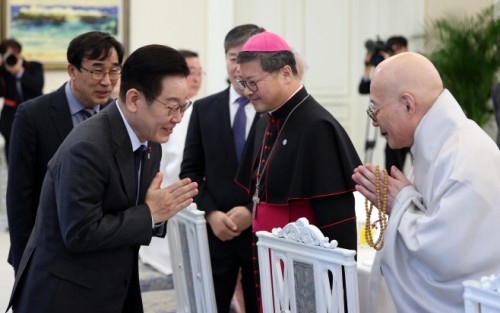 |
| President Lee Jae-myung greets Ven. Jinwoo, chief administrator of the Jogye Order of Korean Buddhism, during a luncheon meeting with religious leaders at Cheong Wa Dae on Monday. At center is Archbishop Peter Chung Soon-taick of the Archdiocese of Seoul. / Yonhap News |
President Lee Jae-myung on Monday acknowledged growing public concern over the social damage caused by pseudo-religious groups, saying the issue has been neglected for too long, as leaders of the nation’s major faiths voiced support for strong measures — including dissolution — against groups that harm citizens.
Lee made the remarks during a luncheon meeting at Cheong Wa Dae with leaders representing seven major religious traditions. According to a written briefing by presidential spokesperson Kang Yoo-jung, the president agreed with calls from religious figures to deal firmly with groups such as the Unification Church and Shincheonji Church of Jesus, which they said go beyond church–state entanglement and inflict serious harm on people’s daily lives.
“This is a truly difficult subject, but the harm these groups cause to our society has been left unattended for far too long,” Lee was quoted as saying. “The damage has become very serious.”
Religious leaders at the meeting argued that the public would support dissolving religious organizations that undermine the state and harm citizens, and urged the government to consider using the assets of problematic foundations to compensate victims of pseudo-religious groups. Lee did not offer a specific response to those proposals, according to the briefing.
The president also asked religious communities to take an active role in addressing key national issues, including livelihoods and peace on the Korean Peninsula. “On matters tied to the survival of the national community, such as diplomacy and security, it would be helpful if you could help draw clear lines so they do not become subjects of political strife,” he said. When religious leaders replied, “That is our responsibility,” Lee responded, “It is our responsibility.”
Expressing concern over rising social divisions, Lee said hatred and hostility appear to be increasing across society. “One of the most important duties of the president is to unite the people,” he said, adding that while he is making efforts, there are limits. He pledged to work toward a society marked by reconciliation, forgiveness and inclusion.
Ven. Jinwoo, head of the Jogye Order and co-chair of the Korean Conference of Religions for Peace, spoke on behalf of the attendees, stressing that “the security of people’s hearts is as important as national security.” He pointed to South Korea’s high suicide rate, ultra-low birthrate, rapid aging and low happiness index as signs of deep public fatigue, saying that while the government provides institutional support, religious communities should help ensure emotional and spiritual well-being.
Jinwoo added that religious leaders aim to cooperate in shared areas such as meditation and mental healing while respecting each tradition’s beliefs. He also praised Lee’s crisis management and governance, saying public recognition has grown that the administration is exercising balanced judgment and responsible execution across diplomacy, defense, the economy and culture.
Participants further commended Lee for highlighting the dangers of xenophobia and hatred, warning that hostility toward migrants could become fertile ground for fascism, and said many citizens would support efforts to reject hatred and division.
#Lee Jae-myung #pseudo-religion #cults #religious leaders
Copyright by Asiatoday
Most Read
-
1
Trump shares map on social media labeling Strait o..

-
2
Kia Sportage outperforms Mazda CX-5 in German auto..

-
3
Houthis launch successive attacks on Saudi airport..

-
4
U.S. deploys carrier, 10,000 more troops to Middle..

-
5
Trump rejects Iran's offer to open Strait of Hormu..

-
6
N. Korea conducts first swarm attack drill with dr..

-
7
U.S.-China summit falls short on substance as Trum..

PEOPLE



HEADLINE NEWS
- Seoul dismisses Ukraine's claim of 'S. Korean support for Russia' as "inaccurate and inappropriate"
- S. Korea, Japan race to develop nuclear-powered submarines
- Henri Kagan, Kenso Soai win Nobel Prize in Chemistry for uncovering how mol..
- Vance says Alaska LNG cooperation will move forward with Seoul's current or..

-
Address : In-Young Bldg., 34, Uisadang-daero 1-gil, Yeongdeungpo-gu, Seoul
Copyright by ASIATODAY CO., LTD. All rights resereved