



Yoon faces key rulings in packed trial week
Jan 12, 2026, 07:50 am


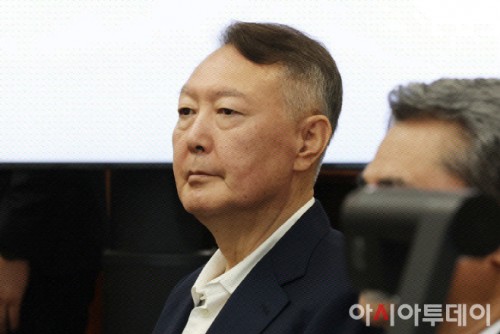 |
| Former President Yoon Suk-yeol arrives at the Seoul Central District Court in Seocho-gu, Seoul, on Sept. 26 last year, to attend a trial on charges including obstruction of official duties. / Joint Press Pool |
This week will see the first court ruling related to charges of obstructing arrest among the eight criminal cases involving former President Yoon Suk-yeol. Proceedings will also move forward in the core case tied to the Dec. 3 martial law declaration, with the final hearing for the charge of leading an insurrection scheduled as well.
According to legal sources on Jan. 11, the Seoul Central District Court’s Criminal Division 35, presided over by Judge Baek Dae-hyun, will deliver its first-instance verdict at 2 p.m. on Jan. 16 in Yoon’s case involving charges of special obstruction of official duties and abuse of authority. This will mark the first sentencing among four trials related to the alleged insurrection.
At the sentencing hearing on Dec. 26, the special counsel team led by Cho Eun-seok sought a combined 10-year prison term for Yoon. Prosecutors requested five years for obstructing arrest, three years for alleged destruction of evidence involving encrypted phones, and two years for drafting a post hoc martial law proclamation.
Meanwhile, the final hearing in the main case—charging Yoon as the ringleader of the Dec. 3 martial law insurrection—will be held on Jan. 13 by the court’s Criminal Division 25, chaired by Judge Ji Gwi-yeon.
Although prosecutors had initially planned to present their final sentencing demand at a hearing on Jan. 9, proceedings were delayed after the defense for former Defense Minister Kim Yong-hyun spent nearly eight hours reviewing documentary evidence. An additional session was therefore scheduled. The Jan. 13 hearing could also run late into the evening, as Yoon’s legal team has signaled plans for extended evidence review and final arguments.
Public attention is also focused on the punishment prosecutors will seek. On Jan. 8, the special counsel team reportedly held a six-hour internal meeting to discuss sentencing options, during which opinions ranging from the death penalty to life imprisonment were considered. Under South Korean law, the statutory penalties for leading an insurrection are limited to death, life imprisonment, or life imprisonment without labor. Prosecutors sought the death penalty for former President Chun Doo-hwan on the same charge 30 years ago.
Another trial linked to the so-called “Pyongyang drone allegation” will also take place this week. On Jan. 12, the Seoul Central District Court’s Criminal Division 36, headed by Judge Lee Jeong-yeop, will hear a case charging Yoon, Kim Yong-hyun, and former Counterintelligence Commander Yeo In-hyung with general treason and abuse of authority. The allegation centers on claims that Yoon ordered drones to be sent to Pyongyang in October 2024 to heighten military tensions with North Korea and use the situation to justify declaring martial law.
In addition, on Jan. 13, the court’s Criminal Division 32, presided over by Judge Ryu Kyung-jin, will hold the first preparatory hearing for a separate case accusing Yoon of perjury in connection with a Cabinet meeting held during the martial law declaration.
#Yoon Suk-yeol #martial law #insurrection charges #obstruction of arrest #sentencing
Copyright by Asiatoday
Most Read
-
1
Celltrion’s Omlyclo gains ground in major European..

-
2
Trump demands rates fall below 1% as Fed hikes for..

-
3
Hyundai Motor Group breaks ground on integrated st..

-
4
U.S. strikes 3 Iranian oil tankers, Iran vows reta..

-
5
Trump makes $1 trillion bet ahead of midterm elect..

-
6
Iran resumes ballistic missile production, assembl..

-
7
Samsung Electronics, Mistral AI to jointly develop..

PEOPLE





-
Address : In-Young Bldg., 34, Uisadang-daero 1-gil, Yeongdeungpo-gu, Seoul
Copyright by ASIATODAY CO., LTD. All rights resereved