



Police face criticism for dragging feet on ruling party probes
Jan 08, 2026, 08:08 am


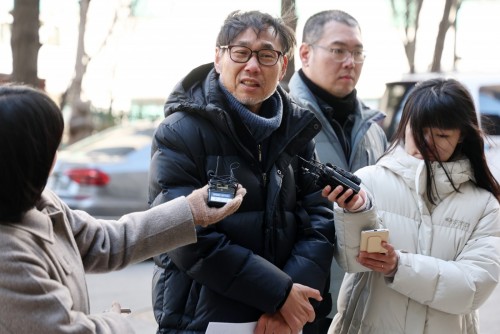 |
| Kim Soon-hwan, secretary general of the civic group People’s Livelihood Countermeasures Committee, enters the Seoul Metropolitan Police Agency’s Public Crime Investigation Division on Jan. 7 to be questioned as a complainant over allegations involving Democratic Party lawmaker Kim Byung-gi. / Yonhap |
South Korean police are facing mounting criticism for dragging their feet on investigations involving key ruling-party figures, fueling concerns that law enforcement is shrinking before political power despite repeated pledges of neutrality.
Several cases tied to prominent members of the ruling camp have remained stalled for months, with police failing to formally book suspects or assign investigations after receiving complaints. Critics say the delays suggest that police, now responsible for most criminal investigations following the full separation of investigation and prosecution, are acting with excessive caution toward the government and the ruling party.
The Seoul Metropolitan Police Agency’s Public Crime Investigation Division said it began probing allegations involving Democratic Party lawmaker Kim Byung-gi on Jan. 4, including claims that he interfered in his son’s transfer to Soongsil University. However, the original complaint was filed at a local police station in September last year, with no significant progress for more than three months. Additional petitions alleging bribery in party nominations were also reportedly left unaddressed without formal booking or case assignment.
In another case, the investigation into allegations that independent lawmaker Kang Sun-woo, formerly of the Democratic Party, accepted illegal nomination funds has drawn scrutiny after a key figure left the country. Kim Kyung, a Seoul city council member accused of delivering 100 million won in exchange for a nomination, departed for the United States late last month. Police had not imposed a travel ban and only requested notification upon re-entry after learning of his departure.
Police explained that the travel occurred before the case was formally accepted and that limited coordination time over a weekend hampered preventive measures. Critics, however, note that other related complaints against Kim had also been left unattended for months.
The pattern has raised broader questions about investigative fairness. Observers argue that delays heighten the risk of evidence destruction, false testimony and coordinated cover-ups, while weakening investigators’ ability to secure suspects and maintain control over cases.
The controversy stands in contrast to New Year remarks by Acting National Police Agency Commissioner Yoo Jae-sung, who vowed to enhance professionalism, speed, fairness and accountability in police investigations until the public is satisfied and reassured.
Legal experts warn that repeated hesitation in politically sensitive cases could erode trust in the police’s claim of political neutrality. “If this pattern continues, the police will lose credibility altogether,” one judicial specialist said. “This is the moment to begin genuine police reform that can guarantee investigative independence.”
#South Korean police #investigation delay #ruling party figures #political neutrality #Democratic Party
Copyright by Asiatoday
Most Read
-
1
Celltrion’s Omlyclo gains ground in major European..

-
2
Trump demands rates fall below 1% as Fed hikes for..

-
3
Hyundai Motor Group breaks ground on integrated st..

-
4
U.S. strikes 3 Iranian oil tankers, Iran vows reta..

-
5
Trump makes $1 trillion bet ahead of midterm elect..

-
6
Iran resumes ballistic missile production, assembl..

-
7
Samsung Electronics, Mistral AI to jointly develop..

PEOPLE





-
Address : In-Young Bldg., 34, Uisadang-daero 1-gil, Yeongdeungpo-gu, Seoul
Copyright by ASIATODAY CO., LTD. All rights resereved