



Jang hints at party expansion but avoids clear break with Yoon
Jan 08, 2026, 08:08 am


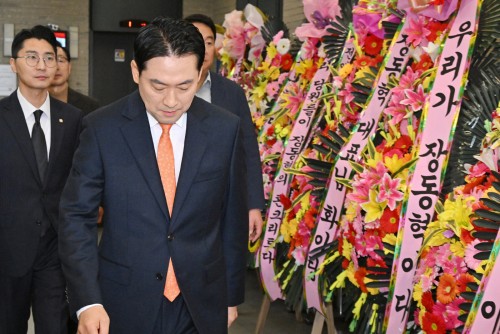 |
| Jang Dong-hyuk, leader of the People Power Party, leaves after announcing a party reform plan at an emergency press conference held at the party’s headquarters in Yeouido, Seoul, on Jan. 7. / Song Eui-joo |
Jang Dong-hyuk, leader of the ruling People Power Party, pledged reform and broader voter outreach on Tuesday, symbolically wearing an orange tie to signal a move beyond the party’s traditional red. Critics, however, said the initiative fell short by avoiding a clear break with former President Yoon Suk Yeol.
Jang offered an apology and unveiled a reform plan at an emergency press conference, marking the party’s first official apology over the Dec. 3 martial law controversy. While the move was seen as easing political pressure, the absence of an explicit severing of ties with Yoon — as well as silence on disciplinary issues involving former party leader Han Dong-hoon — prompted criticism that the reform amounted to only “half measures.”
The most notable shift, observers said, was a change in the party leadership’s framing of the martial law episode. Departing from earlier narratives that emphasized impeachment and special-prosecutor pressure, the party acknowledged internal responsibility, a move widely read as a strategic pivot ahead of the June 3 local elections amid concerns about alienating centrist voters in the Seoul metropolitan area.
The reform announcement drew public welcome messages from metropolitan mayors, including Oh Se-hoon and Park Hyung-joon. A political source said that although Jang’s constituency lies outside the capital region, his emphasis on youth issues and moderation signaled an inevitable push toward centrist appeal and broader outreach.
Party officials said the orange tie was personally chosen by Jang to convey a message of change and expansion through policy-based cooperation. “It was meant to symbolize outreach and a centrist path while calibrating the tone of the apology,” one official said.
Jang also left open the possibility of policy-level cooperation with the Reform Party, though party officials stressed that discussions about electoral alliances or unification were premature.
Still, skepticism persists. Political commentator Park Sang-byung said the plan listed symbolic gestures — such as talk of renaming the party or expanding youth nominations — but avoided the core issue of personnel reform. “Changing one’s stance and taking responsibility are entirely different matters,” he said.
Similar concerns were voiced within the party. A first-term lawmaker said the proposal “felt like a hurried collection of familiar keywords,” while another noted that the most sensitive issue — relations with Yoon — was deliberately sidestepped.
The party’s junior lawmakers’ group, “Alternative and Future,” echoed the criticism, arguing that genuine reform requires a clear break with political forces that defended martial law and promoted election fraud conspiracies — a stance they said was missing from Jang’s message.
#Jang Dong-hyuk #People Power Party #party reform
Copyright by Asiatoday
Most Read
-
1
Trump shares map on social media labeling Strait o..

-
2
Kia Sportage outperforms Mazda CX-5 in German auto..

-
3
Houthis launch successive attacks on Saudi airport..

-
4
U.S. deploys carrier, 10,000 more troops to Middle..

-
5
Trump rejects Iran's offer to open Strait of Hormu..

-
6
N. Korea conducts first swarm attack drill with dr..

-
7
U.S.-China summit falls short on substance as Trum..

PEOPLE




HEADLINE NEWS
- Seoul dismisses Ukraine's claim of 'S. Korean support for Russia' as "inaccurate and inappropriate"
- S. Korea, Japan race to develop nuclear-powered submarines
- Henri Kagan, Kenso Soai win Nobel Prize in Chemistry for uncovering how mol..
- Vance says Alaska LNG cooperation will move forward with Seoul's current or..

-
Address : In-Young Bldg., 34, Uisadang-daero 1-gil, Yeongdeungpo-gu, Seoul
Copyright by ASIATODAY CO., LTD. All rights resereved