



Seoul-Beijing ties thaw, limits remain
Jan 07, 2026, 08:07 am


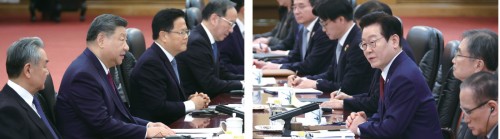 |
| Chinese President Xi Jinping speaks during a summit with President Lee Jae-myung at the Great Hall of the People in Beijing on Jan. 5. In the photo at right, President Lee addresses the meeting during the talks. / Yonhap |
The image of President Lee Jae-myung and Chinese President Xi Jinping clasping hands at the Great Hall of the People symbolized a cautious step toward restoring bilateral ties after years of strain.
At the summit on Jan. 5, the two leaders appeared to signal goodwill even through symbolism, both wearing red ties. Lee, known for favoring blue tones, was seen as offering a gesture of consideration by choosing red, the emblematic color of the Chinese Communist Party.
The timing of the meeting itself underscored both leaders’ intent to reset relations. The encounter came just two months after their previous meeting on the sidelines of the APEC summit in Gyeongju last November. It was also notable that Lee became the first foreign leader to make a state visit to China in the new year.
The messages exchanged at the summit avoided diplomatic “push-and-pull,” focusing instead on forward momentum. Lee said 2026 could serve as “the first year of a full restoration of South Korea–China relations,” while Xi responded that both sides should ensure ties move along “a healthy trajectory.” Ahead of the visit, Lee’s interview with Chinese media reaffirming respect for the “one-China” principle was widely interpreted as a significant diplomatic gesture.
Xi’s remark that the two countries should “stand firmly on the right side of history and make correct strategic choices” was seen as reflecting Beijing’s expectations for Seoul to maintain balance amid intensifying U.S.-China rivalry.
Economic cooperation emerged as the most concrete outcome of the summit. National Security Adviser Wi Sung-lac said the two sides agreed to strengthen practical cooperation in people-centered sectors based on “horizontal and mutually beneficial collaboration,” adding that they would seek meaningful progress this year in services and investment talks under the bilateral free trade agreement.
Policy chief Kim Yong-beom said cooperation would extend beyond manufacturing to include food, fashion, tourism, entertainment, and gaming. Following the summit, the two governments signed 14 memoranda of understanding covering areas such as commercial cooperation dialogue, digital technology collaboration, expanded exports of wild-caught seafood, and intellectual property protection.
A South Korea–China business forum held alongside the summit drew about 400 Korean business leaders, resulting in 32 additional MOUs between companies. Financial sector exchanges aimed at strengthening bilateral financial networks were also cited as tangible gains.
Despite progress on economic ties, several sensitive issues were left unresolved. No clear breakthrough was reached on lifting China’s long-standing restrictions on Korean popular culture, known as the “Korean Wave ban,” with both sides agreeing to continue working-level discussions.
Disputes over structures in the Yellow Sea and maritime boundary issues were also deferred, though the two countries pledged efforts to hold vice ministerial-level talks later this year. On Seoul’s plan to introduce nuclear-powered submarines with U.S. cooperation, officials said discussions amounted to an exchange of positions rather than concrete agreement.
Differences over North Korea’s denuclearization and broader peace on the Korean Peninsula also persisted. Wi said the two leaders reaffirmed that peace and stability on the peninsula are a shared interest and confirmed China’s willingness to play a constructive role.
Park Seung-chan, a professor of Chinese studies at Yongin University, said the summit clearly reflected a desire to restore bilateral ties. He added that Xi’s comment about “the right side of history” conveyed a layered message urging South Korea to avoid focusing solely on a U.S.-centric strategic outlook and instead pursue strategic balance.
#Lee Jae-myung #Xi Jinping #South Korea–China relations #economic cooperation
Copyright by Asiatoday
Most Read
-
1
Trump shares map on social media labeling Strait o..

-
2
Kia Sportage outperforms Mazda CX-5 in German auto..

-
3
Houthis launch successive attacks on Saudi airport..

-
4
U.S. deploys carrier, 10,000 more troops to Middle..

-
5
Trump rejects Iran's offer to open Strait of Hormu..

-
6
N. Korea conducts first swarm attack drill with dr..

-
7
U.S.-China summit falls short on substance as Trum..

PEOPLE





HEADLINE NEWS
- Seoul dismisses Ukraine's claim of 'S. Korean support for Russia' as "inaccurate and inappropriate"
- S. Korea, Japan race to develop nuclear-powered submarines
- Henri Kagan, Kenso Soai win Nobel Prize in Chemistry for uncovering how mol..
- Vance says Alaska LNG cooperation will move forward with Seoul's current or..

-
Address : In-Young Bldg., 34, Uisadang-daero 1-gil, Yeongdeungpo-gu, Seoul
Copyright by ASIATODAY CO., LTD. All rights resereved