



Jang pushes personnel overhaul despite stagnant ratings
Jan 07, 2026, 08:05 am


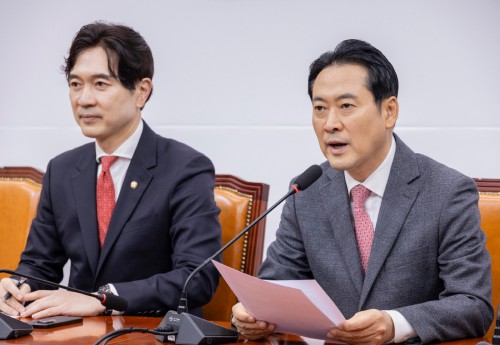 |
| Jang Dong-hyuk, leader of the People Power Party, speaks during a press briefing at the National Assembly in Seoul on Jan. 2. / Song Eui-joo |
Despite approval ratings remaining stuck in the 20–30 percent range, Jang Dong-hyuk, leader of the People Power Party, is pressing ahead with a party overhaul centered on personnel changes rather than policy shifts or additional apologies over the martial law controversy.
With about five months left until the June local elections, the party leadership is expected to announce a reform package as early as this week. The plan is likely to include proposals on election strategy and the redefinition of conservative values, as well as organizational changes such as the creation of a talent recruitment committee and a new advisory team for the party leader.
Jang has repeatedly emphasized “personnel reform” as the core task for party renewal ahead of the elections. He has argued that incremental adjustments to existing practices are insufficient to overcome the party’s current crisis, calling instead for bold replacements that better reflect public expectations. He has also made clear that sweeping personnel changes should be a key prerequisite for victory in the local elections, including during the candidate nomination process.
However, Jang has kept his distance from calls for further apologies or a clearer break from the martial law episode. While voices within the party—including those aligned with Seoul Mayor Oh Se-hoon—have urged a more explicit distancing to broaden support among moderate voters, Jang has maintained what critics describe as a “my way” approach.
Jang has pointed out that he participated in the parliamentary vote to lift martial law and has publicly stated his respect for the Constitutional Court’s ruling, arguing that continued criticism amounts to politically motivated attacks.
Within the party, some interpret Jang’s message as reinforcing his hardline stance rather than signaling an effort to expand the party’s base. Critics say the focus of reform appears aimed more at internal consolidation than at unity or outreach.
A senior party official warned that Jang’s push for “radical reform” could, during the nomination phase, intensify internal friction rather than help the party broaden its appeal ahead of the local elections.
Public opinion remains another burden. Recent polls show the People Power Party’s approval ratings trapped within a narrow band. Calls are growing within the party to attract more centrist voters, while criticism continues over the proposed primary rules that would give party members a 70 percent share of the vote.
Vice National Assembly Speaker Joo Ho-young, the party’s most senior lawmaker, wrote on Facebook that winning the local elections must be the party’s top priority. “If we lose our way, we need to navigate by the lighthouse,” he said. “That lighthouse for our party is public sentiment.”
Meanwhile, a cross-faction lawmakers’ group called “Alternatives and the Future,” made up of 12 three-term, two-term and first-term lawmakers from the People Power Party, is scheduled to meet with polling experts on Jan. 7 to discuss future strategies and responses.
#People Power Party #Jang Dong-hyuk #approval ratings #party reform #personnel reshuffle
Copyright by Asiatoday
Most Read
-
1
Trump shares map on social media labeling Strait o..

-
2
Kia Sportage outperforms Mazda CX-5 in German auto..

-
3
Houthis launch successive attacks on Saudi airport..

-
4
U.S. deploys carrier, 10,000 more troops to Middle..

-
5
Trump rejects Iran's offer to open Strait of Hormu..

-
6
N. Korea conducts first swarm attack drill with dr..

-
7
U.S.-China summit falls short on substance as Trum..

PEOPLE





HEADLINE NEWS
- Seoul dismisses Ukraine's claim of 'S. Korean support for Russia' as "inaccurate and inappropriate"
- S. Korea, Japan race to develop nuclear-powered submarines
- Henri Kagan, Kenso Soai win Nobel Prize in Chemistry for uncovering how mol..
- Vance says Alaska LNG cooperation will move forward with Seoul's current or..

-
Address : In-Young Bldg., 34, Uisadang-daero 1-gil, Yeongdeungpo-gu, Seoul
Copyright by ASIATODAY CO., LTD. All rights resereved