



Progressives also call disinformation law unconstitutional
Dec 26, 2025, 08:41 am


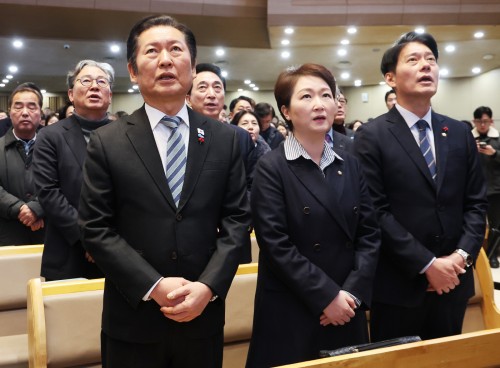 |
| Democratic Party leader Jung Cheong-rae attends a Christmas service at New Eden Church in Yongin, Gyeonggi Province, on Dec. 25. From left are Jung, Supreme Council member Lee Eon-ju, and chief of staff Han Min-soo. / Yonhap |
A controversial revision to South Korea’s Information and Communications Network Act, driven through the National Assembly by the ruling Democratic Party, is facing a growing backlash not only from conservatives but also from within the broader progressive camp, with critics urging President Lee Jae-myung to exercise his veto.
The amendment, often dubbed the “anti-disinformation law,” passed the Assembly on Dec. 24 as the Democratic Party leveraged its 170-seat majority. However, smaller progressive allies — including the Progressive Party, the Basic Income Party and the Social Democratic Party — either opposed the bill or abstained, warning that it could violate constitutional protections on freedom of expression.
“The criteria for judging what constitutes harm to the public interest are unclear,” Sohn Sol, senior spokesperson for the Progressive Party, said in a statement on Wednesday. “There is a serious risk the law could be abused as a tool to arbitrarily suppress speech critical of those in power,” she said, calling on the president to return the bill to the Assembly.
During the plenary vote, Progressive Party lawmaker Jung Hye-kyung voted against the bill, while Sohn abstained. Lawmakers Yong Hye-in of the Basic Income Party and Han Chang-min of the Social Democratic Party also cast abstentions. Even Park Joo-min, a Democratic Party lawmaker, abstained, later saying that key provisions he had championed — including the complete repeal of criminal defamation for statements of fact and changes to complaint-based prosecution — were not included in the final version.
The revised law allows courts to award punitive damages of up to five times the assessed harm against media outlets or YouTubers found to have intentionally disseminated fabricated or manipulated information. It also empowers the Korea Communications Commission to impose fines of up to 10 billion won on those who repeatedly distribute content ruled to be false by the courts. Supporters argue the measures are necessary to dismantle profit-driven fake news operations.
Despite criticism from both opposition parties and parts of the progressive bloc, the Democratic Party has held firm. Party leader Jung Cheong-rae said “irresponsible freedoms that fuel chaos and profit from malicious agitation cannot be left unchecked,” while Supreme Council member Han Jun-ho dismissed warnings about chilled speech as “overblown.”
The main opposition People Power Party said it would seek legal remedies, including filing a jurisdictional dispute with the Constitutional Court, calling the law “an unconstitutional gag order that suffocates liberal democracy.” Floor leader Song Eon-seok urged President Lee to “immediately exercise his veto.”
Attention has also turned to the Justice Innovation Party, which played a swing role in the legislative process. While the party initially pushed alternative proposals — including limits on punitive damages claims by public officials and repeal of criminal defamation for factual statements — those demands were not fully reflected. The party ultimately backed the Democratic Party’s bill, citing future discussions on criminal law revisions, while securing amendments to strengthen defendants’ rights for journalists and other targets of lawsuits.
#information network law #disinformation bill #freedom of expression #Democratic Party
Copyright by Asiatoday
Most Read
-
1
Trump shares map on social media labeling Strait o..

-
2
Kia Sportage outperforms Mazda CX-5 in German auto..

-
3
Houthis launch successive attacks on Saudi airport..

-
4
U.S. deploys carrier, 10,000 more troops to Middle..

-
5
Trump rejects Iran's offer to open Strait of Hormu..

-
6
N. Korea conducts first swarm attack drill with dr..

-
7
U.S.-China summit falls short on substance as Trum..

PEOPLE






HEADLINE NEWS
- Seoul dismisses Ukraine's claim of 'S. Korean support for Russia' as "inaccurate and inappropriate"
- S. Korea, Japan race to develop nuclear-powered submarines
- Henri Kagan, Kenso Soai win Nobel Prize in Chemistry for uncovering how mol..
- Vance says Alaska LNG cooperation will move forward with Seoul's current or..

-
Address : In-Young Bldg., 34, Uisadang-daero 1-gil, Yeongdeungpo-gu, Seoul
Copyright by ASIATODAY CO., LTD. All rights resereved