



Insurrection court plan advances amid constitutional doubts
Dec 23, 2025, 08:56 am


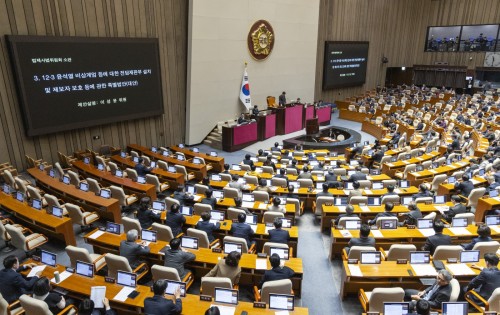 |
| The National Assembly’s plenary session on Dec. 22 considers a bill to establish a special court division for insurrection-related cases. / Yonhap |
A special court division dedicated to insurrection-related cases, long dogged by constitutional concerns, is now on the brink of becoming reality.
On Monday, the National Assembly of South Korea placed the bill to establish an “insurrection-specialized court division” on the plenary agenda, led by the Democratic Party of Korea. With the ruling party holding a majority of 166 seats, passage of the bill appears all but certain.
Earlier the same day, the Supreme Court of South Korea issued an administrative notice of its own internal rules for operating such a division. However, because statutes take precedence over court regulations, legal observers say the judiciary’s response could be rendered largely ineffective if the bill is enacted.
The National Assembly advanced the “Special Act on Criminal Procedures for Crimes of Insurrection, Foreign Aggression and Rebellion,” commonly referred to as the insurrection-special court bill. The ruling party initially proposed forming a candidate recommendation committee made up of nominees from the Constitutional Court Secretariat, the justice minister and a judges’ council. After facing constitutional criticism, lawmakers revised the plan.
Under the final version, the recommendation committee was scrapped. Instead, the Supreme Court’s case allocation committee would select judges for the special division, subject to approval by a judges’ meeting. The party argues that excluding external figures and leaving the court’s composition solely to the judiciary removes constitutional defects.
Critics counter that the core constitutional issue lies in the principle of random case assignment. They warn that legislation directing specific cases to a designated court division could undermine judicial fairness and independence. The Supreme Court sought to minimize such concerns by drafting rules that would assign cases randomly first and then designate the assigned panel as a specialized division.
Cha Jin-ah, a law professor at Korea University Law School, said the fundamental problem is the post hoc creation of a court to handle specific cases. She argued that the legislature’s artificial selection of judges goes beyond a violation of court rules and could amount to a serious constitutional breach, particularly if a new division were formed to exclusively hear a sitting president’s case and force a reassignment.
Legal experts also note that the Constitution provides mechanisms to review the validity of potentially unconstitutional laws. If enacted, the bill could be subject to constitutional review by the Constitutional Court of Korea, a process that could delay trials.
Cha warned that defendants and their lawyers could request a constitutional review, or courts could initiate one on their own authority, prolonging proceedings. She added that the judiciary could also file a jurisdictional dispute against the legislature over infringement of judicial independence, and that a ruling of unconstitutionality could invalidate trials altogether.
The Supreme Court said it will collect public opinion on its draft rules until Jan. 2. Still, if the bill passes the National Assembly, legal experts expect the court’s regulations to be revised to align with the new law, given the higher legal status of statutes over internal rules.
#insurrection special court division #constitutionality #National Assembly #Democratic Party of Korea #Supreme Court
Copyright by Asiatoday
Most Read
-
1
Celltrion’s Omlyclo gains ground in major European..

-
2
Trump demands rates fall below 1% as Fed hikes for..

-
3
Hyundai Motor Group breaks ground on integrated st..

-
4
U.S. strikes 3 Iranian oil tankers, Iran vows reta..

-
5
Trump makes $1 trillion bet ahead of midterm elect..

-
6
Iran resumes ballistic missile production, assembl..

-
7
Samsung Electronics, Mistral AI to jointly develop..

PEOPLE






-
Address : In-Young Bldg., 34, Uisadang-daero 1-gil, Yeongdeungpo-gu, Seoul
Copyright by ASIATODAY CO., LTD. All rights resereved