



Harvard’s Julie Battilana Highlights Principles of Organizational Change and Power Dynamics as Executive Program Concludes
Dec 16, 2025, 09:27 am


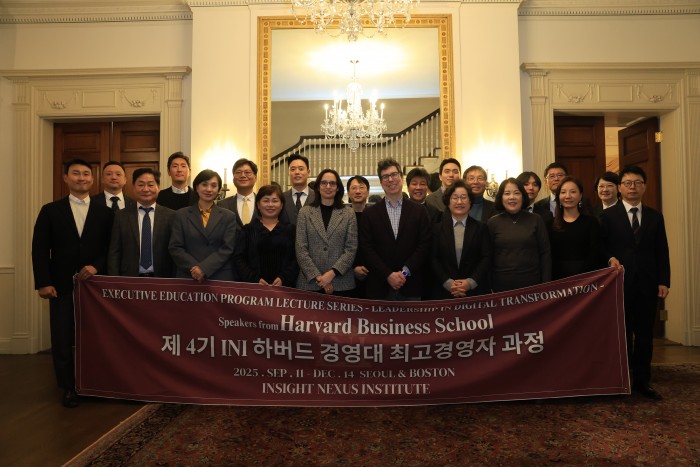 |
| Professors Julie Battilana of Harvard Kennedy School and Jonathan Zittrain of Harvard Business School delivered a lecture on December 9 (local time) at a Harvard Business School classroom. Following the session, Professors Battilana and Zittrain joined Chairman Yoon Tae-keun and members of the 4th INI Harvard Business School Executive Program for a commemorative photo. / Photo courtesy of INI |
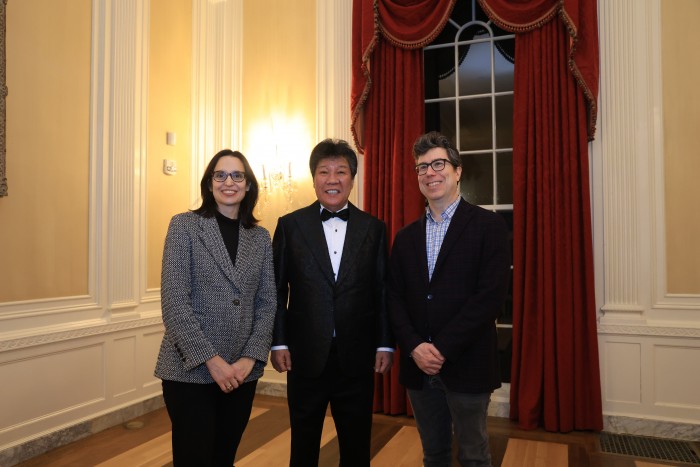 |
| Prof. Julie Battilana of Harvard Kennedy School (left), Chairman Yoon Tae-keun, and Prof. Jonathan Zittrain of Harvard Business School pose for a commemorative photo. / Photo courtesy of INI |
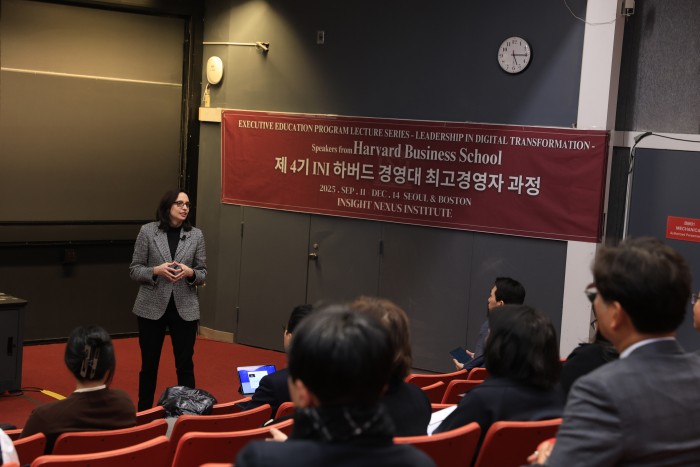 |
| Prof. Julie Battilana of Harvard Kennedy School and Harvard Business School delivers a lecture to participants of the 4th INI Harvard Business School Executive Program on December 9 (local time) at a Harvard Business School classroom. / Photo courtesy of INI |
She also highlighted the importance of “fence-sitters,” those who do not clearly express support or opposition, saying that “maintaining relationships with them and persuading them is the most effective strategy for driving change.”
“Effective change makers are those who understand structures and organize change through strategic relationships and collective action,” Battilana said. “The key is to leverage both individual capabilities and networks at the same time.”
Meanwhile, Prof. Jonathan Zittrain, who joined the session as a co-lecturer, spoke on “The Excellence and Uniqueness of Large Language Models,” underscoring the importance of AI control. He argued that while AI offers an opportunity for humans to focus on more creative and productive roles, developers, institutions, and governments must play a critical role in building and maintaining digital trust.
Prof. Zittrain teaches law, public policy, and computer science at Harvard University.
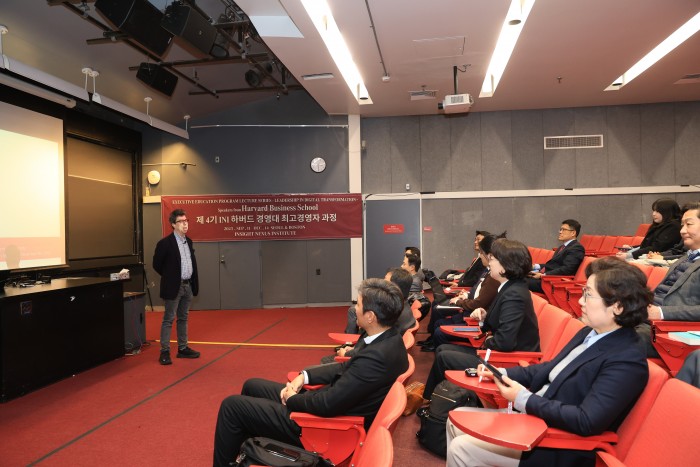 |
| Prof. Jonathan Zittrain of Harvard Kennedy School and Harvard Business School delivers a lecture to participants of the 4th INI Harvard Business School Executive Program on December 9 (local time) at a Harvard Business School classroom. / Photo courtesy of INI |
Park Byung-gon, president of the alumni association of the fourth cohort of the INI Harvard Business School Executive Program, said in his opening remarks that he was grateful for the professors’ passion in sharing “living knowledge and insights” amid a rapidly changing business environment. He added that participants would continue to grow as leaders who create social value in their respective roles by maintaining a mindset of seeking answers for themselves and humbly accepting guidance from mentors and alumni.
Yoon Tae-keun, Chairman of the Insight Nexus Institute (INI), expressed his gratitude to Professors Julie Battilana and Jonathan Zittrain during his remarks at the INI Harvard Business School Advanced Management Program. He noted that their lectures offered meaningful insights into corporate direction and social responsibility.
Citing an anecdote from Zhuangzi, Yoon referred to stage, time and knowledge as the limits within which people confine themselves, urging participants not to remain bound by what they had learned in the curriculum but to continuously strive to move beyond it.
He went on to stress seon-u-hu-rak—a virtue meaning “to worry first and enjoy later”—saying that leaders who guide organizations should take on difficult tasks first and reserve enjoyment for last.
He also referred to the Western concept of noblesse oblige, noting that when leaders put responsibility into practice, capable and principled people naturally gather around them, enabling organizations to reach more ambitious goals.
Yoon concluded by saying he hoped the participants would become leaders who continually refine themselves in order to gain a broader perspective.
In her remarks at the banquet following the completion ceremony, Battilana welcomed the fourth cohort of the INI Harvard Business School Executive Program to Harvard University.
“I am very pleased to move from delivering live online lectures to teaching in person here at Harvard,” she said, adding that she hoped the INI Harvard Business School Executive Program would continue to grow and develop in the years ahead.
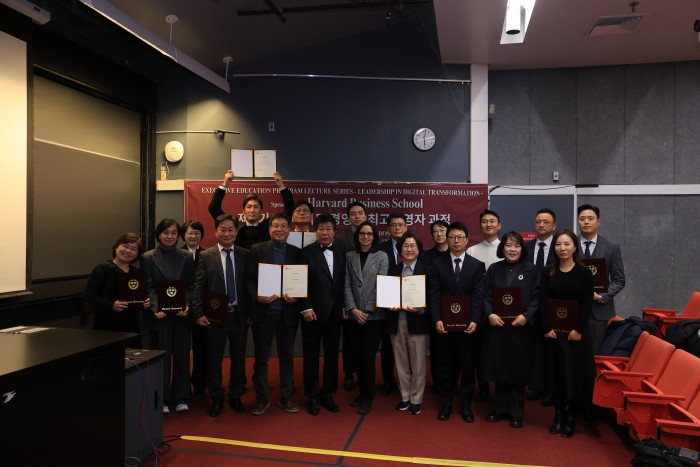 |
| Professors Julie Battilana of Harvard Kennedy School and Jonathan Zittrain of Harvard Business School delivered a lecture on December 9 (local time) at a Harvard Business School classroom. Following the session, Professors Battilana and Zittrain joined Chairman Yoon Tae-keun and members of the 4th INI Harvard Business School Executive Program for a commemorative photo. / Photo courtesy of INI |
Most Read
-
1
Celltrion’s Omlyclo gains ground in major European..

-
2
Trump demands rates fall below 1% as Fed hikes for..

-
3
Hyundai Motor Group breaks ground on integrated st..

-
4
U.S. strikes 3 Iranian oil tankers, Iran vows reta..

-
5
Trump makes $1 trillion bet ahead of midterm elect..

-
6
Iran resumes ballistic missile production, assembl..

-
7
Samsung Electronics, Mistral AI to jointly develop..

PEOPLE







-
Address : In-Young Bldg., 34, Uisadang-daero 1-gil, Yeongdeungpo-gu, Seoul
Copyright by ASIATODAY CO., LTD. All rights resereved