



Japan grapples with growing customer harassment
Nov 25, 2026, 04:56 pm


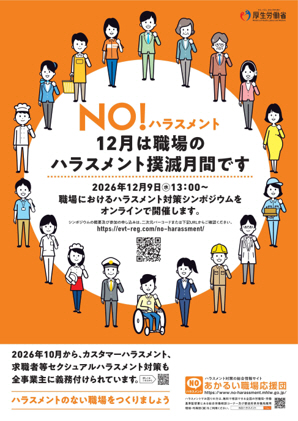 |
| Japan's Ministry of Health, Labour and Welfare began implementing the new Act on Comprehensive Promotion of Labor Policies in October and designated December as Workplace Harassment Eradication Month. / Photo from the ministry's official website |
Japan's attentive and courteous service culture has long been highly regarded worldwide. However, as the belief that customers must be treated with unconditional kindness and receive impeccable service has grown stronger, so-called “customer harassment,” or kasuhara, in which customers demand excessive apologies and responses from employees, has emerged as a social problem. Critics point out that a customer-first culture is instead placing psychological pressure on service workers and forcing them to make unfair sacrifices.
In an interview with HuffPost Japan on November 24, food service industry influencer momohaha made these observations about customer harassment, which is emerging as a social problem in Japan.
In Japan, it is not uncommon for people to apologize out of habit even when expressing gratitude. In particular, amid a culture that places the highest priority on avoiding inconvenience to customers, employees frequently bow their heads in apology even when they are not at fault. Customers come to take such behavior for granted as part of the service and sometimes demand an even higher standard of service.
In Japan, verbal abuse, intimidating words or behavior and repeated unreasonable demands by customers toward service workers are known as “customer harassment,” or kasuhara. Typical examples include customers using their status to demean employees or force them to apologize publicly.
According to a survey on workplace harassment conducted by Japan's Ministry of Health, Labour and Welfare, 27.9 percent of companies had received requests for consultation regarding offensive behavior by customers over the preceding three years. Among reported cases, persistent and repeated words or behavior were the most common at 72.1 percent, followed by intimidating words or behavior at 52.2 percent and psychological attacks at 44.7 percent.
As customer harassment emerged as a social problem, the Japanese government introduced the Act on Comprehensive Promotion of Labor Policies in October this year, requiring all businesses, regardless of the number of employees, to establish measures against customer harassment and making employee protection mandatory.
Recounting recent consultations with employees, momohaha said, “There are a lot of concerns about the culture of excessive apologies among staff at the restaurant,” adding that she had exchanged views with other employees on why they apologized unnecessarily. She explained that the belief that the customer is king is deeply entrenched in the food service industry and that many employees consider apologizing to be a matter of courtesy.
Momohaha also explained that many customers take offense when employees do not apologize and that she trains employees to say “thank you” rather than “I'm sorry” in situations where no apology is necessary.
HuffPost Japan pointed out that the belief that “the customer is king” is itself problematic, noting that improving service quality is an entirely different matter from employees adopting a submissive attitude and accommodating every customer demand.
If a culture of courteous service becomes distorted to mean that even unreasonable customer demands must be accommodated, employees inevitably end up repeatedly apologizing even when they are not at fault and becoming emotionally drained.
While apologies and appropriate responses to legitimate complaints are certainly necessary, there are growing calls for an end to demands that employees unilaterally apologize and make sacrifices simply because the person making those demands is a customer. Service workers are also workers who deserve respect and need protection from customers' unreasonable words and behavior.
HuffPost Japan pointed out that Japan needs to reflect on whether the image of courteous customer service it has built up over the years is now becoming a stranglehold of its own making.
Jeong Eun-hye
Most Read
-
1
China President Xi's Keynote Speech at the APEC C..

-
2
Alice Huang, affair partner of Jensen Huang, repor..

-
3
Iran resumes attacks after two months, targeting U..

-
4
Russian warship sinks in suspected drone attack at..

-
5
Inside Kylin Villa, the symbol of China's reform h..

-
6
Trump, Xi, Putin call for security cooperation at..

-
7
Trump, Putin, Zelenskyy may hold peace talks at G2..

PEOPLE





HEADLINE NEWS

-
Address : In-Young Bldg., 34, Uisadang-daero 1-gil, Yeongdeungpo-gu, Seoul
Copyright by ASIATODAY CO., LTD. All rights resereved