



Lee faces diplomatic and security challenges as Russian warplanes enter KADIZ
Nov 25, 2026, 09:10 am


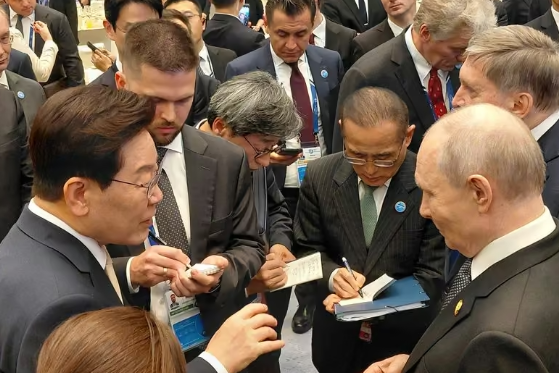 |
President Lee Jae-myung holds a brief meeting with Russian President Vladimir Putin following a welcome dinner for the Asia-Pacific Economic Cooperation (APEC) summit at the Shenzhen International Exchange Center in China on November 18. / Yonhap
On November 24, six days after President Lee Jae-myung and Russian President Vladimir Putin agreed on the need to manage South Korea-Russia relations and ease tensions on the Korean Peninsula, several Russian military aircraft entered the Korea Air Defense Identification Zone (KADIZ) and approached the airspace over Ulleungdo. Although the leaders opened a diplomatic channel through dialogue, continued military tensions have left Lee facing the challenge of managing relations with Russia while addressing security concerns.
Lee met Putin in person for the first time since taking office on the sidelines of the Asia-Pacific Economic Cooperation (APEC) summit in Shenzhen, China, on November 18. The two leaders met informally toward the end of the welcome dinner and spoke for approximately 10 minutes.
A senior Cheong Wa Dae official said at the time, "While acknowledging that relations between South Korea and Russia are currently facing difficult circumstances, the two leaders largely agreed on the need to manage bilateral relations by identifying areas where cooperation is possible." Cheong Wa Dae also said the leaders agreed on the need to ease tensions to prevent further deterioration of the situation on the Korean Peninsula.
Military cooperation between North Korea and Russia is a key factor shaping Seoul-Moscow relations. South Korea joined international sanctions against Russia following its invasion of Ukraine in 2022, while Russia has expanded military cooperation with North Korea. Observers say whether the leaders' shared understanding of the need to ease tensions on the Korean Peninsula leads to concrete consultations will depend on how the two countries address their differences over North Korea-Russia military cooperation.
On the economic front, the Northern Sea Route project being pursued by the South Korean government is considered a key issue for discussions with Russia. The route, which connects Busan and Europe along Russia's northern coast, is expected to reduce sailing distances by approximately 35% compared with the existing route through the Suez Canal. Cooperation from Russian authorities is necessary because a substantial portion of the route passes through waters under Russian jurisdiction.
At a Cabinet meeting last month, Lee was briefed on the results of a trial voyage along the Northern Sea Route and examined whether the project would conflict with sanctions against Russia. The government reported at the time that Russia was taking a cooperative stance, while Lee stressed the need to pursue the project in compliance with the international community's sanctions principles. Amid continued military tensions, whether the common ground established by the two leaders can translate into substantive diplomatic consultations is expected to be a key factor shaping future South Korea-Russia relations.
Park Young-hoon |
Most Read
-
1
AMD's Lisa Su floated as potential Nvidia successo..

-
2
China President Xi's Keynote Speech at the APEC C..

-
3
Alice Huang, affair partner of Jensen Huang, repor..

-
4
Iran resumes attacks after two months, targeting U..

-
5
Russian warship sinks in suspected drone attack at..

-
6
Inside Kylin Villa, the symbol of China's reform h..

-
7
Trump, Xi, Putin call for security cooperation at..

PEOPLE






HEADLINE NEWS

-
Address : In-Young Bldg., 34, Uisadang-daero 1-gil, Yeongdeungpo-gu, Seoul
Copyright by ASIATODAY CO., LTD. All rights resereved