



Thailand moves to block mining chemical exports to Myanmar over river pollution
Nov 23, 2026, 04:51 pm


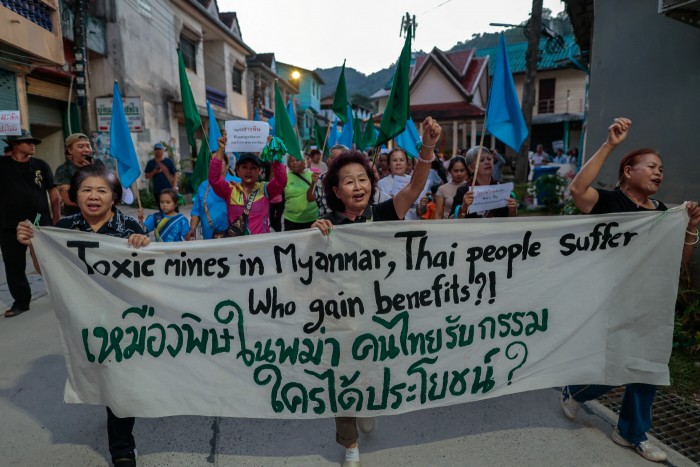 |
| Activists hold banners during a protest near the Thailand-Myanmar border in Chiang Rai, Thailand, on November 22 (local time), opposing rare-earth mining in Myanmar, which has been blamed for contaminating rivers in northern Thailand. / Reuters-Yonhap |
The Thai government has decided to completely block exports and transit shipments of chemicals used in rare-earth mining in Myanmar to prevent heavy metal contamination of rivers along the border. With arsenic concentrations in northern rivers rising to as much as 30 times the safety limit due to wastewater from mines in Myanmar, Thailand has opted for the drastic measure of directly restricting supplies of key materials used in mineral extraction rather than relying on slow-moving diplomatic consultations.
According to the Bangkok Post and other news outlets on November 23 (local time), Thai Deputy Prime Minister Yodchanan Wongsawat announced that the country would halt exports of mining chemicals targeting rare-earth production in Myanmar and other relevant countries. He stressed that the move was aimed at "leveraging every possible avenue" to prevent transboundary pollution. The Thai government also plans to seek approval on December 2 to designate approximately 150 kilometers of the Kok River within its territory as a "pollution control zone" and expand alternative drinking water supplies for 20,000 residents of Chiang Rai province, along with 20 water quality monitoring stations.
Behind Thailand's decision to restrict chemical supplies is a water pollution crisis affecting drinking water and food supplies. According to international environmental news outlet Mongabay, arsenic concentrations in the Sai River in Chiang Rai province reached 0.284 milligrams per liter, more than 28 times the safety limit of 0.01 milligrams per liter, after wastewater from unauthorized mines in Myanmar flowed into the river. The local waterworks authority suspended raw water production on November 5. As contamination spread to approximately 20,800 hectares (about 208 square kilometers) of farmland in the river basin, residents staged protests along the border. In a Suan Dusit University opinion poll, 85.9% of respondents said they lacked confidence in the government's ability to resolve the pollution problem.
Whether the chemical embargo alone can bring illegal mining to an immediate halt remains uncertain. According to analyses by Mongabay and the U.S.-based Stimson Center, only 577 (25.7%) of the 2,245 identified mining sites in Myanmar are located in areas controlled by the military government, while more than 74% are spread across territories held by ethnic armed groups. China, the largest buyer, purchased $2.5 billion (approximately 3.34 trillion won) worth of minerals from Myanmar between January and September this year. Mineral imports through Thailand also more than doubled to $228 million (approximately 305 billion won), compared with $110 million last year, creating strong incentives to circumvent the restrictions.
Thailand is therefore also bringing China, a major buyer, to the negotiating table. Prime Minister Anutin Charnvirakul asked Chinese President Xi Jinping for cooperation on water quality monitoring on November 20. This will be followed by trilateral talks among Thailand, China and Myanmar and bilateral working-level meetings from November 24 to 26. Thailand has proposed establishing eight joint water quality monitoring stations on both sides of the border. It also reportedly plans to raise the issue of transboundary pollution at the Ayeyawady-Chao Phraya-Mekong Economic Cooperation Strategy (ACMECS) summit in Hanoi at the end of this month.
Jeong Ri-na
Most Read
-
1
AMD's Lisa Su floated as potential Nvidia successo..

-
2
China President Xi's Keynote Speech at the APEC C..

-
3
Iran resumes attacks after two months, targeting U..

-
4
Alice Huang, affair partner of Jensen Huang, repor..

-
5
Russian warship sinks in suspected drone attack at..

-
6
Inside Kylin Villa, the symbol of China's reform h..

-
7
Trump, Xi, Putin call for security cooperation at..

PEOPLE







-
Address : In-Young Bldg., 34, Uisadang-daero 1-gil, Yeongdeungpo-gu, Seoul
Copyright by ASIATODAY CO., LTD. All rights resereved