



Presidential office weighs life without parole, longer restraining orders for stalkers
Nov 23, 2026, 03:22 pm


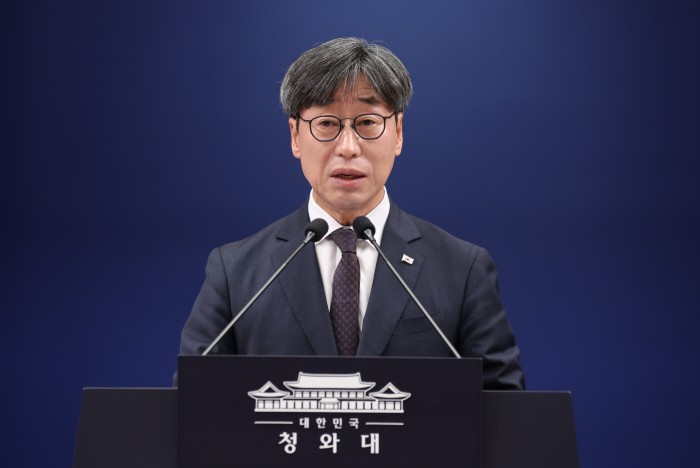 |
| Presidential spokesperson Kim Sung-wan speaks at a briefing on the Public Safety Plus project at the Chunchugwan press center on November 23. / Yonhap |
Cheong Wa Dae is considering introducing life imprisonment without parole to permanently prevent perpetrators of heinous crimes from being released on parole. The presidential office also plans to extend restraining orders against stalking offenders and strengthen victim protection measures through private security services and intelligent closed-circuit television (CCTV) systems. The government plans to draw up comprehensive interagency measures detailing the direction of institutional reforms and a timetable for implementation.
"We are considering extending the duration of restraining orders against stalking offenders and introducing life imprisonment without parole to permanently isolate perpetrators of heinous crimes from society," presidential spokesperson Kim Sung-wan said at a briefing at the Chunchugwan press center on November 23.
Regarding when the measures would be introduced, Kim said, "The comprehensive measures being prepared by an interagency task force (TF) will include a detailed roadmap for implementation."
Under the current Act on the Punishment of Stalking Crimes, courts can impose provisional measures prohibiting offenders from approaching within 100 meters of victims or their residences for up to three months. If further protection is necessary, the measures can be extended twice, for a maximum of nine months. The government is considering further extending this period to make victim protection more effective.
Life imprisonment without parole is intended to permanently isolate perpetrators of serious violent crimes from society. Under Article 72 of the current Criminal Act, prisoners serving life sentences may be granted parole after serving at least 20 years if they have demonstrated good conduct and clear signs of remorse. If life imprisonment without parole is introduced, prisoners sentenced to this form of punishment will be ineligible for parole regardless of how long they have served or their conduct in prison.
The proposed measures are part of President Lee Jae-myung's efforts to strengthen the country's response to crime. The government has been preparing a comprehensive plan called "Ultra-Safe Society: Safety for All, 365 Days a Year" since the October 23 meeting chaired by President Lee. At a Cabinet meeting on November 10, Lee also instructed government agencies to concentrate their efforts on responding to various crimes.
In response, Cheong Wa Dae launched the "A Government That Protects My Life, Public Safety Plus" project on November 15. The government also plans to strengthen its response to relationship-based crimes, including stalking, and crimes targeting socially vulnerable people, ahead of the Week for the Elimination of Violence against Women, which begins on November 25.
The government also released the results of its interagency efforts to combat crimes that harm people's livelihoods, including voice phishing. As of October this year, the number of reported voice phishing cases had fallen 49% from the same period last year, while financial losses had declined 58%. The government is also expanding international cooperation against transnational scam operations, including by pursuing police cooperation projects during Lee's ASEAN-related trip last week.
Kim said, "Protecting the lives and safety of the people is the government's most important responsibility. We will respond firmly to crime, proactively prevent risks and strengthen victim protection."
Park Young-hoon
Most Read
-
1
AMD's Lisa Su floated as potential Nvidia successo..

-
2
China President Xi's Keynote Speech at the APEC C..

-
3
Iran resumes attacks after two months, targeting U..

-
4
Alice Huang, affair partner of Jensen Huang, repor..

-
5
Russian warship sinks in suspected drone attack at..

-
6
Inside Kylin Villa, the symbol of China's reform h..

-
7
Trump, Xi, Putin call for security cooperation at..

PEOPLE







-
Address : In-Young Bldg., 34, Uisadang-daero 1-gil, Yeongdeungpo-gu, Seoul
Copyright by ASIATODAY CO., LTD. All rights resereved