



KOSPI falls below 4,900 on U.S. chip stock rout, triggering sell-sidecar
Nov 20, 2026, 01:40 pm


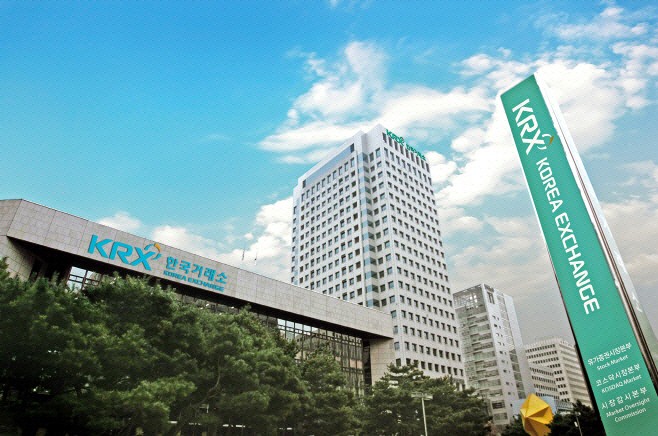 |
| The Korea Exchange in Yeongdeungpo-gu, Seoul. / Courtesy of the Korea Exchange |
The KOSPI fell below the 4,900 mark during intraday trading following a sharp decline in U.S. semiconductor stocks.
According to the Korea Exchange on November 20, the KOSPI stood at 4,890.62 as of 1:12 p.m., down 247.27 points, or 4.81%, from the previous session. The benchmark index, which closed at 5,137.89 the previous day, fell below the 5,000 mark in early trading before extending its losses.
At the same time, the KOSDAQ was trading at 653.62, down 31.19 points, or 4.55%, from the previous session.
Selling by both foreign and institutional investors is driving the market decline. Foreign and institutional investors were net sellers of 889.4 billion won and 548.8 billion won, respectively, on the KOSPI market. Retail investors, meanwhile, absorbed the selling pressure with net purchases of 1.1938 trillion won. Major semiconductor stocks were also down across the board, with Samsung Electronics and SK Hynix falling 6.40% and 6.34%, respectively, dragging down the index.
At 11:54 a.m., a sell-side sidecar was triggered on the KOSPI market after the KOSPI 200 futures index plunged more than 5%. It marked the first activation of a sell-side sidecar in 10 trading sessions since November 6. The measure suspended program sell orders for five minutes.
The sharp decline in the South Korean stock market is attributed to overnight losses in U.S. semiconductor stocks. On Wall Street on November 19 (local time), the Dow Jones Industrial Average, the S&P 500 and the Nasdaq Composite fell 2.19%, 2.02% and 2.25%, respectively.
The Philadelphia Semiconductor Index also fell 2.42%. Major semiconductor stocks declined across the board, with AMD plunging 7.72%, Nvidia falling 3.30% and Micron shedding 2.10%. Analysts attribute the losses to allegations surrounding U.S. semiconductor companies' supply of technology to China and weakening investor sentiment toward artificial intelligence (AI) stocks.
Kim So-ra
Most Read
-
1
AMD's Lisa Su floated as potential Nvidia successo..

-
2
China President Xi's Keynote Speech at the APEC C..

-
3
Iran resumes attacks after two months, targeting U..

-
4
Alice Huang, affair partner of Jensen Huang, repor..

-
5
Xi secures fourth term as China reshuffles next-ge..

-
6
Trump, Xi pledge cooperation on Hormuz, Iran nucle..

-
7
Inside Kylin Villa, the symbol of China's reform h..

PEOPLE






-
Address : In-Young Bldg., 34, Uisadang-daero 1-gil, Yeongdeungpo-gu, Seoul
Copyright by ASIATODAY CO., LTD. All rights resereved