



Public institutions strengthen cybersecurity amid rising cyber threats
Nov 20, 2026, 11:20 am


 |
Amid a recent spate of hacking incidents and personal data breaches affecting both the private and public sectors, government ministries and public institutions are stepping up efforts to strengthen their cybersecurity systems. They are pursuing a range of projects to improve their incident response capabilities, from operating and maintaining existing security monitoring systems to detecting cyber threats using artificial intelligence (AI) and identifying security vulnerabilities through penetration testing.
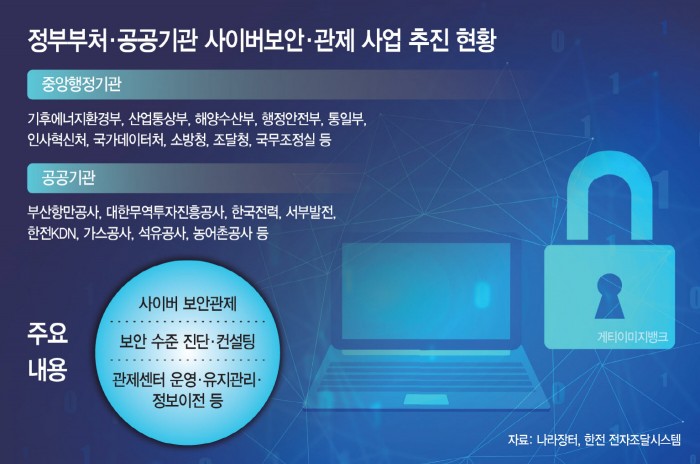
According to industry sources on November 19, government agencies and public institutions, including the Ministry of Climate, Energy and Environment, the Ministry of Oceans and Fisheries and the Ministry of the Interior and Safety, have been issuing a series of tenders for cybersecurity monitoring and consulting services. Dozens of tender notices involving government ministries and public institutions can currently be found by searching for keywords such as “security” and “monitoring” on bidding platforms, including the Korea Online E-Procurement System (KONEPS). While some involve routine renewals of cybersecurity monitoring operation and maintenance contracts, a considerable number of institutions are also launching new projects in response to increasingly sophisticated cyberattack threats.
Busan Port Authority recently issued an urgent tender for cybersecurity monitoring consulting and pilot operation services. “We are looking to introduce a security monitoring system by December,” a Busan Port Authority official said. “We plan to conduct pilot operations of our own daytime security monitoring services and establish a monitoring framework.”
The port authority explained that although it receives security monitoring services from the Oceans & Fisheries Cyber Security Center operated by the Ministry of Oceans and Fisheries, the move is intended to further strengthen its own security. The center provides real-time security monitoring support to the ministry and 25 affiliated institutions.
Korea Electric Power Corporation (KEPCO), which suffered a massive leak of employee information last October, is currently conducting a consulting project to assess the information security level of its sales and distribution information system and upgrading its real-world cybersecurity training system.
In particular, KEPCO sees a need to address security vulnerabilities in its sales and distribution information system as the growing number of high- and low-voltage smart meters (AMI) and information security equipment has led to an increase in vulnerabilities. “We are inspecting equipment and strengthening security monitoring to address AI-driven threats and vulnerabilities in PHP, a programming language used for service development,” a KEPCO official said.
State-owned energy companies, including Korea Western Power, Korea South-East Power and KEPCO KDN, are also pursuing their own security projects. What distinguishes these efforts from previous ones is their emphasis on countering AI-driven attacks.
Korea Western Power plans to enhance automated attack simulations using generative AI, penetration testing by white-hat hackers and AI-based continuous security vulnerability assessments. Korea South-East Power is also strengthening its response capabilities through AI-based security monitoring and anomaly detection in power generation control networks. Last month, the Ministry of Climate, Energy and Environment sent an official document instructing its affiliated institutions to strengthen information system security management.
Security experts stress that public institutions should examine security blind spots while strengthening their cybersecurity systems. “Some recent security incidents have occurred in support networks rather than core networks,” said Youm Heung-youl, professor emeritus at the Department of Information Security Engineering at Soonchunhyang University. “It is necessary to examine whether there are any security monitoring blind spots in systems used to manage employees or external contractors.”
He also identified whether actual response measures are taken following security monitoring as a major issue. “Even if a security monitoring service provider detects signs of a security breach over the weekend or on a holiday and contacts the institution concerned, problems can arise if no action is actually taken,” Youm said. “It is also necessary to check whether communication and response systems between monitoring service providers and the institutions concerned are functioning properly.”
Bae Seok-won
Most Read
-
1
AMD's Lisa Su floated as potential Nvidia successo..

-
2
China President Xi's Keynote Speech at the APEC C..

-
3
Iran resumes attacks after two months, targeting U..

-
4
Alice Huang, affair partner of Jensen Huang, repor..

-
5
Xi secures fourth term as China reshuffles next-ge..

-
6
Trump, Xi pledge cooperation on Hormuz, Iran nucle..

-
7
Inside Kylin Villa, the symbol of China's reform h..

PEOPLE







-
Address : In-Young Bldg., 34, Uisadang-daero 1-gil, Yeongdeungpo-gu, Seoul
Copyright by ASIATODAY CO., LTD. All rights resereved