



98 caught cheating on CSAT, including cases involving smart devices
Nov 20, 2026, 09:23 am


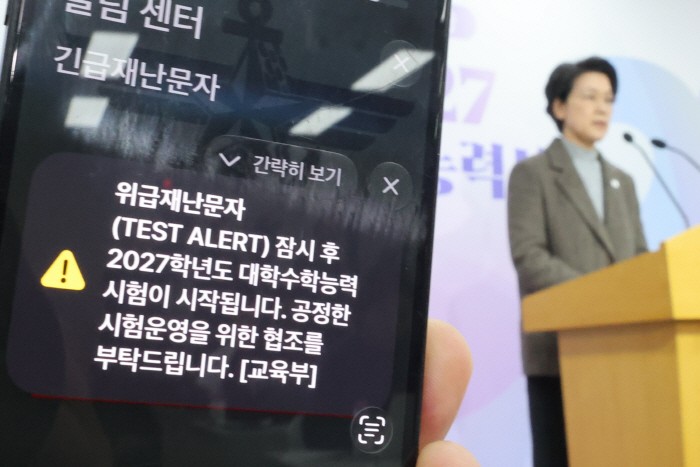 |
| Vice Education Minister Choi Eun-ok briefs reporters on the administration of the College Scholastic Ability Test (CSAT), including the detection of smartphones through emergency disaster alerts, at the Government Complex Sejong on Nov. 19. /Yonhap News Agency |
A total of 98 examinees were caught cheating on the College Scholastic Ability Test (CSAT) for the 2027 academic year, which was held amid concerns over cheating involving artificial intelligence (AI). In particular, the detection of cheating involving advanced devices such as smart glasses, miniature cameras and wireless earbuds confirmed fears that such technology could undermine the fairness of the exam. However, while the Ministry of Education is sharing information on serious cases with police, it has not disclosed the exact number of examinees referred to investigative authorities.
Vice Education Minister Choi Eun-ok announced the findings at a second briefing on the progress of the CSAT at the Government Complex Sejong at 7 p.m. on Nov. 19.
According to the ministry, a total of 49 examinees were caught through three extreme emergency alerts sent out that day. The first alert at 8:30 a.m. led to the detection of 31 examinees, the second at 2:21 p.m. identified 11, and the third at 2:57 p.m. identified seven.
Alongside the distribution of emergency alerts, the government deployed additional proctors specializing in detecting Wi-Fi and Bluetooth signals at all test centers. Separately from the emergency alerts, two examinees in Seoul were caught through Wi-Fi signal detection.
A total of 44 examinees were found to be carrying electronic devices, including smart devices. Seoul accounted for the largest number at 18, followed by Gyeonggi Province with 11, Incheon with six, Daejeon and South Chungcheong Province with three each, Daegu with two and South Gyeongsang Province with one.
In particular, five cases of cheating involving smart devices during the exam were confirmed. In South Chungcheong Province, an examinee was caught using smart glasses, while in Gyeonggi Province, an examinee was found in possession of a miniature camera and wireless earbuds.
In Seoul, an examinee was caught photographing a question booklet with a smartphone during the exam. One case each of smartphone use in a restroom was also confirmed in Seoul and Gyeonggi Province.
The ministry classified all 98 examinees as having committed cheating and plans to hold those who used smart devices to cheat more strictly accountable.
However, it has yet to be confirmed which examinees could face criminal penalties or how many have been referred to police. Asked how many examinees who had actually used or worn such devices had been referred to investigative authorities, Lee Hae-sook, head of the ministry's Office of Higher and Lifelong Education Policy, said, "We are currently receiving information from police on serious cases. As we are still receiving reports, we will provide specific figures once we have compiled the information."
The ministry also said further investigation was needed to determine how examinees had managed to cheat using smartphones despite the three extreme emergency alerts.
"We will need to closely examine the condition of the smartphones and other relevant details," Lee said. Shin Jin-yong, director of the ministry's College Admissions Policy Division, explained, "We will make a final determination through the examination misconduct review committee based on various pieces of evidence, statements and written accounts provided by the individuals involved."
The Ministry of Education and the Korea Institute for Curriculum and Evaluation (KICE) will convene the examination misconduct review committee to determine the final disciplinary measures based on the severity of each case. All procedures, including appeals, are scheduled to be completed before Dec. 11, when exam scores are to be released.
"The government will assume full responsibility to ensure that proctors who diligently performed their duties, including detecting miniature cameras during the exam, suffer no adverse consequences from complaints or lawsuits," Choi said.
Meanwhile, a total of 551,864 people registered for this year's CSAT, of whom 497,526 took the exam and 54,338 were absent. The absentee rate stood at 9.85%, up 0.45 percentage points from 9.4% last year.
The ministry plans to release final statistics and findings on cheating cases following further review.
Park Ji-sook
Most Read
-
1
AMD's Lisa Su floated as potential Nvidia successo..

-
2
Iran resumes attacks after two months, targeting U..

-
3
Alice Huang, affair partner of Jensen Huang, repor..

-
4
China President Xi's Keynote Speech at the APEC C..

-
5
Xi secures fourth term as China reshuffles next-ge..

-
6
Hegseth rejects calls for impeachment over Iran wa..

-
7
Nvidia executive Kimberly Powell at center of Jens..

PEOPLE






-
Address : In-Young Bldg., 34, Uisadang-daero 1-gil, Yeongdeungpo-gu, Seoul
Copyright by ASIATODAY CO., LTD. All rights resereved