



India weighs limits on margin trading per stock
Nov 18, 2026, 01:07 pm


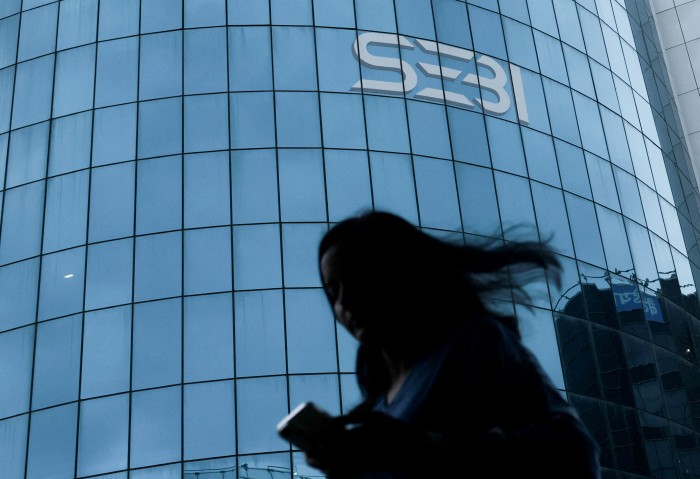 |
| A woman walks past the headquarters of the Securities and Exchange Board of India (SEBI) in Mumbai, India. /Reuters-Yonhap News Agency |
India's securities regulator is considering introducing stock-specific limits on margin buying to curb record-high levels of leveraged investing. With two-thirds of total margin funding concentrated in small- and mid-cap stocks, concerns are mounting that a wave of selling to repay loans during a market downturn could trigger a chain of losses extending even to investors who do not trade on margin.
According to Reuters on Nov. 17 (local time), the Securities and Exchange Board of India (SEBI) is discussing measures to restrict fresh margin buying when the outstanding margin-funded holdings of an individual stock exceed a certain proportion of its free float, or shares available for public trading excluding major shareholders' holdings, among others. Two sources with direct knowledge of the matter said one proposal under discussion would prohibit new margin positions in stocks where 5% to 10% of the free float has been purchased on margin, although specific limits and criteria have yet to be finalized. SEBI reportedly plans to release the proposal for public consultation before finalizing the regulations.
As recently as June, SEBI had proposed expanding margin trading by allowing brokerages to issue corporate bonds to raise funds for margin financing, but subsequently put the discussions on hold. The regulator shifted its focus to risk management after outstanding margin funding in India's stock market surged 29% over the past year to 1.53 trillion rupees (approximately 21.7566 trillion won), nearly double the level at the end of 2024. "While the regulator's review found no immediate signs of concern, more safeguards are needed to prevent cascading sell-offs during abrupt market swings, given the growing number of retail investors," one official told Reuters.
Of particular concern to the regulator is that approximately two-thirds of total margin funding is concentrated in small- and mid-cap stocks. Many well-known companies, including recently listed Jio Platforms and Zee Entertainment, which has a large retail shareholder base, also have high levels of margin buying. Through margin financing offered by Indian brokerages, investors can purchase stocks worth up to four times their own capital at annual interest rates of 9% to 18%. For example, if an investor uses 100 rupees (approximately 1,400 won) of their own money and borrows another 300 rupees (approximately 4,200 won) to purchase stocks worth 400 rupees (approximately 5,600 won), a mere 10% decline in the stock price would result in an unrealized loss of 40 rupees, equivalent to 40% of their own capital.
If falling stock prices erode the value of collateral and investors fail to provide additional collateral, brokerages forcibly liquidate their stock holdings to recover the loans. When the same stock is dumped onto the market from multiple accounts, its price could fall further, triggering margin calls for other investors as well. Reuters reported that South Korea also experienced a series of margin calls during market downturns this year. In July, South Korean financial authorities temporarily suspended new listings of single-stock leveraged products and raised the minimum deposit requirement for ordinary retail investors from 10 million won to 30 million won in cash.
Following reports of the proposed regulations, India's benchmark Nifty 50 index, which had risen as much as 0.83% from the previous session during intraday trading, briefly pared its gains to 0.5%. Shares of local brokerages Groww and Angel One also gave up some of their gains. Officials said the potential impact on retail investors who had already borrowed money at high interest rates and the brokerages that provided the financing should also be taken into account when setting the limits. However, Indian business news outlet NDTV Profit reported that evening, citing regulatory officials, that "SEBI regularly reviews risk management measures, and the latest discussions do not necessarily mean that regulations will be implemented."
Jeong Ri-na
Most Read
-
1
AMD's Lisa Su floated as potential Nvidia successo..

-
2
China President Xi's Keynote Speech at the APEC C..

-
3
Iran resumes attacks after two months, targeting U..

-
4
Alice Huang, affair partner of Jensen Huang, repor..

-
5
Inside Kylin Villa, the symbol of China's reform h..

-
6
Xi secures fourth term as China reshuffles next-ge..

-
7
Trump, Xi, Putin call for security cooperation at..

PEOPLE







-
Address : In-Young Bldg., 34, Uisadang-daero 1-gil, Yeongdeungpo-gu, Seoul
Copyright by ASIATODAY CO., LTD. All rights resereved