



SK Innovation develops catalyst for next-gen aviation fuel
Nov 18, 2026, 11:18 am


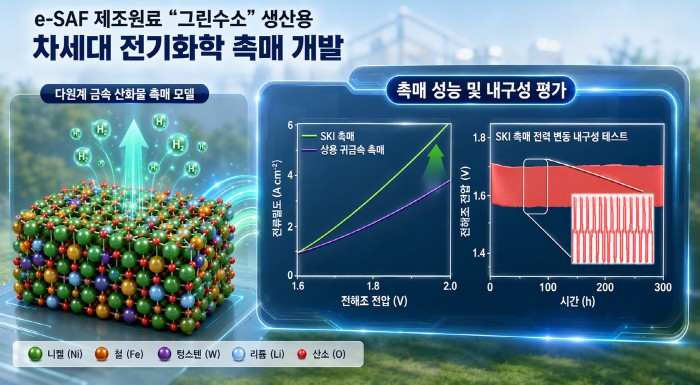 |
| Schematic diagram of next-generation catalyst technology. /SK Innovation |
SK Innovation has developed catalyst technology that enables efficient hydrogen production even with intermittent power supplies from renewable energy sources. The company aims to strengthen the foundation for commercializing environmentally friendly aviation fuel production technology by improving the production efficiency of green hydrogen, a key feedstock for next-generation sustainable aviation fuel (e-SAF), and enhancing catalyst durability.
SK Innovation announced on Nov. 18 that its independently developed high-efficiency water electrolysis catalyst technology developed by the Institute of Environmental Science and Technology had been featured in the Journal of Materials Chemistry A, an international academic journal published by Britain's Royal Society of Chemistry (RSC).
Water electrolysis is a technology that produces hydrogen by splitting water using electricity. Using renewable energy sources such as solar and wind power can reduce carbon emissions. However, fluctuations in electricity supply depending on weather conditions and the time of day can damage catalysts or reduce hydrogen production efficiency.
SK Innovation researchers addressed these issues by adding trace amounts of lithium to a nickel-iron-tungsten (Ni-Fe-W)-based catalyst. The company explained that lithium increases oxygen reactivity within the catalyst, promoting hydrogen production while suppressing the degradation of the catalyst's structure.
Green hydrogen produced using this technology can be used to manufacture e-SAF, an aviation fuel synthesized from hydrogen produced using renewable energy and captured carbon dioxide. The production process involves converting carbon dioxide into carbon monoxide, combining it with green hydrogen to produce synthesis gas, and subsequently converting the gas into synthetic crude oil and refining it.
SK Innovation said the research had enabled it to secure patented technologies covering the entire production process, from water electrolysis catalysts and carbon dioxide electrolysis to synthetic crude oil production and e-SAF refining and conversion.
According to the International Air Transport Association (IATA), global sustainable aviation fuel (SAF) production is expected to reach approximately 2.4 million metric tons this year. An estimated 500 million metric tons of SAF will be needed annually for the aviation industry to achieve carbon neutrality by 2050.
"This research demonstrates how we have extended our expertise in catalyst technology accumulated through energy and chemical research and development into electrochemical technologies needed to produce environmentally friendly fuels," said Kim Phil-seok, head of SK Innovation's Institute of Environmental Science and Technology. "We will secure future clean energy technologies and contribute to building an e-SAF ecosystem."
Lee Seo-yeon
Most Read
-
1
AMD's Lisa Su floated as potential Nvidia successo..

-
2
China President Xi's Keynote Speech at the APEC C..

-
3
Iran resumes attacks after two months, targeting U..

-
4
Alice Huang, affair partner of Jensen Huang, repor..

-
5
Xi secures fourth term as China reshuffles next-ge..

-
6
Inside Kylin Villa, the symbol of China's reform h..

-
7
Trump, Xi, Putin call for security cooperation at..

PEOPLE







-
Address : In-Young Bldg., 34, Uisadang-daero 1-gil, Yeongdeungpo-gu, Seoul
Copyright by ASIATODAY CO., LTD. All rights resereved