



New U.S. regulations on China's remote use of AI chips stall data center expansion in Southeast Asia
Nov 17, 2026, 01:10 pm


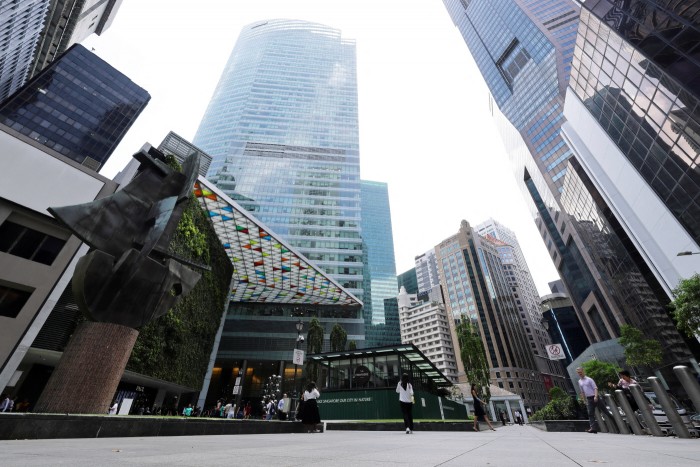 |
| The Ocean Financial Centre building, where the registered office of Singapore-based company Megaspeed is located. /Reuters-Yonhap News Agency |
The U.S. government's introduction of stringent regulations aimed at blocking Chinese companies from circumventing restrictions on the use of artificial intelligence (AI) chips has also put the brakes on Southeast Asia's data center business. The measures regulate transactions that allow Chinese companies to rent computing power from overseas servers while also requiring separate licenses to supply advanced chips to countries such as Singapore and Malaysia. Local data center operators now face new regulatory hurdles in both maintaining business relationships with existing Chinese customers and procuring the equipment needed to expand their server capacity.
According to Singaporean daily The Straits Times (ST) on Nov. 17 (local time), the U.S. Department of Commerce's Bureau of Industry and Security (BIS) announced new regulations on Nov. 16 (local time) to control remote access to advanced semiconductors through overseas data centers. The move reflects the assessment that Chinese companies could use overseas data centers as a means of accessing advanced U.S. technology even if direct sales of advanced chips to mainland China were restricted.
AI data centers have traditionally operated by building servers equipped with high-performance chips and charging customers for access to their computing power. This has allowed Chinese companies such as Alibaba, ByteDance and Tencent to develop AI and operate services by remotely accessing servers installed in Southeast Asia without bringing the chips into China. The Commerce Department's new regulations specifically target such arrangements, in which the physical chips remain in Southeast Asia while Chinese companies reap the actual computing benefits.
Under the new regulations, suppliers of advanced chips and servers to data centers that provide computing power above a certain threshold to Chinese companies and other entities will be required to obtain licenses from U.S. authorities. Operators already providing services subject to the regulations will also need to obtain licenses to continue their operations. Even companies that have invested heavily in facilities and equipment may be forced to find alternative customers or completely revise their business plans if transactions with Chinese customers are restricted.
ST identified Singapore-headquartered Megaspeed International as a prominent example of the companies targeted by the United States. The company has purchased billions of dollars' worth of Nvidia chips and built data centers across Southeast Asia. Given the nature of the data center business, which requires substantial upfront investment in chip purchases and facility construction, investment recovery depends on how much of the computing capacity secured can be sold to customers. Whether operators obtain licenses to do business with Chinese customers is therefore expected to become a key factor determining their profitability.
Building new data centers or expanding existing facilities will also become more difficult. The United States has made it mandatory to obtain separate licenses when supplying advanced chips subject to the regulations to five countries: four Southeast Asian nations — Singapore, Malaysia, Thailand and Indonesia — and Brazil. Even if operators secure customers outside China, they will still have to undergo U.S. review when importing chips for their servers. Depending on whether licenses are granted, equipment procurement and expansion schedules themselves could be disrupted.
Meanwhile, U.S.-based companies operating in the same region will face fewer equipment procurement burdens. Companies whose headquarters or ultimate parent companies are based in the United States are exempt from licensing requirements for supplying chips to the five countries, provided they meet specified conditions. This effectively creates a gap in equipment procurement conditions between U.S.-based cloud companies such as Amazon Web Services (AWS), Microsoft and Google and local Southeast Asian operators. However, even U.S.-based companies are not exempt from restrictions on providing remote computing power to Chinese customers.
Facing an urgent situation, the Singaporean government has begun assessing the potential impact on businesses operating in the country. Singapore's Ministry of Digital Development and Information and Ministry of Energy, Trade and Industry said in a joint statement that day, "We are reviewing the impact of the regulations with the companies concerned and are also discussing the specific scope and implementation of the measures with U.S. authorities." The two ministries reaffirmed their principle of not tolerating attempts to circumvent other countries' export controls, while emphasizing that they would seek solutions to ensure that companies operating legally in Singapore could retain access to advanced semiconductors and computing power.
Jeong Ri-na
Most Read
-
1
AMD's Lisa Su floated as potential Nvidia successo..

-
2
China President Xi's Keynote Speech at the APEC C..

-
3
Iran resumes attacks after two months, targeting U..

-
4
Alice Huang, affair partner of Jensen Huang, repor..

-
5
Inside Kylin Villa, the symbol of China's reform h..

-
6
Xi secures fourth term as China reshuffles next-ge..

-
7
Trump, Xi, Putin call for security cooperation at..

PEOPLE







-
Address : In-Young Bldg., 34, Uisadang-daero 1-gil, Yeongdeungpo-gu, Seoul
Copyright by ASIATODAY CO., LTD. All rights resereved