



S. Korean, Chinese top diplomats meet in Beijing
Nov 16, 2026, 10:55 am


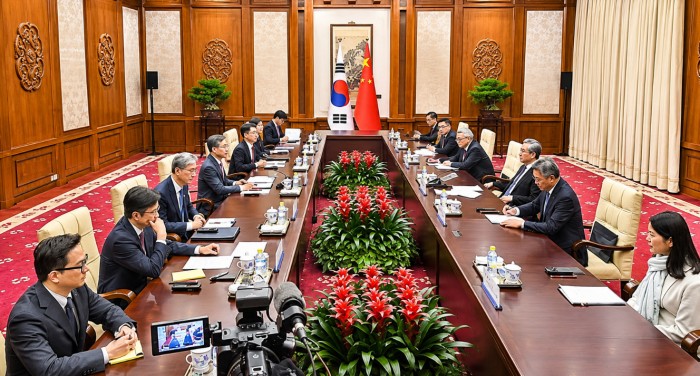 |
| South Korean Foreign Minister Cho Hyun and Wang Yi, a member of the Political Bureau of the Communist Party of China Central Committee and Chinese foreign minister, hold talks with their respective delegations at the Diaoyutai State Guesthouse in Beijing, China, on Nov. 13. /AI-generated graphic; source photos: Yonhap News Agency and joint press corps |
As South Korea and China accelerate efforts to restore bilateral relations through summit diplomacy, attention is turning to whether Beijing will step in as a mediator in the stalled dialogue between North Korea and the United States.
South Korean Foreign Minister Cho Hyun asked his Chinese counterpart, Wang Yi, on Nov. 13 to play a constructive role in bringing North Korea back to the negotiating table.
In particular, Wang's recent series of contacts with senior diplomatic officials from North Korea, the United States and South Korea has brought China's influence over Pyongyang and the prospects for resuming U.S.-North Korea dialogue into the diplomatic spotlight.
Cho urges China to help bring North Korea back to talks
According to an announcement by South Korea's Ministry of Foreign Affairs on Nov. 13, Cho met Wang at the Diaoyutai State Guesthouse in Beijing and emphasized that peace and stability on the Korean Peninsula serve the shared interests of South Korea and China.
In particular, Cho explained the South Korean government's efforts to achieve North Korea's denuclearization and resume dialogue, and asked China to play a constructive role.
Wang said China's policy toward the Korean Peninsula, including denuclearization, remained unchanged and that Beijing would continue to play a constructive role in maintaining peace and stability.
Reuters also reported on Nov. 13 that South Korea had asked China to cooperate in efforts to bring North Korea back to dialogue.
The meeting took place ahead of the Asia-Pacific Economic Cooperation (APEC) summit scheduled for Nov. 18–19 in Shenzhen, China.
With a summit between South Korean President Lee Jae Myung and Chinese President Xi Jinping being pursued, a key question is whether the restoration of South Korea-China relations can extend beyond economic and trade cooperation to the North Korean nuclear issue.
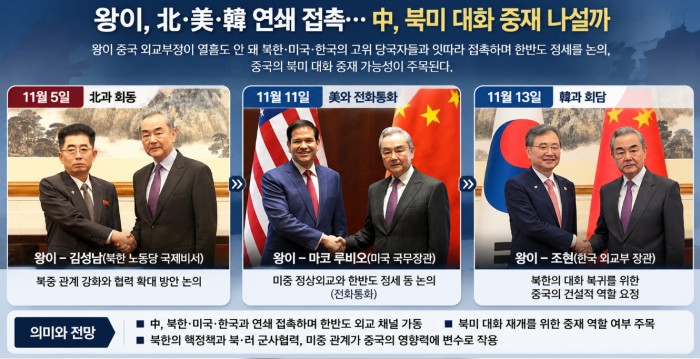 |
| Wang Yi, China's foreign minister, met Kim Song-nam, international secretary of North Korea's Workers' Party, on Nov. 5, spoke by phone with U.S. Secretary of State Marco Rubio on Nov. 11, and held talks with South Korean Foreign Minister Cho Hyun on Nov. 13. From left: Kim Song-nam and Wang Yi; Rubio and Wang Yi; Cho Hyun and Wang Yi. /AI-generated graphic; reconstructed from archival photographs |
Wang holds successive contacts with North Korea, U.S. and South Korea
Wang met Kim Song-nam, international secretary of North Korea's Workers' Party, on Nov. 5, spoke with U.S. Secretary of State Marco Rubio on Nov. 11, and held talks with Cho on Nov. 13.
In less than 10 days, Wang had successive contacts with high-level diplomatic channels in North Korea, the United States and South Korea. However, there is no confirmation that these contacts amounted to preliminary mediation aimed at resuming U.S.-North Korea dialogue.
On Nov. 14, Wang also provided Cho with an explanation of North Korean leader Kim Jong-un's visit to Dandong on Oct. 24 and recent high-level exchanges between North Korea and China.
The Chinese side reportedly explained that the recent focus of China-North Korea relations was on economic cooperation rather than political issues.
Expanding trade and logistics cooperation between North Korea and China could strengthen Beijing's economic influence over Pyongyang, but it remains uncertain whether that influence could bring about changes in North Korea's nuclear policy.
Cheong Seong-Chang: China-North Korea economic ties must be viewed alongside Pyongyang's closer military relations with Russia
Cheong Seong-Chang, vice president of the Sejong Institute and an expert on North Korean military strategy, has argued that expanding economic cooperation between North Korea and China should be examined alongside North Korea's growing military cooperation with Russia.
According to Cheong's previous analysis, North Korea is pursuing strategic autonomy by expanding economic and logistics cooperation with China while strengthening military ties with Russia, thereby avoiding excessive dependence on either country.
Kim Jong-un's visit to Dandong and the expansion of exchanges between North Korea and China through the New Yalu River Bridge can also be interpreted in the context of this strategy to diversify Pyongyang's foreign relations.
This means that even if China's economic influence over North Korea grows, its political and diplomatic leverage to pressure Pyongyang into changing its nuclear weapons policy will not necessarily increase as a result.
In particular, with North Korea having broadened its diplomatic options through military cooperation with Russia, analysts believe it would be difficult for China to persuade Pyongyang to abandon its demand for recognition as a nuclear-weapon state or its refusal to denuclearize, even if Beijing were to act as a mediator in U.S.-North Korea dialogue.
Seoul raises concerns over recognition of North Korea as nuclear-weapon state; balancing US alliance coordination and Chinese mediation remains a challenge
The South Korean government also reportedly conveyed concerns during the meeting that discussions recognizing North Korea's status as a nuclear-weapon state should not be included in summit diplomacy involving the United States, China and Russia.
According to South Korean media reports on Nov. 14 citing a senior Foreign Ministry official, the South Korean side emphasized that its security interests must not be compromised in discussions concerning the Korean Peninsula.
China has stated that its policy toward the Korean Peninsula remains unchanged. However, it has yet to be confirmed how the principle of North Korea's denuclearization will be reflected in the actual outcomes of the upcoming summits.
Ultimately, the central task for South Korean diplomacy is to maintain extended deterrence and denuclearization principles based on the South Korea-U.S. alliance while using China's influence over North Korea as diplomatic leverage to help revive U.S.-North Korea dialogue.
Attention is now focused on whether China will go beyond its existing statements of principle and propose concrete measures to bring North Korea back to dialogue at the upcoming South Korea-China summit.
With China-North Korea economic cooperation expanding at the same time as North Korea and Russia deepen their military ties, China's ability to serve as an effective mediator will be put to the test.
Koo Pil-hyun
Most Read
-
1
AMD's Lisa Su floated as potential Nvidia successo..

-
2
China President Xi's Keynote Speech at the APEC C..

-
3
Iran resumes attacks after two months, targeting U..

-
4
Alice Huang, affair partner of Jensen Huang, repor..

-
5
Inside Kylin Villa, the symbol of China's reform h..

-
6
Xi secures fourth term as China reshuffles next-ge..

-
7
Trump, Xi, Putin call for security cooperation at..

PEOPLE







-
Address : In-Young Bldg., 34, Uisadang-daero 1-gil, Yeongdeungpo-gu, Seoul
Copyright by ASIATODAY CO., LTD. All rights resereved