



China's expected diesel export drop opens opportunities for S. Korean refiners
Nov 13, 2026, 10:21 am


 |
| AsiaToday AI |
South Korean oil refiners could gain more opportunities to expand overseas sales as China is expected to sharply reduce diesel exports due to dwindling inventories. With the South Korean government easing diesel export limits starting this month, a decline in Chinese supplies could create favorable conditions for domestic refiners to capture additional demand in the Asian market.
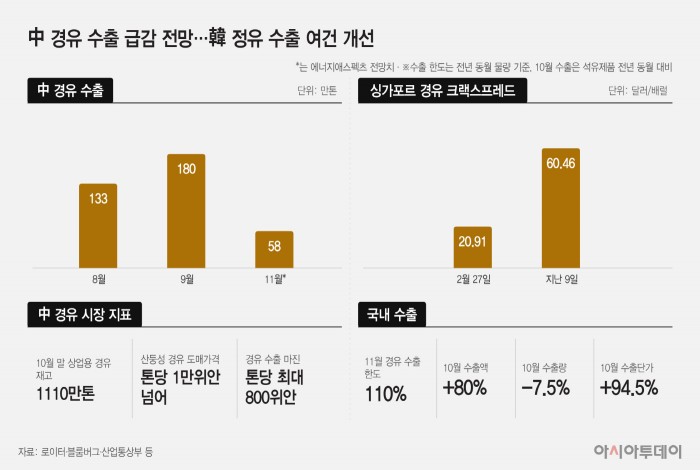
According to foreign media reports, including Reuters and Bloomberg, as of Nov. 12, energy market consultancy Energy Aspects has lowered its forecast for China's November diesel exports by 400,000 metric tons to 580,000 tons. This represents a decline of approximately 68% from 1.8 million tons in September. Reuters also reported, citing industry sources, that exports this month were expected to fall below 800,000 tons.
China's diesel exports increased to 1.33 million tons in August and 1.8 million tons in September after the Chinese government eased restrictions on petroleum product exports in July. However, domestic inventories fell rapidly as overseas sales increased.
According to Chinese energy information provider OilChem, commercial diesel inventories stood at 11.1 million tons at the end of October, the lowest level since the firm began tracking the data in 2011. Wholesale diesel prices in Shandong Province also exceeded 10,000 yuan per ton, their highest level since 2018. Some refiners reportedly even restricted supplies to major domestic customers.
With domestic supplies running short, Chinese refiners have found it difficult to increase overseas sales despite high export profitability. Reuters reported that China's diesel export margins recently reached as much as 800 yuan per ton.
This reflects lower-than-expected production and steady domestic demand. It also explains why exports are expected to decline despite the Chinese government's allocation of additional petroleum product export quotas. As China is a major supplier to the Asian diesel market, the decline could also put pressure on regional supplies.
China's expected export decline is drawing attention because the volume of diesel available for trading in international markets is shrinking.
According to IBK Investment & Securities, global refinery crude runs fell by approximately 5% year-on-year in August, while diesel exports from Russia and the Middle East plunged 75%. With Europe importing around 20% of the diesel it needs, rising winter demand could prompt more buyers to seek alternative suppliers.
South Korea, meanwhile, has lowered its export barriers. The Ministry of Trade, Industry and Resources (MOTIR) conditionally raised the diesel export limit from 100% to 110% of the volume exported in the same month last year, effective November. The measure partially eases restrictions introduced in March.
The government determined that there was sufficient room in inventories after securing crude oil imports in October and November at levels above last year's monthly average, while domestic diesel consumption also declined.
Pricing conditions are also favorable. According to Reuters, Singapore's diesel crack spread stood at $60.46 per barrel on Nov. 9, nearly three times the $20.91 recorded on Feb. 27, before the outbreak of the war in the Middle East. The crack spread is the difference between the price of diesel and crude oil, with a wider spread generally benefiting refiners' profitability.
The impact of higher prices was also evident in South Korea's petroleum product exports. Export value rose 80% year-on-year in October. Although export volume fell 7.5%, unit export prices increased 94.5%.
With 58.8% of South Korea's diesel production exported last year, changes in overseas supply and demand are particularly important. A decline in Chinese diesel supplies could create further opportunities for South Korean refiners to increase sales.
However, China's November diesel export figure remains a forecast and could change depending on domestic demand. South Korean refiners must also meet their domestic supply obligations and maintain adequate inventories before they can increase exports.
In a report last month, Lee Dong-wook, an analyst at IBK Investment & Securities, said, "When supplying countries prioritize domestic consumption, the burden of production cuts falls on the remaining volumes available for trade."
He added, "South Korean refiners have the capacity to translate this supply premium into earnings."
Son Kang-hoon
Most Read
-
1
AMD's Lisa Su floated as potential Nvidia successo..

-
2
China President Xi's Keynote Speech at the APEC C..

-
3
Iran resumes attacks after two months, targeting U..

-
4
Alice Huang, affair partner of Jensen Huang, repor..

-
5
Xi secures fourth term as China reshuffles next-ge..

-
6
Inside Kylin Villa, the symbol of China's reform h..

-
7
Trump, Xi, Putin call for security cooperation at..

PEOPLE







-
Address : In-Young Bldg., 34, Uisadang-daero 1-gil, Yeongdeungpo-gu, Seoul
Copyright by ASIATODAY CO., LTD. All rights resereved