



Housing crisis sparks Spain's first general strike in 14 years
Nov 12, 2026, 01:18 pm


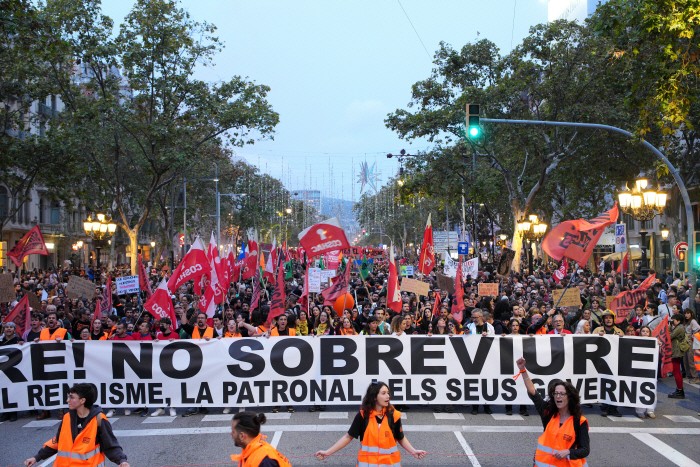 |
| Protesters march during a nationwide general strike in Barcelona, Spain, on Nov. 11 (local time). /AP-Yonhap News Agency |
A nationwide general strike was held in Spain on Nov. 11 (local time) to protest the country's housing crisis. The labor-led strike was the first nationwide general strike in 14 years, since 2012, with tenants' associations and labor unions joining forces to demand curbs on rent increases and guarantees of housing rights.
According to The Guardian, Reuters and other news outlets, around 4 million workers participated in the strike, according to organizers' estimates. The strike involved Spain's two largest labor unions, the General Union of Workers (UGT) and the Workers' Commissions (CCOO). The number of participants was equivalent to about one-fifth of Spain's total workforce of 23 million.
The strike halted production and operations in major industrial sectors, including automobile manufacturing, ports and energy, with participation rates reaching 90% in some sectors.
The nationwide strike was largely peaceful, but clashes broke out between protesters and police in some areas, including Madrid and Barcelona, disrupting road traffic and public transportation.
The forced eviction of María del Carmen Abascal, an 87-year-old woman in Madrid, on Sept. 23 marked a turning point in the spread of public anger over Spain's housing crisis.
Abascal had lived in an apartment in Madrid for more than 70 years. After the building where she lived was acquired by a real estate investment company, a dispute arose over rent. The company sharply increased her monthly rent from 500 euros (about 740,000 won) to 2,650 euros (about 3.9 million won). Although the rent was later reduced to 1,650 euros (about 2.4 million won), Abascal, who lived on her pension, could not afford the new amount.
Following a legal dispute, Abascal was evicted from her home on a stretcher on Sept. 23 in the presence of police officers, court enforcement officers and others. Images of the eviction circulated through news outlets and social media, causing a major public outcry across Spain.
Hundreds of people set up tents and began a sit-in protest at Puerta del Sol square in central Madrid, while tenants' associations demanded protections for housing rights, including rent freezes and restrictions on evictions.
As the controversy grew, the real estate company offered to let Abascal return to the apartment at a monthly rent of 533 euros (about 790,000 won). However, Abascal, who had been hospitalized with severe anxiety and dehydration following her eviction, died on Oct. 7 before she could return home.
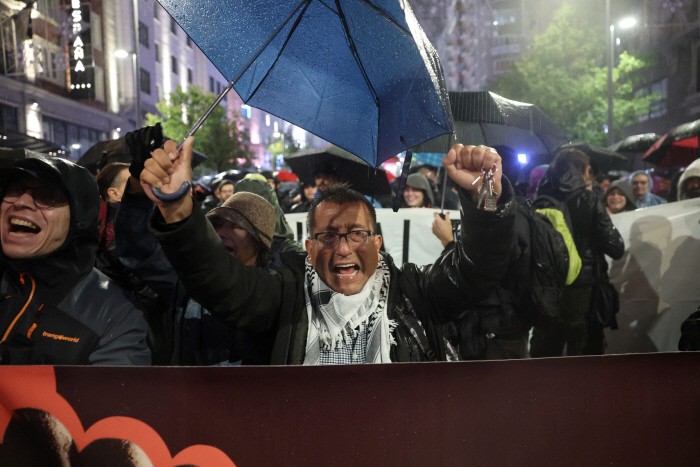 |
| A protester holds up a key during a nationwide general strike against Spain's housing crisis in Madrid on Nov. 11 (local time). /AFP-Yonhap News Agency |
Spain's housing crisis has worsened in recent years as rents and home prices have risen sharply while housing supply has failed to keep pace with demand. Over the past decade, rents have surged by 80% and home prices by 63%. According to the Youth Council of Spain, the average monthly rent of 1,176 euros (about 1.7 million won) is equivalent to approximately 98.7% of the average monthly salary of a young person in Spain.
Housing supply is also a serious problem. According to the Bank of Spain, the country currently faces a shortage of approximately 750,000 homes, a figure projected to exceed 1 million by 2028.
Regional disparities are also worsening as housing demand becomes concentrated in major cities and popular tourist destinations, particularly Madrid and Barcelona. Critics point out that the growth of short-term rentals for tourists has reduced the supply of homes available to long-term residents, adding upward pressure on rents.
The shortage of public housing is another problem. According to The Guardian, public and social housing accounts for only about 2.5% of Spain's total housing stock, significantly below the corresponding shares of 14% in France and 34% in the Netherlands.
With a snap general election scheduled for Nov. 29, housing has emerged as a major political issue in Spain. Prime Minister Pedro Sánchez's Socialist-led government previously pushed for legislation to curb forced evictions and cap rents. However, after the measures were rejected by parliament due to opposition from conservative parties, Sánchez called a snap election in a political gamble.
The ruling camp is seeking to use the strike to shift public attention toward issues affecting people's livelihoods, amid unfavorable public sentiment over a recent deadly train disaster and migrant deaths. Meanwhile, the conservative opposition, including the People's Party (PP) and the hard-right Vox party, has criticized the strike as "a political act by labor unions aimed at helping the government stay in power," with the two sides continuing to clash over the issue.
Lee Jeong-eun
Most Read
-
1
AMD's Lisa Su floated as potential Nvidia successo..

-
2
China President Xi's Keynote Speech at the APEC C..

-
3
Iran resumes attacks after two months, targeting U..

-
4
Alice Huang, affair partner of Jensen Huang, repor..

-
5
Inside Kylin Villa, the symbol of China's reform h..

-
6
Xi secures fourth term as China reshuffles next-ge..

-
7
Trump, Xi, Putin call for security cooperation at..

PEOPLE







-
Address : In-Young Bldg., 34, Uisadang-daero 1-gil, Yeongdeungpo-gu, Seoul
Copyright by ASIATODAY CO., LTD. All rights resereved