



[Exclusive] S. Korean police identify fugitives via Interpol biometrics
Nov 11, 2026, 09:58 am


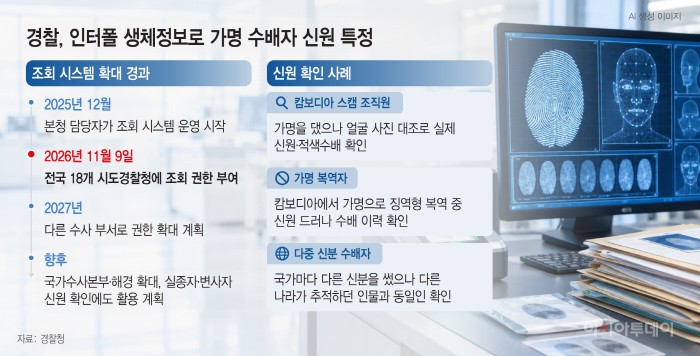 |
South Korean police have identified internationally wanted fugitives who concealed their identities using aliases or forged passports by searching the International Criminal Police Organization's (INTERPOL) biometric database. The Korean National Police Agency (KNPA) has granted search access to all 18 metropolitan and provincial police agencies nationwide and plans to expand access to other investigative departments next year.
According to the KNPA on Tuesday, officials at its headquarters have identified numerous individuals using the "INTERPOL Biometric Search System" since it began operating in December last year. The system is used to verify individuals' real identities and wanted status by comparing facial images, fingerprints and DNA profiles with information registered with INTERPOL. While police previously relied mainly on personal details and passport information to establish identities, biometric matching allows them to track criminals who use false identities.
One notable example involves members of scam networks operating in Cambodia. When members of voice phishing and investment fraud groups arrested by local authorities provided false names, South Korean police used facial recognition to establish their real identities and confirm that they were subject to INTERPOL Red Notices. Police also identified an individual who was serving a prison sentence in Cambodia under an alias. By comparing biometric data obtained by local law enforcement agencies with records registered with INTERPOL, investigators were able to uncover previously unknown wanted records.
In other cases, police used facial images and fingerprint comparisons to establish the real identities and criminal histories of fugitives who had evaded detection by using different identities in different countries. Some were found to be the same individuals being pursued by law enforcement agencies in other countries. South Korean police are working with the countries concerned to carry out follow-up measures, including arrests and repatriations.
Facial images, in particular, are expected to improve investigative efficiency because they can be used to identify fugitives hiding overseas and criminals using aliases abroad, even when fingerprints are difficult to obtain. Biometric data can also help connect wanted-person records held separately by different countries, making it easier to trace the movements of international criminal network members and identify links between their crimes.
On Nov. 9, the KNPA granted search access to officers responsible for international police cooperation at all 18 metropolitan and provincial police agencies nationwide. Next year, it plans to develop a separate access system and security measures before extending access to other investigative departments. It also intends to expand the system's use to other law enforcement bodies, including the National Office of Investigation and the Korea Coast Guard, and use it to identify missing persons and unidentified deceased individuals. Through these measures, the police aim to strengthen efforts to track not only fugitives hiding overseas but also internationally wanted individuals operating under false identities within South Korea.
"We have so far identified numerous individuals, including internationally wanted fugitives, and there are additional cases in which biometric matches are undergoing cross-verification," a KNPA official said. "We have seen particularly significant results in identifying individuals through facial images." The official added, "We have granted search access to all 18 metropolitan and provincial police agencies nationwide. Going forward, we plan to expand the system's use to other investigative agencies to strengthen our ability to track down and apprehend fugitives hiding overseas."
Seol So-young
#Interpol #Police #Biometrics #Investigation
Copyright by Asiatoday
Most Read
-
1
AMD's Lisa Su floated as potential Nvidia successo..

-
2
China President Xi's Keynote Speech at the APEC C..

-
3
Alice Huang, affair partner of Jensen Huang, repor..

-
4
Iran resumes attacks after two months, targeting U..

-
5
Russian warship sinks in suspected drone attack at..

-
6
Inside Kylin Villa, the symbol of China's reform h..

-
7
Trump, Xi, Putin call for security cooperation at..

PEOPLE







-
Address : In-Young Bldg., 34, Uisadang-daero 1-gil, Yeongdeungpo-gu, Seoul
Copyright by ASIATODAY CO., LTD. All rights resereved