



TSMC weighs memory entry, but impact on Korea's two giants seen limited
Nov 10, 2026, 10:24 am


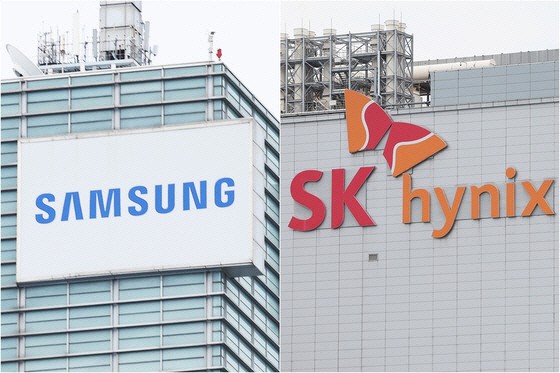 |
| Samsung Electronics and SK Hynix. /Yonhap |
Competition in the memory semiconductor market, currently led by Samsung Electronics and SK Hynix, is intensifying.
U.S. chipmaker Micron Technology and China's ChangXin Memory Technologies (CXMT) are expanding their production capacity, while Taiwan Semiconductor Manufacturing Co. (TSMC), the world's largest contract chipmaker, is reportedly considering entering the memory market.
TSMC has also reportedly put Vice President Hsu Kuo-chin, a former executive at Micron's Taiwan operations, in charge of the initiative.
However, industry observers believe that it would be difficult for new competitors to challenge the market dominance of Samsung Electronics and SK Hynix in the short term.
According to industry sources and foreign media reports on Monday, TSMC has recently been considering producing next-generation three-dimensional dynamic random-access memory (3D DRAM) at Nvidia's request.
The company is reportedly exploring options including building new fabrication plants or acquiring existing semiconductor factories and converting them into memory production facilities.
The initiative is said to be led by Hsu, who previously headed Micron's Taiwan operations and currently oversees advanced packaging at TSMC.
Although TSMC has reiterated its commitment to focusing on its core foundry business, reports of concrete plans for memory production have continued to emerge.
The potential move comes as the rapid development of artificial intelligence (AI) increases the importance of memory chips, with supply continuing to fall short of demand.
In March, Micron acquired the Tongluo plant of Taiwanese semiconductor company Powerchip Semiconductor Manufacturing Corp. (PSMC) for $1.8 billion and is converting it into an advanced DRAM production facility.
China's CXMT is also expanding its share of the conventional DRAM market while developing high-bandwidth memory (HBM).
Industry observers say these developments reflect the growing gap between memory supply and demand.
Samsung Electronics and SK Hynix, which currently dominate the market, are closely monitoring these developments but expect their immediate impact to be limited.
This is because memory chip production requires considerable time to reach mass production, even after factories and equipment have been secured.
Industry officials say that even if new competitors begin mass production, they would struggle to close the technological gap quickly enough to pose an immediate threat.
Nevertheless, with memory shortages continuing and potential new competitors emerging, both companies are expanding production and accelerating technology development.
Samsung Electronics' Device Solutions (DS) Division, which oversees its semiconductor business, plans to invest 76.8 trillion won in facilities this year alone.
The company is expanding production facilities at its P4 plant in Pyeongtaek while continuing construction of the P5 plant.
Samsung is also accelerating the development of its next-generation HBM4E memory chips.
SK Hynix, meanwhile, plans to increase production capacity at its M15X facility in Cheongju by the end of this year to expand HBM4 supply.
The company is also developing its first fabrication plant at the Yongin Semiconductor Cluster, aiming to open its first cleanroom in February next year.
In addition, SK Hynix has decided to invest 54.3 trillion won in its second Yongin plant, known as Y2, and its M17 facility in Cheongju.
The company is also continuing to develop next-generation technologies, including 3D DRAM.
Both Samsung Electronics and SK Hynix are working to strengthen their leadership in the memory market.
Experts are closely watching TSMC's potential entry into the memory business but believe it is unlikely to significantly change the competitive landscape in the near term.
"With memory chip prices rising so sharply, discussions about TSMC entering the market appear to be gaining traction," said Lee Jong-hwan, a professor in the Department of System Semiconductor Engineering at Sangmyung University.
"However, optimizing the manufacturing process alone would take several years."
"This is something to watch over the medium to long term. For Samsung Electronics and SK Hynix, the important thing is to maintain their current technological lead and continue investing in research and development," he added.
Choi In-gyu
Most Read
-
1
AMD's Lisa Su floated as potential Nvidia successo..

-
2
China President Xi's Keynote Speech at the APEC C..

-
3
Iran resumes attacks after two months, targeting U..

-
4
Alice Huang, affair partner of Jensen Huang, repor..

-
5
Inside Kylin Villa, the symbol of China's reform h..

-
6
Xi secures fourth term as China reshuffles next-ge..

-
7
Trump, Xi, Putin call for security cooperation at..

PEOPLE







-
Address : In-Young Bldg., 34, Uisadang-daero 1-gil, Yeongdeungpo-gu, Seoul
Copyright by ASIATODAY CO., LTD. All rights resereved